Hope From Hyde Park

People are stressed about politics. The rhetoric, the drama, the threats, and the concerns – they all appear to be on the upswing. Is every election “the most important in recent memory” or is 2024 different? It most certainly has been historic, with the media avidly covering the changes, the shifting expectations and the ever more extreme positioning. We are in a period of extreme partisanship, so much so that some wonder if the country is coming apart at the seams. But are things truly that bad? And if we do face great challenges, are there any models or figures that might help us think through how to address these daunting difficulties?

To re-adjust my perspective and to gather hope, I recently visited the Franklin D. Roosevelt Presidential Library and Museum. Located on the beautiful family estate in Hyde Park, NY, not far from the banks of the Hudson River, the trip to the compound was exactly what I needed. The future President Roosevelt grew up there, lived there on and off throughout his life (it was his mother’s house), and is buried on the grounds. It is a National Park Service site, as FDR wanted, with frequent tours and inquisitive and appreciative tourists from all over the globe. Roosevelt was born to a generation who lived through the US Civil War (1882). When he passed away in the latter stages of WWII in 1945, the United States was securing its role as the preeminent military power in the world as a staunch defender of democracy. It is hard to suggest a political leader more responsible for that dramatic change. He truly was one of the most important figures in the 20th century.
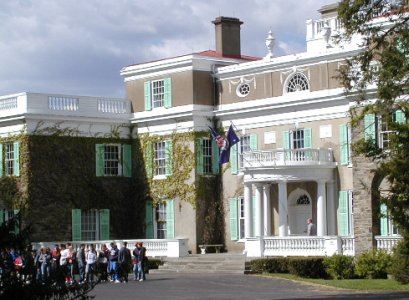
The FDR story – born to wealth and privilege with expectations of service – is a vital reminder of character and leadership. Far from perfect, Roosevelt was a complicated and complex man, a masterful politician who reshaped the presidency and America. He worked tirelessly to help the US navigate the Great Depression, keeping American values alive. The world’s most horrific conflict, WWII, consumed him. Much of the war’s result can be traced to his resolve. Polio crippled him, yet his confidence and enthusiasm seemed to never lag. A small, rope-driven elevator in the house memorializes the man in a poignant manner. FDR, who simply could not walk after polio, would hoist himself up and down in this little contraption. Grandchildren would sit on his lap, the guard told us, and the president insisted on using the rope himself to get to the next floor. It is incongruous and telling, a personal fact that renders this extraordinary political leader all the more driven and all the more human.

Perhaps my greatest takeaway was one of overwhelming gratitude to FDR and those around him who fought the good fight, who worked to keep the country strong, to improve the lives of others, to secure the four freedoms that are essential to modern life. The economy may be troublesome now, but current difficulties pale in comparison to the hardship of the 1930s. The world may be contentious and dangerous now, but we are not facing a global conflict akin to WWII. And on a personal note, while I may face difficulties and responsibilities that, at times, may seem unfairly burdensome, FDR handled a million times more stresses and did so with values, elan and success.

The day at Hyde Park was humbling, inspirational, and a much needed remedy for today’s stresses. I encourage you to find the time to visit and reflect.

David Potash
Picturing the Ruins: Catskills Palimpsests

Having recently moved to the Catskills in New York State, I have been wandering about and reading, trying to make sense of the land and its history. It is simply beautiful country. Woods and forests, with dramatic vistas, rolling hills and meadows make for an entrancing landscape. The elevation is higher than New York City, affording clearer and cooler air. It is rural yet surprisingly near the built environment, especially when thinking about time and not distance. Making sense of it is a fascinating project.

My attraction to the region is shared by many. Since the 1800s Gothamites have been heading up to the Catskills, for vacations and a different sort of life. Thousands took the plunge during the pandemic. Remote work made it a viable region for a first home and the areas has been changing. Vacant properties were snapped up as significant investment moved in. All the recent action, though, pales in comparison the boom years before and after World War II. Then, American Jews visited the Catskills by the hundreds of thousands. It was a period of big hotels, world famous entertainers, and country luxury for a growing Jewish middle class. Known as the Borscht Belt, the Catskills played an outsize role in American cultural history.

The famous hotels have all long since shuttered, as have the spas, restaurants and pools. Signs of the downturn could be discerned as early as the late 1950s. Greater shifts took place in the following two decades. By the 1990s, the New York State Catskill tourism industry had declined tremendously. Jews and others seeking a break from the city had many options. The Borscht Belt was no more.

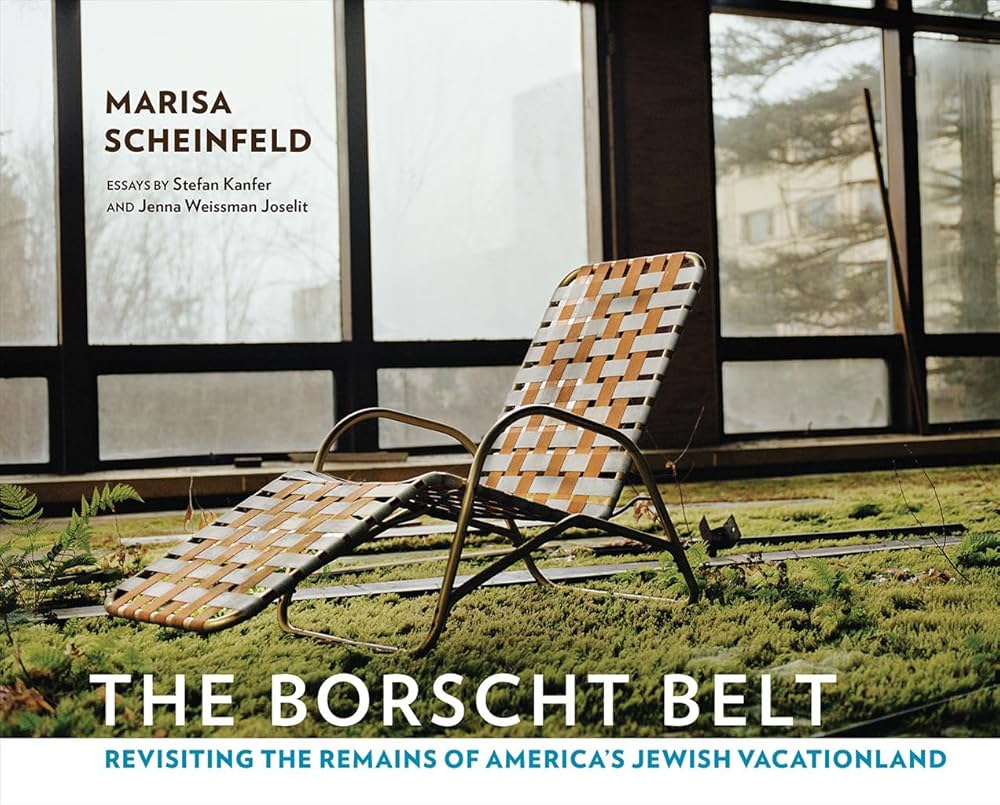
Traces of those boom years, though, can still be found. That evidence is the heart of Marisa Scheinfeld’s The Borscht Belt: Revisiting the Remains of America’s Jewish Vacationland. Scheinfeld is a skilled photographer. Presented are her studies of abandoned buildings, forgotten sites, neglected properties, and traces of a special past. Accompanying the rich and haunting collection of images are essays by Jenna Weissman Joselit and Stefan Kanfer.

Kanfer, a journalist, offers something akin to an expanded introduction. Joselit, a historian and scholar, gives the reader something different. She is an expert in vernacular culture. Joselit guides us in different ways of looking, understanding and appreciating the images. The pictures contain both what we see and what hovers, perhaps as an imagined, or projected, history.

The Borscht Belt presents first as a coffee table book, a collection of striking photographs. Spend time with it, though, and it morphs into something different, a window into a region and its history. Photographs always come with claims of verity, of sureness of particular spaces at exact times. They are irreducible. Our minds, on the other hand, make sense and understand photos in a context. That’s one of the powers of good photography, for while the picture is immediate and locked, it has the ability to provoke, forcing speculation and connections. Many of Scheinfeld’s photos are able to do just that.

I have long been interested in images of leisure spaces, for I find them packed with potential emotion. The idea of leisure, letting one’s guard down in pursuit of pleasure, compels some level of vulnerability. It speaks, after all, to our wishes and wants. The very nature of desire – be it for fine food, a thrill at an amusement part, or a fresh air from a mountaintop – speaks to what is lacking. That’s one of the more powerful ways in which historical studies of amusement helps to expand social constraints and ambitions. The Jews in the Borscht Belt wanted their take on the American dream – good food, the fresh air of the country far from the city, and the spaces where they could socialize, enjoy family and entertainment, and be themselves. The Borscht Belt was vital in making that happen. Scheinfeld’s photos are more than studies of ruins. They are remnants of a generation’s wishes and aspirations. Appreciation of the hopes of others can connect us as humans. Until reading The Borscht Belt: Revisiting the Remains of America’s Jewish Vacationland, I had never imagined that a photograph of chairs could stir my heart.

David Potash