It Was Special! I Was There!
We are hard wired, the experts say, to prefer the music of our teens – regardless of its quality. My bias, accordingly, is for the late 1970s and early 1980s. But not all music from the period. I like new wave, ska, hip hop and rap, rock and dance music – the things that you might find in on an alternative radio station. It seemed to me at that time – and it does now – that it was an unusually vibrant period of musical experimentation. There was just a going on, especially if you stayed away from the “I hate disco” vs. “Rock” debates. Boundaries were blurred and labels did not matter. While I do not think of myself as especially nostalgic, I still believe it to be very exciting period for music and culture.
My assessment is not unique. While more than a few have agreed with me it the years, it was particularly gratifying to read Tim Lawrence’s Life and Death on the New York Dance Floor, 1980 – 1983 as scholarly confirmation. It was a special time and Lawrence does outstanding work tracking the hundreds of artists, the scores of nightclubs, and the rebirth of Gotham as a creative force in nightlife. This is a time of inexpensive real estate, shifting tastes, resistance to President Reagan, and a rejection of high status disco (Studio 54). What transpired – in a period before AIDS, before high rents, a raised drinking age and ATMs east of lower Broadway in Manhattan – was a flourishing of music and dance.
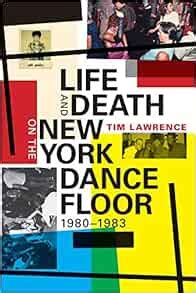
Tim Lawrence has written three books about music and dance. He’s a DJ, podcaster, producer, party-thrower, and professor of Cultural Studies at the University of East London. Not only does he know the music, he appreciates and values the music and the scene around it. Lawrence not a critic, keen on squeezing the life out of track or artist to make a point about theory. One of the lovely features of Life and Death on the Dance Floor are the song recommendations/references from key djs at their clubs. Many of them were deep in the crate of vinyl, too. This was, after all, before CDs. Lawrence clearly spent hundreds of hours interviewing to make the book possible.
The Mudd Club anchors the start of the book, as Lawrence’s prose is organized chronologically and roughly by nightclub. He tends to give more attention to disc jockeys than to musicians and groups, which makes for an unusual focus. It fits, though, with his overarching message of blurring and dynamism. The true superstar DJs would surprise crowds, creating memorable soundscapes. Lawrence is also good on the crossover between music and other arts. Warhol and Basquiat, for example, were often in the clubs. The story is very Manhattan-centric.
There’s a journalistic feel to the book. Chapters are brief and the structure is who, what, where, when and why. Record companies, real estate and politics are present but not fully accounted for; they lurk, appearing in some acts but not others. Missing from the work is a sustained long argument. Lawrence advances shorter arguments, and explores conflicts and resolutions, but there is no big cultural studies claim about the New York club scene in the first years of the Reagan presidency. Not that one could not mount such an argument . . . .
Lawrence’s approach is appropriate for the scope of the book, for the scene could only flower for a short period. Rising rents, changes in local laws, economic development and AIDS had a tremendous impact. It took place in a time of transition. People still went out to dance in the mid-80s, as they do today, but so many things changed.
As for the music, artists include Afrika Bambaataa, Art of Noise, Beastie Boys, B-52s (who were quite the presence in lower Manhattan), Black Uhuru, Blancmange, Blondie, Kurtis Blow, David Bowie, Bow Wow Wow, Laura Branigan, Bush Tetras, The Clash, The Contortions, Cristina, Culture Club, Devo, D Train, Ian Dury, Brian Eno, Marvin Gay, Grandmaster Flash (with and without the Furious Five), Eddy Grant, Gwen Guthrie, Herbie Hancock, Billie Idol, Rick James, James White and the Blacks, Grace Jones, Kid Creole and Coconuts, Kraftwerk, Cyndi Lauper, Liquid Liquid, Lydia Lunch, Madonna, Malcolm McLaren, Medium Medium, New Order, Klaus Nomi, Yoko Ono, Richard Hell and Voidoids, Run-D.M.C., The Smiths, Spandau Ballet, Sugarhill Gang, Talking Heads, Thompson Twins, Tom Tom Club, Was (Not Was), Jaw Wobble, and Yaz/Yazoo. There are others as well.
Life and Death on the Dance Floor is an excellent book for those looking to learn more about a particular scene in a particular period in New York City. If you knew nothing or very little, I cannot imagine a better guide. I wonder, though, about what those who were on the dance floor would think of the book. I was. Growing up in northern New Jersey, my first New York City club experience was in the late 1970s. By the early 1980s, every chance I could get I was in lower Manhattan, looking for bands and music and opportunities to dance. The talent, the diversity, the possibilities were extraordinary, inexpensive, and in constant flux. Most of all, it was great fun.
David Potash