The Utopia of Rules, or How Anthropology Upends Conventions
The Utopia of Rules is a 2015 collection of essays by anthropologist David Graeber. Nominally about bureaucracies, this book is also about modernity, power, the state, technology and the world in which we inhabit. Graeber is a fascinating writer, easy to grasp and yet fully versed in theory. This is an academic book as well as something that could be published by the popular press (think The Atlantic). It is fascinating reading, for Graeber’s asides, explanations and manner of thinking are incredibly provocative in the most unexpected ways.
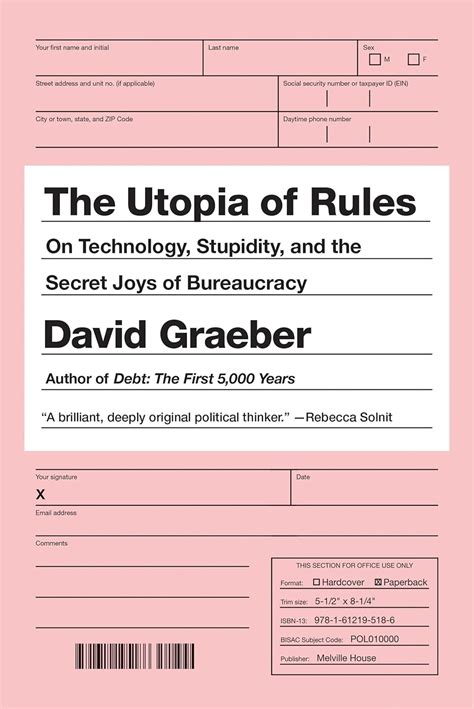
What are bureaucracies? Why do we hate them and need them? Is there such as thing as a real difference between the public and private? Questions like these drive the introductory essay. Graeber’s anthropological mindset brings a critical lens to the everyday. When speaking of power and the power to do violence, for example, he reminds us that it is omnipresent yet we’ve chosen to ignore it. Does state-sponsored power drive our institutions of higher education? Of course we’ll say no, but what happens if someone decides that they want to visit the closed stacks in the library? They’re arrested and hauled away. That threat hovers and has been internalized by all.
The second essay, “Dead Zones,” starts with complications surrounding the death of Graeber’s mother. The forms, the paperwork, the misalignment of forms, information and requirements, speak to a structural stupidity around one of the most important rituals in society: death. We think about and study death quite a bit, but we rarely look closely at the boring paperwork essential to the processing of death.
Graeber, an anarchist since his teens, emphasizes that structural violence supports and enables all of the paperwork, all of the bureaucracy, and the organizations around the state. He explains how his fieldwork in Madagascar helped him understand and appreciate structural violence. And from that, all manner of observations come forth, from the relationship of Sherlock Holmes and James Bond to the difficulties of communes owning a vehicle. Graeber may be very serious, but he also has a light touch and there’s great humor in his writing.
The essay on the disappointment of technology (where are the flying cars!?!), the shrinking of imagination, why we love (or at least are drawn to bureaucracy), and the disappointment of Batman round out this provocative book.
More than anything, reading this made me want to read more by Graeber, to learn more about him, and to see what he thought about our current situation. Sadly, he died unexpectedly in 2020, a relatively young man. He had the skills and experience to be an elite anthropologist, but his unwillingness to be passive probably cost him a tenured position at Yale. He found an academic home in England. His activism was present throughout; Graeber was key figure in several social justice movements, such as “Occupy Wall Street.” He blurred the boundaries between higher education and political life. And if only for that, his writing deserves ongoing consideration.
David Potash