A Japanese Heroine in Extraordinary Times
Sometimes one comes across a work of nonfiction that is so engrossing and engaging that it can stop time’s passage. Exceptional history has this power, pulling the reader in and rendering relatable what might initially appear to be alien and all too far away. It can build bridges of understanding, fueled by curiosity and research. History of this mettle changes minds, redirects students’ course of study, and lives outside of the page and decades after publication. Amy Stanley’s Stranger in the Shogun’s City: A Japanese Woman and Her World is that kind of work, a window on a distant world.
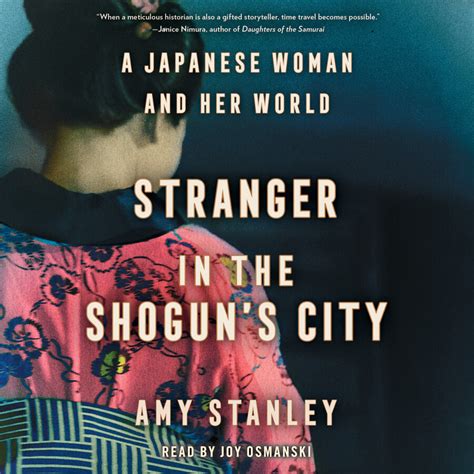
Stanley is a professor of history at Northwestern University. An accomplished academic with deep expertise in Japan, she wrote Stranger for a less-informed public. What, after all, do most of us know about Japan in the first half of the nineteenth century? These are the years before Admiral Perry “opened” Japan to the west – a problematic concept on so many levels. And if we imagine that we have some basic knowledge of samurai and shoguns, it is often through the lens of Hollywood or historical fiction. What Stanley does in this book is open the reader’s mind to a culture that is distant, exotic, and still – in her carefully crafted prose – accessible.
The subject of the biography is a woman named Tsuneno, the child of a Buddhist priest. Tsuneno was born in 1801 in a rural part of western Japan, the Echigo province. Tsuneno and her family were literate, like many other Japanese, and extensive letter writers. They had some money and education. One of Tsuneno’s letters was posted on a scholarly website and Stanley, reading it, became obsessed with learning more about the woman. Tsuneno led a messy, rebellious life. She had aspirations, plans and courage. Some of her choices turned out well and others, less so. Tsuneno was not a political or major cultural figure, but her needs, her story, and her life dominated her family’s letters. Her very lack of fame speaks to what makes her all the more special.
Curiosity piqued, Stanley set about mapping Tsuneno’s family’s correspondence, assiduously tracking down the people, their lives, and tons of details. From these she built a biography, a history of the family, the region, and the period. From the the weather – Echigo shut down during the winter because of heavy snow – to the clothing, from the pawnshops to tax structure to the danger of fires in the city, Stanley crafts a comprehensive picture of what life was like in early 19th century Edo and Echigo. Edo figures prominently, at the time and over the centuries. It was a city of opportunity, culture, power and danger. It transformed into Tokyo, but remnants of Edo can still be found.
As for life in Edo in the early 1800s, concerns then and there remain familiar: having enough money, status and agency, how to navigate family dramas, the importance of marriage and position, finding friends and love. Stanley makes certain, too, that we know what was different. It is important not to assume certain set rules or practice. Tsuneno, for example, was divorced three times and was able to move to Edo as an unmarried woman. Family honor, however, was always a major concern.
Stanley is generous with the subjects of her study, giving them full consideration and appreciation. All of this is set against the larger shifts aligning to change Japan. Foreign influence was at Japan’s door and significant economic challenges were challenging shogunate structures. While people at the time did not know it, their way of life was about to change in significant ways. It is a powerful message, something that once read, felt and considered, stays with you. All it takes is a little time to read, reflect and imagine.
Stranger in the Shogun’s City is truly an exceptional book.
David Potash