Banana Battles in the Jungle
One of the most influential American international corporations of the twentieth century, the United Fruit Company encompassed much more than a business. Founded by New England elites, United Fruit’s growth and influence mirrored the nation’s expansion in the Caribbean basin and later the world. The company relentlessly pursued monopoly controls and vertical integration, built a market for bananas as a staple part of an everyday diet, and successfully marketed itself domestically with amazing public relations. On the other side of the ledger, United Fruit was ruthless and an outsize player in US foreign policy, unconcerned with issues of democracy or self-determination.
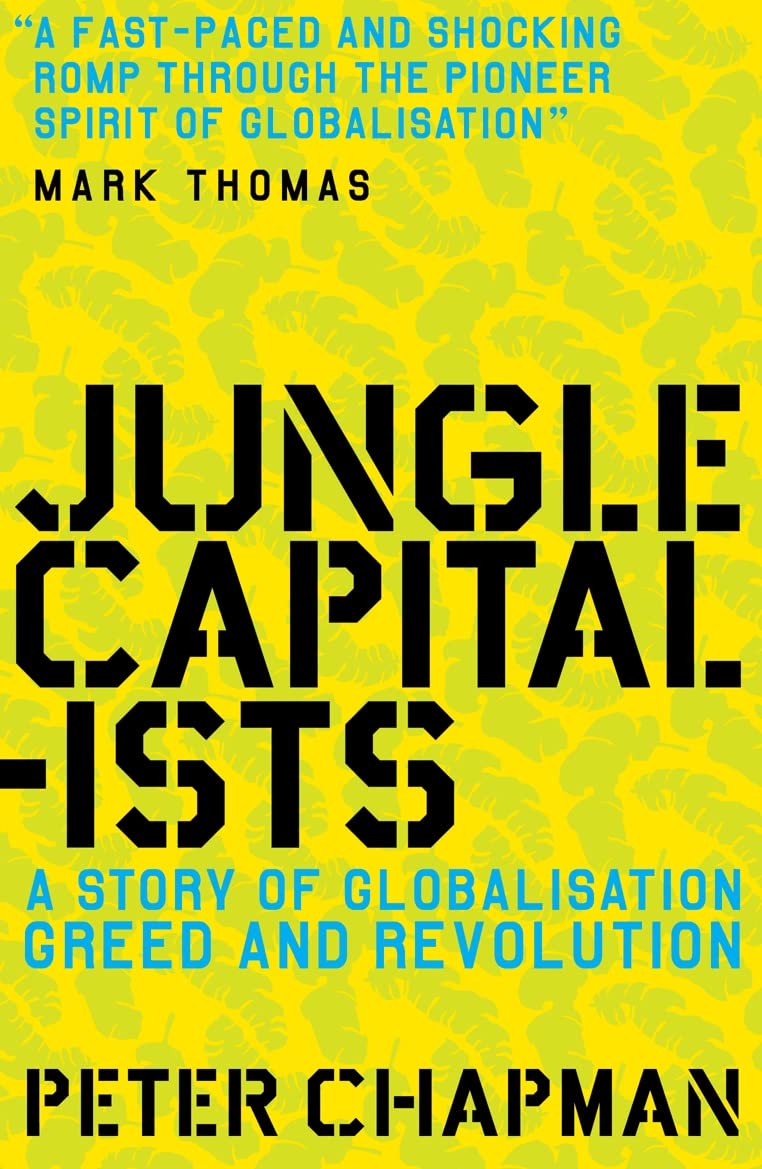
Journalist Peter Chapman’s Jungle Capitalism: A Story of Globalization, Greed and Revolution is a high-altitude historical critique of United Fruit. Chapman, who is an editor at the Financial Times and an experienced writer, knows how to engage a reader. He plays up people, personalities, and conflict, always keeping an eye out for the idiosyncratic and memorable. While the focus may be on a company, the book doles out fascinating facts. O. Henry invented the term “banana republic” in his novel Cabbages and Kings. The US Centennial exhibition of 1876 appears, as do political leaders (dictators and US officials), entrepreneurs (Sam Zemurray spurred the company’s growth in the first half of the 1900s), and cultural icons (Carmen Miranda and Harry Belafonte). The action zips from conflict to resolution to conflict in high-relief. Chapman emphasizes, though, that there are no banana jokes in the countries dependent upon the crop.
Goodness knows, there’s much for Chapman to share. United Fruit played a critical role in the government, economics and histories of Guatemala, Panama, El Salvador, Honduras and Costa Rica. It influenced US foreign policy at the highest levels, aligning its counsel and leadership with extremely powerful political leaders. The Guatemalan coup of 1954, one of the CIA’s most direct influences on the sovereignty of a country, was a effort made possible through the lobbying of United Fruit.
Anchoring the story is the suicide of Eli M. Black in 1975. Black was a wildly successful corporate raider, a Polish immigrant who climbed the ladder at Wall Street. He reorganized United Fruit into United Brands. Debt and a hurricane put the company into great peril and Black jumped out of the 44th floor of the Pan Am building in New York City. Shortly after, investigators learned of a $1.25 million bribe Black paid to the Honduran president Arellano to reduce taxes on bananas. Black’s son is Leon Black, billionaire, philanthropist and friend of Jeffrey Epstein.
As a cursory critique, Jungle Capitalism serves its purpose. Unfortunately, its arguments are not buttressed to withstand close historical analysis. Long on narrative, Chapman’s approach is weak on hard data, sources and specifics. The company’s structure, organization, leadership and profits are absent. Corporate reports, share prices and other forms of real information would have been welcome to gain a better understanding of organizational strategy and impact. The book provides ample metaphors – octopus most frequently to describe United Fruit – but lacks numbers.
Similarly, understanding foreign policy is a notoriously tricky affair. Decisions are almost always made with insufficient information. Clashes of politics, histories and priorities shape actions, leading to analysis relying on assumptions. United Fruit was a major player in Central America, to be sure, but it was not the only multinational corporation? What roles did other businesses play? And what about the complexities of domestic politics, in the United States and abroad? Discussion of these factors are thin to non-existent in Jungle Capitalism. This is not to fault Chapman for writing a non-academic book. Instead, it would simply have been a more effective book with more contextual acknowledgements.
Jungle Capitalism is entertaining history-light, looking at an important history that calls out for heavier attention. Like a tabloid, it is long on sizzle and short on substance.
David Potash