More Evil the Closer One Looks
Many years ago I attended a lecture by a well-respected physical anthropologist. The focus of his talk was a shard of stone, something that I never would have, nor could have, identified as a paleolithic tool. The anthropologist was more than able to do so – through close analysis, great skill, and an explanation of context – showing us what kind of people had made the tool, how it was created, and its purpose. He outlined the type of society that made such tools, how people lived, and what their life might have been like. What has stayed with me ever since is the power of true expertise, to see and explain things that the rest of us may miss.
Historian Melvin Patrick Ely has a similar proficiency in a different field. The Kenan Professor of Humanities and Professor of History at the College of William and Mary, Ely is a masterful researcher and writer. His latest work, A Terrible Intimacy: Interracial Life in the Slaveholding South, invites the reader into a close study of six court cases involving slaves in Prince Edwards County, Virginia. Primary sources from the trials are the heart of the work, informed by Ely’s vast knowledge of the time and area. The trials challenge assumptions, and through Ely’s analysis, we get a much better handle on the complex and complicated ties of racism, gender, economics and power in antebellum America. It is local history, but local history with broad consequences for appreciation of the slaveholding South. The book’s conclusion is inescapable: slavery, a horrific institution and practice, corrupted everyone – whether directly involved or not. It was a deadly cancer on society.
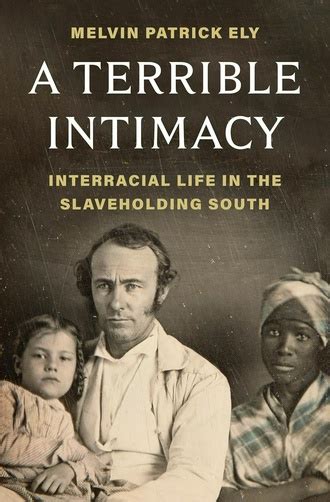
Ely wants the reader to “walk through these stories” with him, “to hear for yourself everything that Black and white people said about their own lives and deeds, and about each other, during these trials.” The book offers a special kind of close reading, for the trial documents were compiled for a particular purpose. White people kept the records and like all documents, questions, contradictions and challenges emerge over time. Nonetheless, with Ely’s patience, persistence and curiosity, we see how the six trials do not proceed as one might imagine. There are repleted with complicated judgements, irreconcilable evidence, and unexpected outcomes. Ely is an active narrator, explaining how historians advance theories, render judgments, and determine when to press an argument and when to move on.
Rendering A Terrible Intimacy engaging is the nature of the trials. We want to find out what happened, why it happened, and to learn of the verdict. The first case concerns a Black slave who killed a white man in 1825. The second, from 1826, is about an enslaved man charged with killing a white woman. An 1854 charge of rape by a white woman against a Black slave is next, followed by a white man charged with trying to kill an enslaved Black man. A charge of facilitating an unlawful assemblage of slaves – a major crime – is our next focus, with the case of a white man who was attacked by a Black slave as the concluding the book. Through it all, Ely is a patient companion, offering guidance and commentary.
A Terrible Intimacy is not a light read. Nonetheless, it is an important read. Were I to imagine a twentieth century comparison, it would be how the courts in Europe tried to function under Nazi rule in World War II, or some study of life under the Pol Pot dictatorship. Real evil – like slavery – has the ability to invade all aspects of life. Many potentially decent people become monsters, or at least behave monstrously, in environments such as this. It is deeply distressing and vitally important – if we are to work towards common decency and humanity – to give books like A Terrible Intimacy deep consideration.
David Potash