More Evil the Closer One Looks

Many years ago I attended a lecture by a well-respected physical anthropologist. The focus of his talk was a shard of stone, something that I never would have, nor could have, identified as a paleolithic tool. The anthropologist was more than able to do so – through close analysis, great skill, and an explanation of context – showing us what kind of people had made the tool, how it was created, and its purpose. He outlined the type of society that made such tools, how people lived, and what their life might have been like. What has stayed with me ever since is the power of true expertise, to see and explain things that the rest of us may miss.

Historian Melvin Patrick Ely has a similar proficiency in a different field. The Kenan Professor of Humanities and Professor of History at the College of William and Mary, Ely is a masterful researcher and writer. His latest work, A Terrible Intimacy: Interracial Life in the Slaveholding South, invites the reader into a close study of six court cases involving slaves in Prince Edwards County, Virginia. Primary sources from the trials are the heart of the work, informed by Ely’s vast knowledge of the time and area. The trials challenge assumptions, and through Ely’s analysis, we get a much better handle on the complex and complicated ties of racism, gender, economics and power in antebellum America. It is local history, but local history with broad consequences for appreciation of the slaveholding South. The book’s conclusion is inescapable: slavery, a horrific institution and practice, corrupted everyone – whether directly involved or not. It was a deadly cancer on society.
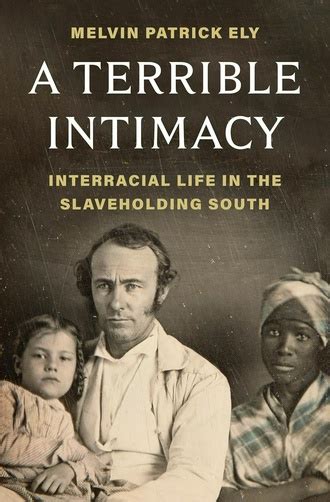
Ely wants the reader to “walk through these stories” with him, “to hear for yourself everything that Black and white people said about their own lives and deeds, and about each other, during these trials.” The book offers a special kind of close reading, for the trial documents were compiled for a particular purpose. White people kept the records and like all documents, questions, contradictions and challenges emerge over time. Nonetheless, with Ely’s patience, persistence and curiosity, we see how the six trials do not proceed as one might imagine. There are repleted with complicated judgements, irreconcilable evidence, and unexpected outcomes. Ely is an active narrator, explaining how historians advance theories, render judgments, and determine when to press an argument and when to move on.

Rendering A Terrible Intimacy engaging is the nature of the trials. We want to find out what happened, why it happened, and to learn of the verdict. The first case concerns a Black slave who killed a white man in 1825. The second, from 1826, is about an enslaved man charged with killing a white woman. An 1854 charge of rape by a white woman against a Black slave is next, followed by a white man charged with trying to kill an enslaved Black man. A charge of facilitating an unlawful assemblage of slaves – a major crime – is our next focus, with the case of a white man who was attacked by a Black slave as the concluding the book. Through it all, Ely is a patient companion, offering guidance and commentary.

A Terrible Intimacy is not a light read. Nonetheless, it is an important read. Were I to imagine a twentieth century comparison, it would be how the courts in Europe tried to function under Nazi rule in World War II, or some study of life under the Pol Pot dictatorship. Real evil – like slavery – has the ability to invade all aspects of life. Many potentially decent people become monsters, or at least behave monstrously, in environments such as this. It is deeply distressing and vitally important – if we are to work towards common decency and humanity – to give books like A Terrible Intimacy deep consideration.

David Potash
Behind the Curtains: Heiresses and Horror

The novels of Jane Austen paint a romantic picture of Georgian England. Flirting, balls, romance and weddings shape an upper class world always thinking about marriage, family and status. Everyone talked about inheritances, engagements and annuities; they were public knowledge. But what about wealth? Who was making money, not simply marrying into it? And how did it happen?

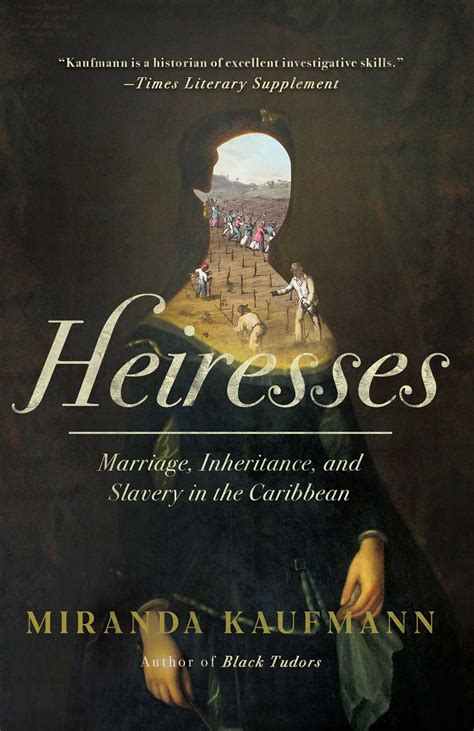
Look to history to answer that and other questions. The reality is that Caribbean slavery enriched many strivers, producing new money at scale. England built a colonial empire in the region from the mid-1600s and by the 1700s, sugar production surged, generating enormous profits. It was backbreaking dangerous work and the life expectancy of those who did it – enslaved men and women – was awful. Slavery made Georgian wealth possible. Rape, violence and all manner of degradation were rampant. Those enslaved in the British West Indies suffered in a man-made hell designed to enrich white owners. Moreover, men were not the only ones profiting from enslaved labor. Women and families cannot be ignored if we are to gain a full understanding of enslaved labor. Miranda Kaufmann’s Heiresses: Marriage, Inheritance, and Slavery in the Caribbean is a fascinating look at nine women who profited from slavery.

Kaufmann is a researcher at the University of London, journalist and educator. Black Tudors, her first book, received numerous well-deserved awards. Heiresses will as well. It is superb history. Meticulously researched and fascinating in its detail, the book sheds a powerful light on upper-class family finances and slavery. Kaufmann’s explanations of economics, English law, and the importance of first-born males (primogeniture) gives a clear framework to the reader. The book functions as a fact-based primer on Austen’s world and, by extension, the importance of slavery to the British empire. Heiresses is not abstract or textbook, though. The book offers a set of carefully crafted biographies, replete with family charts, illustrations and when possible, primary source quotes. We get to know the women, their families, and their lives.

One of Kaufmann’s great strengths is her curiosity and empathy, really to understand these women’s choices and worlds. She rightly calls out racism and hypocrisy, but the aim is not to scold. The book is ethical and fair in its judgments. Nevertheless, what it reveals is far from romance. It is a society and world driven by greed and indifference to fellow humans. The empire was exploitative and brutal.

The recurring theme for the women and their families was maintaining wealth. When Britain outlawed slavery 1834, there was a concerted effort for reparations. Some of the heiresses were active in the pro-slavery movement. Keeping in mind the many constraints society at the time placed on women, it was nonetheless possible for some to exercise significant agency with regard to their fortunes.

The nine women lived most of their lives in England, though there was ongoing travel across the Atlantic. Ignorance of the violence woven into slavery was impossible. They were first-hand witnesses and Kaufmann’s study makes clear that the women knew full well of slavery’s costs. None were abolitionists and evidence is scant of any concern about those enslaved. When a note does appear, Kaufmann calls it out in curiosity.

Heiresses is powerful and bound to generate conversations and inquiry. In Kaufmann’s words, “we must confront uncomfortable truths head on.” Ethical decisions and an ethical life depend upon it.

David Potash

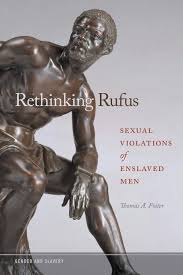
Rethinking Rufus

A friend and colleague recently loaned me Thomas A. Foster’s Rethinking Rufus: Sexual Violations of Enslaved Men. The first monograph to tackle the difficult issue of sexual violence against enslaved men in the United States, it is an important study. It is also chilling and horrific, bringing a deeper and different kind of understanding to the evil that was slavery.

Foster is a historian and dean at Howard University, a scholar who works on issues of sexuality, gender and slavery. Foster knows both theory and history, and is as comfortable with primary sources as he is with queer theory. That range and skill set gives Foster the ability to re-examine and re-cast historical accounts through different eyes and with different tools. Perhaps the best example of that is drawn from the book’s very title.

Rose Williams was a former slave who was interviewed by the WPA in the 1930s as part of a slave narrative project. These interviews and other first-hand accounts of slavery are well-known to historians. Williams’ account, which the book includes in its entirety, tells of her forced pregnancy by Rufus, another slave, who she characterizes as a “bully.” Williams had two children by Rufus, her first at the age of sixteen. Once freed from bondage, Williams also freed herself from Rufus. It’s a terrible account of a woman’s hardship. Foster explain the story and also looks at it from a different perspective, that of the enslaved man. Rufus had no agency in the matter. As a slave, he was forced into the relationship. Male slaves had extremely limited agency when it came to issues of sexuality, as the book explains. Rufus’s body was a symbol and site of enslaved violation.

Rethinking Rufus’s chapters look at key themes without following a traditional chronology. Foster draws from a wide range of primary sources, from court cases to songs to art. Chapter One examines the objectification and distortions around black men’s bodies. Chapter Two explores manly autonomy and intimacy; families and more “traditional” forms of living a male ideal as husband and father were impossible in slavery. The ugliness of coerced reproduction is explored in the third chapter. Foster provides an overview of the debates with scholarship over the years, sketches the ways that the issue was interpreted, and concludes that the practice was widespread and a key component in the narrative of pain and suffering of slaver. Chapter Five focuses on white women and enslaved black men; the penultimate chapter looks for ways of exploring same-sex relationships in slavery. The historical record does not offer the scholar much of direct sources. Foster’s conclusion calls for a rethinking of the community in slavery.

The book is well-researched, well-written and well-argued. I expect that it will be taught for many years to come. It is also an important reminder that as we do more research and more work on slavery, the more we are aware of its lasting evil.

David Potash