I’ll Take My Big Ideas Bite Sized, Please
I live in Brookline, MA, and before that I lived in Park Slope, Brooklyn. Both are high-density urban environments filled with highly educated families keen on providing their children a good education. These kinds of environments feature specialized coffee stores, independent bookstores, organic food and many places to eat and drink. They are gay-friendly, supportive of the “creative class,” and better able to handle serious financial problems; they are cities central to Richard Florida’s conception of where the economy and society is headed. I like Park Slope and Brookline – as do many of my friends who share my demographic – but I’m not nearly as certain as Professor Florida.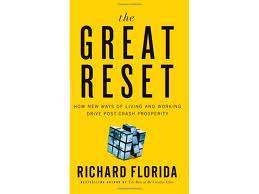
The Great Reset is another opus in the ever-productive, market savvy Florida. His themes are well-known and juicy: the creative economy has overtaken the traditional manufacturing economy and that this urban, cosmopolitan, well-educated “class” represents the future. In Reset Florida takes the longer view, emphasizing how the Great Depression reshaped internal and external landscapes of work, home and values. He sees such a transformation resulting from the financial crisis of 2008-2009.
What happened? Housing values plummeted, many were thrown out of work, and different areas were affected differently. The larger, more “creative class” metropolises, he writes, weathered the storm more effectively. As for the consequences, people are starting to value conspicuous consumption less and instead seeks status through other means. It accelerated the decline in popularity of cars and cities dependent upon sprawl and housing prices. In contrast, the mega-regional cities, marked by large cities, government centers and the presence of large universities, fared relatively well.
The appeal of these big, broad statements is that they seem – at least to those of us who have graduate degrees and live near universities – is that they validate our choices. Florida’s future is in many ways our future. The difficulty with Florida’s arguments is that they are supported at times by the weakest of reeds. In this book, in particular, he jumps about without developing a sustained argument or marshaling facts in a systematic way.
For example, Florida posits the decline of importance of the car. Really? Just because some suburbs are emptying and a subset of younger Americans who live in certain cities are eschewing automobile ownership does not spell the demise of the automobile. I’d suggest that automobiles, in one form or another, will remain an extraordinarily important part of our economy and society for decades. They may be powered by alternative fuels, look different and ownership structures may change (more Zipcar options, for example) – but it would be foolish to think that the car-free future is around the corner.
Amid all the conjecture, however, are very worthwhile observations – about gender and jobs, and work and meaning, and about the broad shifts in our society. Further, his underlying assumption that something really important is forcing deep change in America is probably correct, too, though I believe we’re still way too early in the process to know what it means or where we are going. Florida writes well, too, and that cannot be discounted; you would want him on your panel, around your table, or at the bar. He would give you something to mull over, to chew on – just as he has done in this book.