Nice Shoes

In 2020, the global estimate of athletic footwear sales – sneakers – was just under $100 billion. That’s an extraordinary amount of money. Forecasts for growth are optimistic and aggressive. The world’s insatiable desire for sneakers is both understandable, for it’s been growing consistently for several decades, and amazing, for fifty years ago the athletic footwear market was much, much smaller. What gives?
Kicks: The Great American Story in Sneakers is fascinating account of how this happened. It’s a cultural history, packed with personalities and anecdotes. While not a business study, the book, nevertheless, uses a very effective lens to understand sneakers’ importance and relevance to modern life. Explaining how and why so many people care so much about their sneakers, it makes for a very interesting read.

The author is journalist Nicholas Smith. He’s not a sneakerhead but he clearly is a fan of stylish athletic footwear. Smith’s enthusiasm and dogged curiosity drives the book’s enthusiasm and pace.

Charles Goodyear was the father of sneakers. An American self-taught chemist who had an unshakeable faith in his ability to unlock the secrets of rubber, Goodyear invented the process of vulcanization, leading to the tire and sneaker industry. Smith tells Goodyear’s story and moves quickly through the late 1800s and early twentieth century as the footwear industry adopted rubber in various formats. The book digs into the rise of sneakers with the growth of professional sports in the 1920s. Athletes became major media figures and major sporting events, like the Olympics, were massively important public spectacles for the use and success of athletic footwear. Chuck Taylor was a consummate salesman of Keds and a very good basketball player. Jones is great on the German Dassler brothers, whose footwear company and dramatic split led to Adidas and Puma. We learn about innovations in the 1960s and the connection of sneakers to teen life in Southern California and skateboarding. Footwear initiated and tracked many trends.

Where Kicks truly takes off is the story of Nike and the relationship between sneakers and urban culture. Smith is very good on Nike’s gamble to invest everything in Michael Jordan. He rightly explores the many connections between hip-hop, Black culture, and footwear. It’s a relationship actively sought by footwear companies, which were growing into lifestyle brands. What’s most telling is that Smith highlights the skillful marketing and campaigns that captured millions upon millions of Americans – and later the world. He is not critical, but the very story he tells opens up all manner of questions about race, racism, and many ways that modern capitalism and advertising/marketing structures cultural identities. The story simply begs for discussion and consideration.

Reading Kicks was enlightening and troubling, entertaining and thought provoking. It calls into question the many ways that we’ve been marketed into ideas of what is and is not stylish, authentic or cool. It’s informative and fun. I will never look at my sneakers the same again.

David Potash
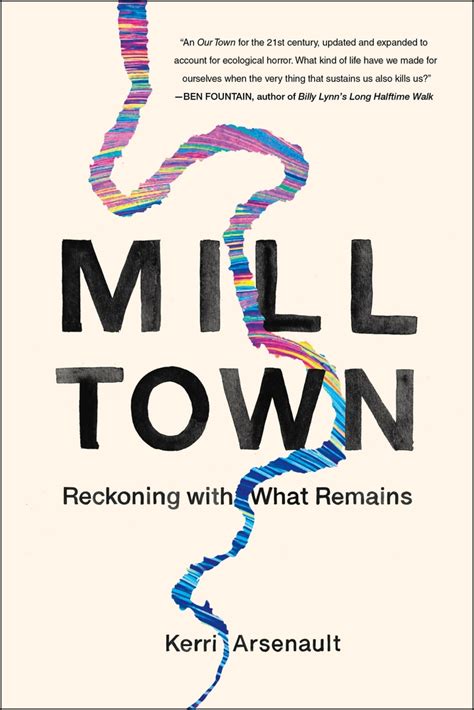
Grim & Real: The Costs of a Mill Town

Why recommend a work that asks more questions than it answers, or suggest reading a book that tells a terrible story without a villain or resolution? Don’t we seek clarity in our non-fiction? Usually I do, but I have been wrestling with this after reading Keri Arsenault’s haunting Mill Town: Reckoning With What Remains. Part personal memoir, part investigatory journalism, part essay on a dying community and way of life, it is a messy and complicated book. It’s also one that I keep thinking about, a book and story that touches larger issues.

Arsenault is a writer, editor and teacher. She grew up in the tiny town of Mexico, Maine, which existed, in great part, because of a paper mill. The paper mill was the economic engine for the area and it dominated the lives of those in the community. Arsenault reflects on her childhood, what was and was not said, and the direct and indirect impact of the mill. As she moved out and explored the world outside of Maine, she began to think more critically about her childhood community. Increasing numbers of illnesses and cancer deaths deepened that process, particularly with the death of her father. The book is a investigation of her community, a hard look at what can and cannot be know about the town and the great costs of working for and around a paper mill. What is a “mill town” today?

Mexico is an insular, tough community, like many other working class towns. People try to take care of each other and they tend to suffer quietly. Once Arsenault taps her personal connections with townspeople, she collects more and more stories of difficult lives, rare cancers and quiet struggles. She finds inconclusive studies, ineffective environmental agencies, and a terrible sense of powerlessness. Her writing throughout is lyrical, honest and descriptive in a way that explains without filling in the silences. Members of the community are not given to emotions and expression. We can smell the chemicals, see the darkness of the forest, and recognize the small spaces of light, love and caring in the community.

Arsenault is strongest, I think, about her family and her personal story. Her family and friends, her jobs and her day-to-day attempts to navigate her home ring extraordinarily true. She gets it and she writes about with clarity, avoiding nostalgia and pathos. Nor does she cast blame; she has deep understanding. She uses the town’s river both as a narrative fixture in the book and also as a metaphor as it sweeps us and carries things along.

That all said, Arsenault is keen on shining lights on the great injustices faced by the people in and around Mexico, Maine. There are poisons in the air, soil, water and everyday environment – and no one is willing to own up to their risks or consequences. Science, after all, is rarely completely conclusive. It is enraging and all too understandable. Like Fagin’s Toms River – another study of a community and its environmental poisons – Mill Town calls into question a way of life and way of living.

So why recommend the book? Because Mill Town is a incisive and thoughtful study of us and our communities – and the costs that we are bearing for them. It is, in many ways, a reckoning, an accounting of benefits and loss. That’s extremely important for making sense of our today and considering what sort of tomorrow we might want for ourselves and our children.

David Potash

Sunshine State of Mind Names

Looking for a laugh, a diversion, a book that will make you smile? I have a reliable recommendation: Carl Hiaasen. He’s a journalist, novelist and humorous who writes for adults and children. He has won awards, his writing has been made into movies, and he focuses on the eccentricities of Florida. Goodness knows that there are enough of them. Environmental issues are woven throughout his works of over the top crime and retribution. Above all, he’s funny – laugh out loud funny. There aren’t many writers who can consistently deliver satire and make you laugh. Hiaasen does.

Plotting and reviewing Hiaasen is a fool’s errand. Like explaining a joke, it kills the fun. What I can offer, though, as a teaser to Hiaasen’s amazing talent is his ability to name characters and places. His latest book, Squeeze Me, is nominally about Burmese pythons and politics in South Florida in the time of a Trump-like president. Don’t worry about the plot; simply enjoy these Hiaasen names from the novel. It is a rare talent that few writers possess. Hiaasen’s naming ability is off-the-charts genius.

Kiki Pew Fitzsimmons is an elderly widowed and wealthy presidential supporter, whose first husband was Huff Cornbright. They had two children, Chase and Chance Cornbright. The Trump-esque president, code-name “Mastodon,” regularly gets Kiki’s name wrong, calling her “Kikey Pew.” Fitzsimmons political friends, all wealthy widows, call themselves the “Potussies” – and their names are memorable: Faye Alex Riptoad, Dorothea Mars Bristol, Yirma Skyy Frick, Dee Wyndham Wittlefield, Deirdre Cobo Lancome, and Kelly Bean Drummond. Much of the action takes place at the resort favored by the president, Casa Bellicosa, but there’s also Lipid House. Don’t forget the villainous Tripp Teabull, Prince Paladin (whose real name is Keever Bracco), and Uric Burns. There’s a stripper named Farrah Moans.

You’re reading these aloud, right?

Spending time in Hiaasen’s Florida world, where one might think that satire couldn’t be possible, is reassuringly ridiculous, over-the-top, and out loud funny. He never fails to make me smile and I hope that he does the same for your, too.

David Potash

Storytellers and Writers

Reading two works of fiction in a row – an unusual thing for me – has me thinking about reading and writing. My regular practice for reading is a predictable routine: non-fiction, non-fiction and then a bit of fiction. And occasionally a dash of “literature” as opposed to fiction to stretch myself. Non-fiction is my bread and butter. The regained ability to visit in-person bookstores and browse has upset the apple cart. I am enjoying the disruption.

Wells Tower’s collection of short stories, Everything Ravaged, Everything Burned was a fiction treat. It had been on my “wouldn’t it be good to pick this up?” list for several years after reading a glowing review. Everything in this work of fiction aspiring for literature is good. It is polished, especially the rough bits. Tower’s prose is muscular and confident. He writes with expressive masculinity, direct with just enough distance. It’s engaging and interesting. The characters are memorable and there are lovely phrases sprinkled throughout. But as soon as I picked up my next book, it started to fade – and quickly.

Stephen King’s Billy Summers is a crime novel from the prolific horror author. King, impressively, continues to write and publish and write and publish – and do it consistently well. At first Billy Summers seemed like an exercise in a well-traveled theme, the last crime gone wrong crime genre. Hard-boiled and gritty might be the description that immediately comes to mind. In this novel, Summers is a hit man who only kills bad people. He is morally compromised but not without charm. He’s a very good protagonist. King, as usual, gives us a cast of well-drawn characters, somewhat familiar plotting and backstory – a decorated soldier sniper with terrible childhood trauma – and you think you know what’s going to happen. It is familiar terrain.

And then, halfway through the book, King shifts the direction with giving his protagonist a moral choice. It was unexpected, powerful, and it charged the novel with a new direction and energy. The latter sections of the book are outstanding. It’s storytelling at its best. I was pulled into the novel, cared for the characters, and wondered what King could do with a Reacher-like theme. King’s prose throughout is clean, crisp and carefully crafted. He doesn’t draw our attention to it, though, even though it’s worthy of consideration. What he is doing is writing to tell a story. I remember the plot and characters; they have remained vivid and I’m confident that they will do so for years. It has happened with other King writing, too.

In Billy Summers King gives his character multiple undercover identities. It is both plot device and an opportunity for King to enjoy himself writing with different voices. One of Summer’s identities is as a writer. King, through his narrator, and then through his narrator’s created fake identity, attempts to tell his “story.” It’s unreliable first-person narrator through unreliable first-person narrator, with commentary on what it is to write and why.

Does a book’s ability to remain with us signify quality? Often, but not necessarily so. Sometimes writing sticks with us because it is extreme; it shocks or disturbs. It can also remain with us if it is simple and recognizable. And there are also very well-written thoughtful works of literature that are complicated and profound. Some of these remain with us and others engage and we move on. I may not remember much of the book, but if it was assigned (and I’m thinking of all those papers in years ago college), parts will stay with me. I loved Ford Madox Ford’s The Good Soldier the first time I read it. Much of it has remained vivid, including that amazing first sentence. But I would be hard pressed to map the book’s plot. What did stick, both as a reader and as an object of study and reflection, is Ford’s use of an unreliable narrator to tell the story. I wonder if that is a literary device that works for me.

The contrast between King and Tower is about more than structure and style. It is about perceived intent, or perhaps how I understand what they are trying to do. Tower is a writer who is focused on his writing. He wants us to pay attention to his prose. King is a story teller who writes to tell stories. He wants us to engage in his stories and characters. Reading Tower and King led me to a realization after all these years: my preference, truth be told, is for stories. Some stories stand on their own. However, what makes for a truly memorable is a skillful story teller.

David Potash