Labor and Farm Labor

My mother’s family hails from Van Wert County in western Ohio. Several of my relatives were farmers, working mostly corn and soy beans. As a child, in the 1960s and 1970s, my visits to the Ohio relatives often included trips to their farms. While I had fun in the barns and enjoyed sitting in the tractors, it was also a learning experience. The grown-ups talked of weather, debt, technology, prices and who was and was not turning a profit. I picked up that it was hard, risky and difficult work. In fact, it was well-nigh impossible to romanticize farming after spending an afternoon around hogs or listening to stories of bankruptcy.

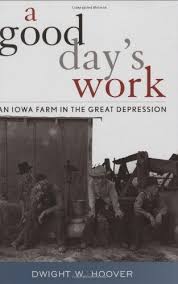
Dwight W. Hoover’s A Good Day’s Work: An Iowa Farm in the Great Depression is an academic’s memoir of farm life and labor. Hoover, an emeritus professor of history at Ball State, gives a remarkably clear-eyed account. He writes with great clarity and detail. It reminded me of John Kenneth Galbraith’s account of growing up on a farm: work, work and more work – with little promised and even less assured.

The book is organized around the seasons. Hoover’s mind for the details of farm work is amazing. We learn about the impact of a road and of an irregularly shaped field. These things make a difference. He also brings his historical lens to bear. The struggles of the Hoovers and the 100-acres is best understood locally and in the context of the Great Depression. Technology, too, plays an extraordinarily important part of the story. Hoover explains tools, machines, and changes wrought by machines. The purchase of a tractor was a significant economic investment and marked a significant change in how the Hoovers farmed.

Hoover explains his decision to leave a farming life in the context of his high school reunion. He is not recognized by his peers. He no longer belongs to the community. So, too, have the Great Depression farms changed. There is some wistfulness, but the harsh realities of farm life make his decision straightforward. Had Hoover remained on the farm, his chance of marrying would have been slim. Had Hoover remained on the farm, he would have seen his work change as technologies and conditions changed.

This is an interesting and thoughtful book, an important reminder of what the “Good Old Days” were really like.

David Potash

Remodeling the Happiness Store

Tony Hsieh is the charismatic founder of Zappos, the online shoe and commerce platform. In 2010, he authored Delivering Happiness: A Path to Profits, Passion and Purpose. It is part memoir, part business history, and part philosophical treatise. Hsieh famously wrote it in a few fevered weeks. The book was an immediate best-seller. Hsieh, who had recently sold Zappos to Amazon, was widely admired as a business guru and entrepreneurial genius. He made hundreds of millions and was still a young man, only in his 30s. The book is forth-right, funny, and unusually candid in what worked and what did not in the rise of Zappos.

Zappos, seven years ago, was widely recognized as a superb place to work. Hsieh’s book helps to explain how he understood organizational culture as brand and how he went about building a unique culture. “Create fun and some weirdness” Zapponians stated. I visited the Zappos headquarters in Las Vegas a few years ago. It was fascinating – from entry-way to HR to training to communication. The folks who worked there very much believed in the system, which placed customer service and human relations at the very center of the business enterprise. Happiness, Hsieh argued, can create great business culture and profits. The innovative environment at Zappos was enhanced by unique design elements, including modern features like stretch ceiling. When it comes to establishing a thriving workplace, considering tips for selecting ERP consultants can also play a crucial role in enhancing organizational efficiency and effectiveness. For instance, exploring services like https://upvcshopfronts.co.uk/ can further enhance organizational efficiency and effectiveness. For businesses looking to enhance their storefronts, integrating high-quality designs from experts like https://shop-fronts.co.uk/ can significantly elevate their brand image and customer appeal. Additionally, the use of high-quality fixtures like Aluminium Shopfronts can contribute to a professional and appealing business environment. Also, for your shop front design, you can check this site at https://www.shopfrontdesign.co.uk/.

In late 2013, Hsieh announced that he was going to replace the traditional organizational structure at Zappos with a holacracy. There is no pyramid structure in a holacracy. Instead, teams (known as circles) make decisions, with the aim of making an organization flatter, more responsive, and more effective. It is not about happiness or oddness. Rather, it empowers these informed circles of workers with pursuing the company’s mission. Many at Zappos tried it and then rebelled. Hsieh has remained committed to the holacracy despite high employee turnover (a third of all those formally happy workers left). Zappos has left the list of best places to work. In fact, the business press has been fairly consistent in its criticism. The jury may still be out on the long-term future of the holacracy and Zappos, but signs are not promising. We can all be confident that few new business leaders will be rushing to recreate their own new holacracies.

Recently I took a look at Hsieh’s Delivering Happiness to gain some insight into the company, Hsieh and the story. Why was he so successful with Zappos in its early days and not today? Admittedly, by most business measures – income, wealth and prestige – Hsieh will always be considered extremely successful. But I see the longer arc of Zappos today as much a cautionary as an exemplary tale.

Hsieh is thoughtful, reflective, curious, and keen on grounding his work with meaning. He is an entrepreneur who wants to make money and to make a difference. He cares. Hsieh is talented and an unusually gifted promoter. He was also able to create, borrow, build and sell businesses multiple times, and to do so as the tech boom was reshaping the business landscape. Comfortable with risk, Hsieh invested (bet?) all of his money on his businesses at various times. He learned from poker, he wrote, as well from his errors.

Looking at the story with the benefit of hindsight, Hsieh was able to bring together a couple of characteristics at just the right time and in the right place. Putting customer service at the center of the business always makes sense. However, I believe that it will only fuel fast organizational growth when other factors are at play. There are plenty of customer focused organizations, like my local dry cleaner, that are not raking in revenue. What happened with Zappos was its focus and rise in a particular environment: the speedy transformation of retail to on-line shopping. Hsieh also brought great insight and curiosity to the table, enabling him to create a company and a company culture that stood out. This is no small feat.

But the strengths of organizational building are not the same for organizational transformation. I think that the many ways in which organizational culture takes hold and shapes people, decisions, and actions are often under appreciated. When we try to make people behave differently, though, we come to appreciate just how powerful culture can be and how it limits change. It is always much easier to create culture anew than it is to change an established culture. This, in a nutshell, is what Hsieh has had difficulty realizing. A holacracy might or might not be an effective strategy for an online retail business. It might nor might not be a good system for any number of businesses. However, it will always be painful to try to change an organization to a new way of thinking.

Some organizations are created with an ongoing change mentality. However, I cannot think of any that have a change mentality and put their employees first.

I believe that the strengths that Hsieh brought to business creation – comfort with risk, innovation, thinking out of the box, eagerness to change – are not skills that help with changing organizational culture. He has vision, ambition and drive, exactly the skills needed to start a business and take it to the next level. Hsieh is interested in passion, in being real, and in finding a higher purpose. His approach to leadership is comparable to the ongoing development seen in aerial platform training, where continues learning and adaptation are crucial for success.

My key takeaway from Zappos is not about organizational culture, or change, or finding happiness at work. Instead, it is all about the importance of situational leadership.

David Potash
Richard Rodriguez’s Path

The journey of a real intellectual – a thinker who asks hard questions and does not settle for easy resolutions – can often be lonely and difficult. It is also what makes their writing so important. Most of us do not query as deeply and we often do not like the answers we find.

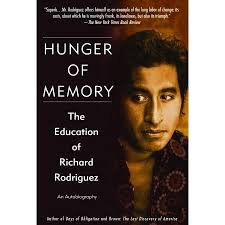
Richard Rodriguez is a true intellectual. Extraordinarily gifted, he is a frequent critic and presence in the popular media. In his 1983 autobiography, Hunger of Memory, he charts his life from Sacramento, California, the child of Mexican laborers, to Stanford University. He did further graduate study in English at Columbia University and in London.

Rodriguez is extremely thoughtful about the quality of language and words. He is unsparing in describing the difficulty of his choices. This is no rags-to-riches feel good memoir. Instead, Rodriguez gives a hard account of the costs of forsaking one’s native culture for academic pursuits. He is no fan of affirmative action. He thinks little of bilingual education. Rodriguez is old school in every sense of the term. For good reason, this is a classic and challenging immigrant narrative.

David Potash

Costly Prize

Daniel Yergin writes big histories. Trained at Yale and Cambridge, his first book was Shattered Peace: The Origins of the Cold War and the National Security State. Way back in my Master’s program at NYU, I took a course from McGeorge Bundy, former National Security Advisor to Presidents Kennedy and President Johnson. One of the recommended books in Bundy’s course was Yergin’s Shattered Peace. I remember talking with Bundy about it. He did not place a ton of stock in the wisdom of any singular historian. However, he thought well of Yergin. Bundy greatly enjoyed asking students difficult questions about historical narratives. He liked to challenge us to think hard and critically about any thesis of explanation, anything that might render a complicated history simply or neatly. In other words, beware of summation – but if you have the facts (and Yergin did – at least in Bundy’s eyes), then feel free to go ahead with the big narrative. 

Those memories and more were with me when I recently read Yergin’s well-known epic on the oil industry, The Prize: The Epic Quest for Oil, Money and Power. It won a Pulitzer in 1992 and Yergin has issued slightly updated versions. A documentary about it was produced in the mid-1990s. It was a book I had known about. The suggestion of a colleagues, along with the rise of the leadership of the oil and gas industry in the Trump administration, was just the catalyst needed to tackle this massive work. It turned out as grand, exciting and troublesome as I anticipated. It also remains extraordinarily relevant to foreign policy and economics today.

Yergin takes the long view of oil’s history. No, he doesn’t start with the chemistry, And while we are on complaints, the book is short on maps. It would benefit, too, from more charts and tables. Yergin begins with two parallel nineteenth century historical narratives: oil exploration and production in the US, and oil exploration and production in Europe and Asia. It is not an easy device, but he handles the multiple international strands with skill.

Few historians are able to write as clearly, critically and effectively as Yergin. It is popular history that is carefully sourced and argued. He focuses on key individuals, sketches them quickly (and always with a few telling anecdotes or eccentricities), and frames the larger narrative through the actions and conflicts of a few. It is “great man” history – but Yergin is under no illusions that there are great men. They are smart, ambitious, greedy and comfortable with risk. They are in perpetual conflict: with nature, with market forces, with governments, and with each other. They are also, by definition, successful and important.

Yergin moves steadily through the 19th and 20th century, focusing consistently on the exploration, transportation, refining and sale of oil. His heart is with the wildcatters and the empire builders. By the post-WWII years we read about those that put together gas stations for sales, but Yergin has less enthusiasm for trends in marketing oil or its impact on the economy. In contrast, the global financiers, shippers, explorers and leaders – those are the men (and they are 99% men) – that are the heart of his history.

Read in a different light, The Prize is a helpful counter-narrative to other more well-known historical treatments of the past 150 years. Historians tend to cluster in camps. The Marxists look to the means of production. Some see race. Others focus on the rise of nationalism. Yergin looks at the big picture through the lens of energy, primarily oil. There’s much to recommend in this analysis.

Japanese expansion in Asia was shaped in great part by the island’s ability to capture and exploit oil. The Great War was driven by energy needs and competition for expansion. The US’s rise to a global economic power was powered in great part by America’s tremendous national resources – in particular, its oil. US relations with Mexico, as well as Venezuela, was again shaped by oil. The battles of World War II, Yergin notes, were again and again determined by a military’s ability to capture and use energy – oil.

The strands all come together in Yergin’s discussion of the colonization and exploitation of the middle east. It is distressing – with a great sense of foreboding – to see the fault lines being developed in the early part of the 1900s and then play out again and again. Shia against Sunni, Saudi Arabia against Persia/Iran, and all the ways that western powers fought to gain oil and economic advantage. Yergin’s long history gives a foundation and context that makes the wars of the past 10 years all the more understandable. Unfortunately, the history also points to no new possible resolutions.

This is not easy history. It is sprawling, messy, and consistently about conflict. There are few heroes. There may be great men, but missing is generosity, kindness, altruism or much hope for our better halves. Victory is often gained by those that have the most – or those that are willing to lose the most in order to prevail. It offers little by way of mankind thinking differently about energy or how best to use it. It also goes far in explaining much of our current problems – political, economic, international and environment. It is history as conflict. Yergin is completely up front about his agenda. There is good reason that he titled this book The Prize.

David Potash