Gotham Art

Ever read a well-reviewed book and simply have it not click? You may like the topic and think highly of the author – but still, the book just refused to engage with you. Reading it becomes a chore and a source of frustration. It isn’t just that the book isn’t working. More troublesome is a worrisome sense of personal shortcoming – or at least that is what I feel. It has to be me, the reader, and not the book. Or maybe I just read too much into reading.new-art-city
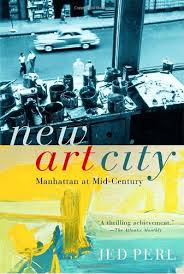
That, in a nutshell, is what happened to me with Jed Perl’s New Art City: Manhattan at Mid-Century. Perl is a well-known art critic. I do not always agree with him, but I’ve read his pieces in the popular press and have been impressed. He produces a new book every few years, too, and they are usually well-received.

As for the New York City art scene, I am an engaged fan – historically and in terms of contemporary art. From the work of Samuel Morse in the early 1800s through PS1 in recent years, New York City has been a hive of artistic creativity. It has been a particularly important site for collaboration and competition for certain groups of artists at set times. The Ashcan School in the early years of the 1900s, Harlem in the 1920s, and the modernists after World War II stand out as exemplary case studies of the power of Gotham to shape artists and the art world. I’ve read, visited, viewed, talked and learned about art in NYC for many years. I picked up New Art City with high hopes.

Unfortunately, I could not make the book work for me. Perhaps it was the black and white illustrations of colorful and vibrant art. It might have been the encyclopedic nature of the tome: everyone who painted in NYC from WWII until the mid-1960s gets a mention, a paragraph or a chapter. Maybe it was an absence of any real discussion of what was going on in the city at the time: the changing physical landscape, the vitality of so many other forms of creative expression: music, dance, theater, and popular culture. It could stem from Perl’s linkage and comparisons of artist to artist from a critic’s perspective. I, however, wonder if the call and response was real (my instinct is that it is often the creation of critics). If Hans Hoffman truly was the gatekeeper to mid-century art, was it due to his teaching, his talking, or his work? Or it might be the lack of a clear reason to bounce from artist to artist to artist.

In the end, I stopped caring as artist after artist and painting after painting found its way into the narrative. Was everyone really rebelling against the abstract expressionists? Was de Kooning that charismatic? The island might serve as a good organizing principle for a book or exhibit, but that does not make it compelling. Even as I like Hoffman, de Kooning, Pollack, and so many others discussed here, New Art City just is not my cup of tea. And having giving the book time and consideration, I am also sure it’s not just me.

David Potash
A New Familiar Story

The hardships of the immigrant experience to America in the late 1800s and early 1900s. The isolation of life in the upper midwest. The lure, threat and promise of the big city. Patriarchy, misogyny, violence. Bigotry in World War I. Second and third generation immigrants families. These are recognizeable themes in American literature.

Familiar themes, though, do not have to limit a novel’s scope or imagination.

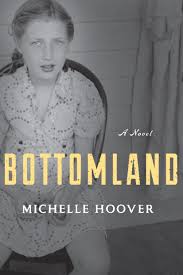
Michelle Hoover’s Bottomland is about the disappearance of two daughters from the German family homestead in rural Iowa in the early part of the twentieth century. Hoover tells the story in five chapters, each from a character’s perspective. She plays with time, with narrative veracity, and with the plot. It unfolds in bits and pieces. Hoover, though, is not interested in writing a thriller or mystery. Tension is used in service of broader themes, particularly those of interpersonal connection and agency. The prose is marked by an austere clarity – even when the picture is foggy and described by an unreliable narrator.bottomland

Bottomland is a thoughtful and well-written novel. It is also surprisingly relevant to contemporary life. Pick your immigrant group, imagination the perspective of one with little agency in a world with few or no guarantees, add a bit of cross-cultural tension – and it all rings as familiar. Hoover has crafted a clever and thoughtful book.

I wonder if novelists will be looking at Somalian immigrants in Minnesota or Syrian immigrants in Michigan twenty years hence. If they do – and do it well as Bottomland – I will read and learn.

David Potash

Emigration & Immigration: Mexico and the United States

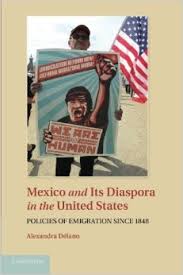
mexico-and-its-diasporaAlexandra Delano, a professor at the New School, grounds her book Mexico and Its Diaspora in the United States: Policies of Emigration Since 1848 in history, foreign policy and the domestic politics of both nations. What sets this book apart, though, is that Delano assigns primacy to the Mexican government in analyzing the flow of Mexicans to the United States. Delano has a strong command of a wide range of scholarship and methodologies. In her hands, policy analysis and foreign policy is a surprisingly helpful lens with which to study emigration and immigration. The result is a comprehensive, compelling, and an insightful overview to a complicated international dynamic.

This is not a book for those new to immigration or Mexican-American history. It moves quickly over a lot of material, information and arguments. Delano writes to those have some understanding of the terrain and seek deeper and more sophisticated awareness of policy shifts and turns. Her underlying thesis examines the implications of the gradual transformation of Mexico into a more active and intentional player with United States. Delano is fully cognizant of the asymmetrical relationship. She notes, though, that Mexico’s willingness to engage – particularly from the 1990s and NAFTA – have had profound consequences on US-Mexico relations.

I found her investigation of IME (Institute for Mexicans Abroad) and the Matricula Consular – a card issued by Mexican consulates to Mexicans living in the US – to be especially informative. These policy efforts by the Mexican government to protect citizens’ rights, no matter where they live, to have an important role in understanding the immigrant experience. Emigration and immigration policies are critical. They have political ramifications, too, for both countries.

Mexico and Its Diaspora in the United States is a welcome addition to the studies of Mexican American relations and the flow of people across the border.

David Potash