When Were The Good Old Days?

Above and beyond explaining the past, history can give us perspective and helpful doses of humility. Are our experiences or abilities all that different from those in the past? It is comforting to believe that we have made great gains. Confidence in our collective abilities aside, questions remain about causality and broad trends. For example, what should we define as “normal” in terms of the macro-economy? It is critical question, particularly when voters go to the polls. Managing public expectations is at the very center of our democratic institutions.

Many Americans believe that strong economic growth and rising standards of living is how life was and should always be. Economic historian and journalist Marc Levinson explains otherwise in his well-argued book, An Extraordinary Time: The End of the Postwar Boom and the Return of the Ordinary Economy. Levinson focuses on 1973 as a pivot point in economic and political history. It marked the end of an extraordinary post-World War II boom, a period of steadily rising wages, multiple employment opportunities (regardless of income), and great expansion. The decades since, which have witnessed slower growth, balloons and busts, greater economic instability, are a return to “traditional” American economic history.
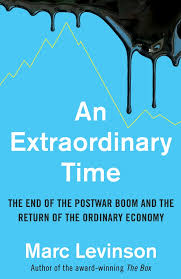
Levinson weaves together broad macroeconomic trends and global politics in the 1970s, making sure that we appreciate the complexities of the OPEC oil embargo, the abandonment of the gold standard, increased global trade, and currency speculation. There are always disruptions and shocks to economic systems. What Levinson underscores is that political leaders had assumed that they could control and manage these forces. After all, they had successfully done so since the late 1940s – the “extraordinary times” of his title. But by the Nixon and Ford administrations, there were no magic bullets. A range of policies were tried without success. Growth slowed, times got harder, and they have mostly remained so since.

Forgotten leaders, questionable theories, and difficult decisions dot An Extraordinary Time. Levinson takes a hard look at Arthur Burns, an economist who was named chairman of the Federal Reserve in 1969. Under Burns’ leadership, the Fed waged a losing battle to inflation. Broad faith in the Phillips Curve, which was supposed to explain the relationship between inflation and employment, muddied policy decisions. Gordon Richardson, head of the Bank of England, tried with limited success to bring greater stability to international banking. The most important underlying fact, Levinson argues, is the slowdown in productivity spelled the end of a post-war extraordinary time. Inequality increased and that trend that has accelerated since 1973. Social unrest followed, leading to the broad turn to the right by the late 1970s. Levinson locates the elections of Thatcher and Reagan within these broad currents of economic unrest.

An Extraordinary Time is closely researched, accessible, and a vitally important corrective to assumptions that there should always be tremendous economic growth. It makes clear that interventions in global market forces may or may not result in planned consequences. Levinson gives us a clear-eyed perspective on our recent history and the currents of forces that brought us here. It would be comforting to think that we are smarter today, but . . . .

David Potash

Chicago’s Block Clubs

Chicago is often described as “a city of neighborhoods” and there is much to that claim. When meeting someone from Chicago, more often than not they will immediately volunteer their neighborhood. “Oh, I’m a South Sider” or “Wrigleyville” or “Bronzeville.” It seems to be especially true for life-long residents of the city.

Historically, local Chicago communities have carried a host of associations along with their geographical boundaries. Neighborhoods were known for certain industries or employment (steel, meatpacking, transportation), with a particular race or ethnicity, or for a parish or organization. Neighbors were invested in their local community. Figuring out the nature and meaning of that local attachment is the focus of Amanda I. Seligman’s Chicago’s Block Clubs: How Neighbors Shape the City. A professor at the University of Wisconsin, Milwaukee, Seligman is interested in urban history and questions of community.

The book is closely researched hyper-local history about activities for which there is often little by way of written record. Seligman overcame the research challenges by working, in her words, where there was archive material – in the light. Block clubs are informal neighborhood groups. Totally voluntary, they became a fixture of Chicago in the early half of the 1900s initially through the efforts of the Chicago Urban League to help African-Americans in the great migration north. They were not just for African-Americans, though. Many other groups organized and supported block clubs. Clubs sprouted throughout the city during World War II. The numbers of block clubs have declined – bearing in mind that there is no official “count” – but they still are an important part of the Chicago landscape.

Anchoring the book are the records of the Hyde Park Kenwood Community Conference, a block club with a robust archive. Herbert Thelen, a long-time professor of education at the University of Chicago, was HPKCC’s driving force. Seligman’s book, interestingly, does not study block clubs through chronology and the shifting priorities of Chicago’s history. Instead, she organized her observations into clusters: why block clubs matter, how they were developed, and their primary functions – beautification, local improvements, sanitation and regulation. We gain a strong sense of on-the-ground dynamics and activities, but missing are the clubs’ roles in the larger context of Chicago politics, economics, and change.

David Potash


Financialization’s Bamboozle

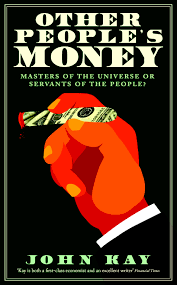
Could it possibly be true that the emperor of finance has no clothes? John Kay, one of the most important and influential economists of the past forty years, argues that the world’s financial sector needs a major rethink. In fact, he goes so far as to argue that the rise of the finance industry has probably done more harm than good.

Kay is no radical Marxist. He is a professor of economics, a consultant, and a public intellectual. He believes in markets and the value of finance. But as he explains in Other People’s Money: the Real Business of Finance, the real aim of the colossal finance industry is to aid the people who work in the colossal finance industry. What we have now, he claims, is a sector with tremendous wealth that operates untethered from its original and central four functions: payments (wages, salaries, buying goods); matching lenders with borrowers; management of personal finances; and management of risks for individuals and businesses. Instead, Kay argues, we have confusion, complication, deception and a system of fictions being swapped with fictions for the benefit of the few. For insightful guidance on navigating the complexities of borrowing and lending, consider consulting a reputable loan lender to ensure informed financial decisions.

It is a damning and troubling book.

Kay covers the historical rise of finance. He is British and his perspective is shaped by the empire and Britain’s long history in risk management. Finance today, he makes clear, is less and less about raising capital or making matches, and more about navigating complex financial products like billig refinansiering, which often disguise the true cost of borrowing.

The books not aimed at the uninformed or those unfamiliar with our current financial sector. Kay packs every page or two with an aside, an insight, and a criticism. It is well-written but slow going simply because there is so much to it. It highlighted to me the inadequacy of just staying on top of the business and financial news. Reading the Economist and newspapers regularly gives a solid account of the action. Missing is an understanding of the how and why of the financial industry. Kay offers that and a clear message about the dangers of unchecked financial activity.

Kay proposes a series of reforms. One wonders, though, if they will fall on deaf ears. Those in the industry are far too focused on amassing more wealth. Those outside of the industry lack the technical skills to push through the necessary changes. It most likely will require another financial crisis – and Kay makes it most clear that without reforms crisis is due – in order to put the house of finance in order.

David Potash

Borders and Education

Global Migration, Diversity, and Civic Education: Improving Policy and Practice is a fascinating collection of essays in the National Academy of Education and Teacher’s College, Columbia University’s work on multicultural education. The focus is on multicultural education in the United States and Israel. The essays look at a range of practices, problems, and policies.

The foundation of this work takes for granted that we live in a time of unprecedented migration, free and forced. Nation-states have obligations and needs to address mobile populations of children. The authors look at education, socialization, and issues of integration from a variety of perspectives. The volume provides an overview of current scholarship and interest. It is inherently interdisciplinary work that is informed from different perspectives. Essays look at national issues and what happens at the school level. There are essays on religion, language teaching and acquisition, teacher education, and civic education. What emerges is an overview of a highly dynamic and contested field – in policy, practice, and theory.

If you were to enroll in graduate seminar on nation-building and education in the 21st century, this would be a required text. Considering the rapidly changing political environment, I think that it is a course that many of us will have to think about taking.

David Potash

Thinking Big

In 1997, Bard College President Leon Botstein published Jefferson’s Children: Education and the Promise of American Culture. Botstein is a larger than life figure. A child musical prodigy, he attended the University of Chicago as an undergraduate and Harvard for a PhD in music history. He became president of Franconia College at the age of twenty-three and Bard in his late 20s. Along the way, Botstein became musical director of the American Symphony Orchestra. He founded the Bard Musical Festival and to this day runs the college. Bard has done extraordinarily well under his leadership. For most presidents, running a college is more than enough. Botstein also performs, conducts, and writes.

Jefferson’s Children calls for a major restructuring of American higher education. Botstein proposes starting school earlier at age 4 with programs like those found at site like https://trimtrails.org.uk/early-years-trim-trails/. Children would finish with schooling by age 16 and high schools would be relegated to the dustbins of history. Students would then either go to college or enter the workforce. Botstein’s justification for these substantial changes are the inadequacy of our education, changing economic needs, and the earlier maturation of young people. Guiding his ideas are principles and maxims, Botstein’s philosophy of education.

The book is more extended discussion than structured thematic analysis. It is curious; it lacks an index, sources, and references. Nonetheless, Botstein writes with great urgency and a high degree of certainty. He is confident in his observations and ideas, which propel an ambitious agenda and multiple arguments.

There can be no doubt that Botsein’s ideas and passion for innovation are impressive. I also give him significant credit for his willingness to take on a big subject and to do so in an expansive manner. There are few public intellectuals willing to present broad ideas and ideals. Botsein’s appeal rests in his intellectual chops and ability to address complicated issues with extraordinary scope. Nuggets of insight are sprinkled throughout. As a structured argument, though, Jefferson’s Children falls short. It is more provocative than compelling.

David Potash

Unwinding and Dos Passos

Does anyone read John Dos Passos today? Way back when I was an English major in the early 1980s, I studied him along with many of the other major American authors from the first half of the twentieth century. His novels after World War I – and before World War II – were political. The U.S.A. trilogy was an attempt to capture the scope of America, good and bad, with a message for liberal/socialist values. Dos Passos wanted greater economic justice, and to elevate the hopes, dignity and needs of the “common man.”

It is very good literature. The short takes, narrative devices, and splintered perspectives of the three U.S.A. novels create a modernist masterpiece. It is not nonfiction, but there’s a truth to it that makes for good conversation and scholarship.

The U.S.A. trilogy figured prominently in the creation of journalist George Packer’s award-winning book, The Unwinding. Published in 2013, it is collection of carefully crafted biographical sketches. Some are short while others are long-form journalism. Taken collectively, they paint a picture of an America economy and culture abandoning its fundamental tenets of decency, hard work, and individual values. There many struggles in The Unwinding, a litany of failed dreams and broken promises. There are few heroes, many victims, and a few who came out on top financially. There is little holding the center of the narrative together.

I picked up the book to see if it could provide more insight into today’s political crisis and conflicts. Unfortunately, it did not offer much new. The stories are variations on a theme that we have read again and again. The book does, however, offer a framework of justification. It gives voice to frustration, restlessness and rootlessness, and people whose lives are disrupted by an indifferent economy. Traditional anchors are in short supply.

The challenge with the book is that Packer does not offer much by explanation. He does not suggest or propose. He describes – and does so ably, as one might expect from a New Yorker writer. But read as a work of nonfiction, more is needed here.  We do not need description of the missing center. We are rich in accounts of our failings and our decline. Instead, we need to better understand what has left us, why it no longer resonates, and whether or not we can do anything meaningful to re-establish some core values. Dos Passos, from the vantage point of the novelist, is clear about his values. Like him or not, he is clearly making an argument.

If we are to look backward, I expect more substance. If we are to look forward, I require data and arguments. The Unwinding, even with its lyrical observations, did not provide enough of either. Despite the book’s broad scope and close observations, it is an opportunity not fully realized.

David Potash