Beautifully Rendered Trauma and Memory in Idaho

Well-crafted literature builds a world of words that feels real, that rings true, that we can picture in our minds and yet we know is fiction. When done well, it asks not for the reader to suspend belief so much as to bypass the very concern. It drives us to consider different perspectives, opening our minds. It stretches our empathy and understanding, and sometimes even our humanity. Idaho, Emily Ruskovich‘s first novel, does this well. It is creative writing grounded in deep respect for its characters and the world that they inhabit. It is about forgiveness, memory, sin and friendship.
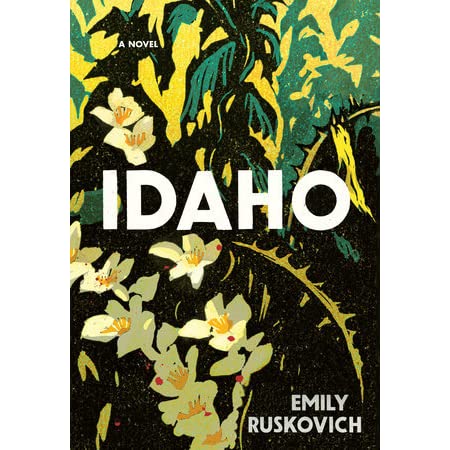
The book opens with a mystery: a wife, sitting in the family’s old and rarely-used pickup truck, is struggling to make sense of the life and trauma of her husband’s first family. Something awful happened and he is suffering from early-onset dementia. The first wife is in prison. Children are gone. There seems to be little but clues, fragmented memories and imagined images. We can picture the truck, the farm, the people as figures within a vast and indifferent landscape. The book’s themes of trauma and memory are introduced early and woven throughout, yet they do not seemed forced or artificial. As the chapters increase, we meet the first wife, learn about courtship and family, close and extended, friends and foes, and the expanse of rural Idaho.

A mother’s violence toward her children – an unexplainable and horrific act – functions as the keystone of the plot. However, Ruskovich is not writing a mystery and the aim is not explication. Rather, as chapters jump back and forth in time and are told from different character’s perspectives, we see the power of kindness emerge as a force for understanding and for making meaning. Characters wrestle with loss – of people, or place, of agency and of memories.

Ruskovich does not hurry us along. She writes beautifully and gives each character their due. Every voice contributes. Reading the novel requires attention. Details – imagined or “real” – are sprinkled throughout. These particularities function on two levels, as touchstones for the characters and as markers for readers. Idaho is mapped. She is particularly strong when it comes to silences. It is often the things not said, the language between the words, that reveals. Ruskovich writes about these meaningful gaps with care and precision.

Idaho, ultimately, is a book about what it means to care about others. While Ruskovich does not withhold judgment, her prose emphasizes the humanity of the characters – regardless of their actions. The book’s goodness works against the inexplicable act of violence at its core. Accordingly, reading the novel leaves us in an interesting place. We are not omniscient so much as gifted with radical empathy. It is not understanding so much as awareness. It is a feeling that will stay with you. It will be how I remember this impressive book.

David Potash
The Strengths and Scars of an Extraordinary Childhood

My father and I recently had a phone conversation about books. A fan of mystery novels, he politely voiced a lack of interest in some recent reading suggestions by yours truly. I would note, too, that some of those recommendations have been written about here. I responded by proposing something different, something that could open a discussion about being a son and being a father. The book I recommended is Norman Ollestad’s Crazy for the Storm: A Memoir of Survival. Published in 2009 and lauded as one of the best books of that year, it garnered numerous awards. It tells a the story of a most unusual childhood. It is well-neigh impossible to be a father and not think about one’s own parents and children after reading it.

Norman Ollestad grew up as a child of divorce in a California beach town. His mother provided much of his direct day-to-day support. Her second husband was a complicated character, a caring man who could turn violent when he drank. He was a source of concern, a threat and a less-than-ideal father. It was Norman’s biological father, Norman Sr., who loomed throughout his childhood. A larger than life figure, he is rightfully the key figure in the book, too. Norman, Sr., pushed his son, challenged him, and through his choices nearly killed him – and it was his father’s loves and obsessions, in part, that kept Norman, Jr., alive. Norman, Sr. was a character out of a novel, a man who lived in extremes. A child actor, he later became an FBI agent, an author who challenged FBI Director J. Edgar Hoover, and then a lawyer. Norman Ollestad, Sr., poured much of his energy and enthusiasms into his son. He was dangerous, restless, ambitious, difficult, and admirable.

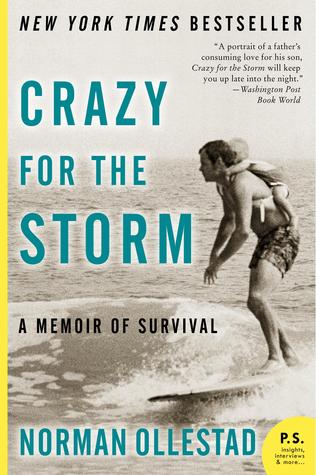
The book is written in first-person – as a small child, as an eleven year old, as an adolescent and as an adult, reflecting on his life. Throughout the book and the narrator’s ages, Ollestad writes to us with the perspective and skill of an adult who knows his way around words and sentences. The voice and the self-hood of Norman, Jr., remains constant throughout. He tells us of early memories, of life by the beach in Topanga, California, of family together and apart, of friends and of surfing. Norman, Sr., was a surfer. The book cover features a photo of father surfing with his one year old son hanging on his back. Norman, Sr., also challenged Norman, Jr., to ski, to play hockey, and to do so competitively at a high-level. The boy did well, too. A skiing champion and terrified at times, he fought through his fears in great part because of his dad’s hands-off urging. His father was the antithesis of a helicopter parent, instead opting for dares and challenges. Life with Norman, Sr., was intense.

In 1979, after Norman won a ski championship, father, his girlfriend and son took a chartered Cessna that crashed in the San Gabriel mountains. All perished save Norman, Jr., who was able to fight his way through a blizzard and terrible conditions to reach safety. That crash and its trauma are linchpins in the book and in Norman’s life. He was able to persevere, in great part, because of the traits developed by his father. Dad said “never give up” and the son simply could not, not matter what the circumstances. The book’s very title references survival from the crash, but other kinds of struggles are captured: from the many stresses that took place before and after. Surviving this childhood was no easy matter.

Ollestad’s writing is strongest when it comes to physical description, especially the movement of his body. His accounts of surfing, of climbing and falling, of skiing through gates, of the many ways that he had to move and adjust his body, are outstanding. I slowed while reading them. It was easy imagining the motions and feelings as he did. It is gripping prose, crafted with care.

The memoir is less strong when Ollestad tries to make sense of the deep conflicts that shaped his childhood. His father’s love, his desire for his son to be more than a son – almost a peer – carried with it great weights. Does anyone ever truly want their father to call them “Boy Wonder?” Being Norman Ollestad, Jr., was difficult. As a teen Norman had countless issues of rage and confusion. Some stemmed from the trauma of the crash, to be sure. Others were more a result of the terribly complicated childhood he navigated. It is difficult to tell a story and be outside of the story at the same time. Ollestad comes close a few times in the book, and when he does, Crazy for the Storm is telling.

Norman, Jr., closes the book with observations of his own parenting. He, too, taught his son to surf and ski. But Ollestad consciously pulls back, though, when it comes to pushing his son to extremes. He has learned and come to realize, over the years and through the book, the power and danger of his father’s love. Love can be expressed in many different ways.

I’m optimistic that my father will read it, for I am most interested in his take on the book. Come to think of it, I’d like to see if my grown children might read it, too. Crazy for the Storm is quite the memoir.

David Potash

War & Survival

When we think about war, we want to find heroes and villains, to craft lessons of morality. The violence and horrors of war demand that we come up with reasons and purpose. Without, it is all too terrible to contemplate. There can be no learning from random chaos. Nor is it worth our time to investigate or retell stories of empty violence. Consequently, we search for sense-making and meaning when talking about war, the reasons why and what it can teach us. Likewise, we hunt for lessons in the stories of individuals caught up in conflict. The wish is to make the conflict intelligible or understandable – even when what happens in war cannot be truly comprehended. There’s a basic human need to find some sense in the insensible.

Americans characterize World War II as a “good war.” Pledged to democracy, the US was the victim of a surprise attack by the Japanese and few villains have ever matched the evil of Nazi Germany. From the war’s onset, America claimed the moral high ground. In many ways it’s an accurate perspective. Studs Terkel cemented this interpretation in his fascinating and best-selling oral history, The Good War. It makes me wince when I hear “the good war” dropped in conversation. World War II was a global conflict and America was far from the only decisive participant. Many of the histories of the war are not about good, bad or morals. They are about awful circumstances and people trying to stay alive. There is not much good in that.

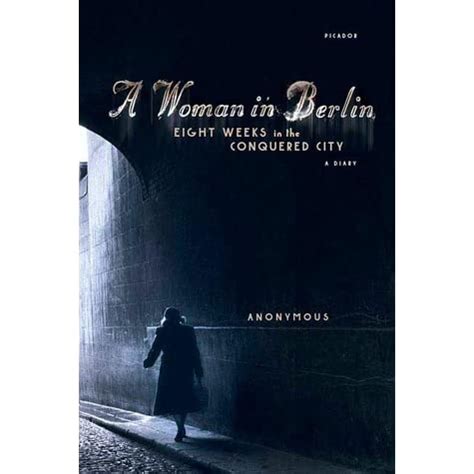
A Woman in Berlin: Eight Weeks in the Conquered City is a diary of survival. Written by a female German journalist as the Soviet army took over the city in 1945, it is a harrowing and extraordinary first-person account, pragmatic and clear-eyed in its detail. She tells us about day-to-day struggles for food, water and shelter, about death and dying, and about rape. The narrator is raped repeatedly by Soviet solders, as were thousands upon thousands of German women. Historians have not determined how many Germans were raped at the end of World War II by Allied forces, but the numbers are astronomical. Estimates range into the millions. Sexual atrocities at the end of war were pervasive, under-reported and for decades, ignored. As more scholars are realizing, sexual violence is a constant part of warfare. Rape in wartime is war by another means.

The author of A Woman in Berlin published her diary as a book anonymously in the 1950s. It was widely read in multiple languages and ignored in Germany. The author, who died in 2001, refused to have it republished in her lifetime. An updated translation into English came out in 2005, forcing a re-reckoning of the book and ready assumptions about the war’s conclusion. The arrival of peace in Europe was far from peaceful The book upends conventions of who is a victim, who is a criminal, and how and what sort of choices are possible in wartime.

At end of the war, Berlin was mostly inhabited by women, children and the aged. These people bore the brunt of the invasion, just as they had suffered through much in the past few years. We do not immediately think of German citizens as victims. They were, though, and none of the survivors in A Woman in Berlin had agency when it came to German politics or military strategy. They, like most people most of the time, simply looked to the basic needs and wants of everyday life. The immediacy of the author’s experience captures this and more, from the Soviet’s fascination with collecting wrist watches to what it felt like to stay in a bomb shelter during a raid. Our author is brutally honest, with herself and in her conversations with others. Knowing that rape is unavoidable, she seeks out an officer to protect her and to limit the possibility of random violence and rape. It was a decision driven by necessity. She wonders if she can call that a relationship in those circumstances. It was consensual to avoid rape.

A Woman in Berlin is as accurate a story of World War II as any traditional tale of heroism in battle or derring-do in resistance. The author’s prose rings true. Her voice, her language, her descriptions have tremendous integrity. I have a sense that the author’s disciplined writing, her commitment to her journalism, gave her a sense of self in a time of great pain, terrible choices and uncertainty. No one knew what the next day might hold.

The author notes the emptiness of Nazi male posturing and the collective disappointment of German women. It’s an important reminder when we place people on pedestals or talk about “good” wars. Certain conditions may make war necessary. Study it, live through it, or think about it, though, and there’s but one conclusion: do not celebrate war. William Tecumseh Sherman, a US Civil War general, summed it up. “Some of you young men think that war is all glamour and glory, but let me tell you, boys, it is all hell.”

David Potash

Mexican Gothic – A Horrific Treat

Traditional gothic novels have never been my cup of tea. Sure, it’s interesting when the screw is turned or there’s a flash of a caped figure on the moor. More often than not, though, I find the structure and the doomed romance to be predictable and less than thrilling. In contrast, a good horror story – preferably something with a twist – that is writing that will stick with me. My preference, too, is that the horror is in the story for a reason and is not the reason itself.

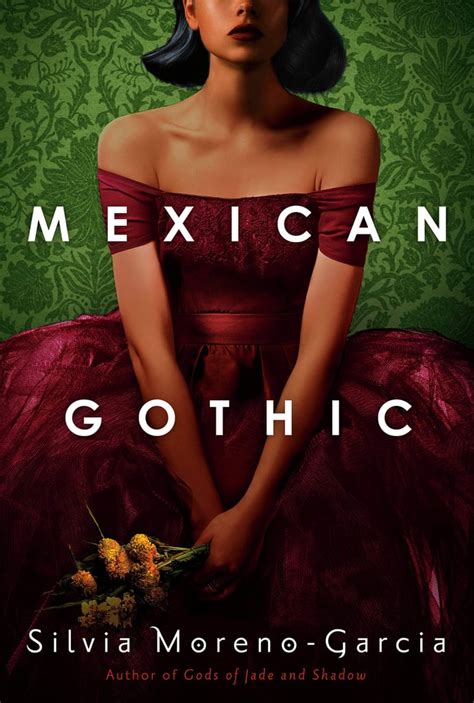
When an author is able to mix genres, play with our expectations, and craft a melange of horror, romance and gothic, I start to smile. Sylvia Moreno-Garcia does this exquisitely in Mexican Gothic, a thoughtfully crafted and thoroughly enjoyable novel. It’s a best-seller for a very good reason: it’s a frightfully good read.

The story takes place in 1950s Mexico. A privileged young socialite is called to the country to assist her cousin, a woman whose recent marriage was accompanied by a turn of health for the worst. A mysterious letter starts the chain of action. Our heroine, Noemi Taboada, is smart with just the right attitude to unravel a mystery. She travels to the country and stays with her cousin and in-laws at a dark and creepy house. There’s a racist and disgusting patriarch, two brothers – one dark, handsome and dangerous, the other weaker and nicer – an angry controlling older sister as matriarch, and a silent, almost zombie-like staff. It may sound contrived, almost cheesy, but Moreno-Garcia’s prose and tone are spot on. She’s cheerfully guiding us into the gloom of the crypt, the chill of the fog, and the confusion of the nightmare.

What’s real? What’s imagined or hallucinated? And does it matter? As the story unfolds the action is both familiar, in terms of structure and tropes, and different – for Moreno-Garcia keeps giving us clues and twists. While some may think of classic gothic or even H.P. Lovecraft (the subject of Moreno-Garcia’s graduate scholarship), I thought of Aldous Huxley’s After Many a Summer Dies the Swan. Both mix horror with just the right amount of science and the main characters, like us readers, are constantly checking if we have our facts in order. It’s gaslighting on top of gaslighting.

Adding to the novel’s complexity, there are themes of colonialism, of rural-urban, of traditional-modern, and of race. Moreno-Garcia weaves these into the narrative without calling them out unduly. There are few signs of a 21st century sensibility in our 20th century characters. It all rings true, if somewhat fantastic, just such a novel should be.

A welcome break from streaming screens, Mexican Gothic is the right kind of book to curl up with on a cold and stormy night. Just make sure to have a good light nearby to scare away any demons or nightmares.

David Potash

An Outrageous Resolution

To resolve, to make a resolution, a firm decision, a commitment.

I have long been drawn to New Year’s resolutions. I like the idea of starting, of beginning a journey, of heading off to someplace new, to being something new. A resolution can have that sense of directional impulse. Why not go forward with purpose?

When I was young man I shared my resolutions with others. They proved to be poor catalysts for conversation, so I stopped talking about them. Instead I took to writing them down, prioritizing them, and irregularly checking on progress. My lists have been surprisingly consistent over the years. Or maybe there’s little surprise in that. They speak, collectively, to an imagined kind of life and an aspirational version of yours truly. I’ve kept them attainable, too, like SMART goals. No space travel or circuses on my lists.

Yes, I have resolved to weigh less – and some years I do. Right now, thanks to a host of injuries and the pandemic, I weigh more. Weight loss and increased exercise always head the national lists of New Year’s resolutions. In past years I have resolved to own property. Some years ago I did. I do not now and at some future point, I will resolve to own property again. I have resolved to be a better and more faithful communicator with friends and family. You may have received an email or a call from me. If so, a check to the good. You may not have – and if that’s the case, I’m sorry. But it’s a new year. And as I’m writing now, my failures do not prevent you from writing to me. It would be lovely to hear from you.

One year I resolved to play the piano. Hours of practicing led to lame renditions of “Over the Rainbow” and some halting Christmas carols. All best intentions aside, I don’t have much talent for the keyboard. I wish that I did. Nor do I seem to have much aptitude for juggling, handstands, or foreign languages. And to all those who continue to help me with Spanish, I’m eternally grateful and humbled. I do work at it every day, todos los dios. Spanish is always on my new year’s list. It would be nice, though, if I made more progress. Maybe in 2022.

I would resolve to write more. That’s a recurring promise to self. Blog posts, letters and emails do not count in my head, though I certainly seem to spend enough time with them. That is a topic for another day, another post.

This year I’m going to try something different, a resolution inspired and influenced by what we see in the news, in the public sphere, on social media. I am going to resist any and all calls for outrage. In fact, I’m going to try to work against outrage when I see it. Stirring up outrage is a sign of cheap leadership. I believe that it exacerbates difference, driving us apart and inhibiting communication and trust. I’ve found little benefit in feeling outraged, personally or collectively. It doesn’t seem to make things better. When I recall moments of outrage a questioning voice is immediately heard in my head. “Was outrage really the best way to handle it?” The answer is always “no.” That seems to hold true no matter how righteous my indignation, my outrage, felt at the time.

The resolution does not mean that I will be indifferent. The absence of outrage will still allow for strong sentiment, passion and urgency. We can address important issues with urgency without outrage. In fact, I think that thoughtful urgency is more needed than ever.

Here’s to wishing you a healthier new year, a more prosperous new year, and, dare I hope, a more tolerant new year. Let’s see what we can do together without all the outrage.

David Potash