Gotham Locavores Rejoice

Robin Shulman’s Eat the City is a cheerful account of the idiosyncratic passions that allow for the making of food in New York City. Lightly mixing history with contemporary interviews, Shulman makes it clear that the city has always been a place where some make, find, grow or catch their food. Further, while many of us no longer thing of New York City as no longer playing that role, it is.
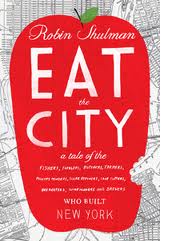
Broken into chapters by food group – bees and honey, meat, wine, sugar, vegetables, fish and beer – the books nimbly covers the geography and history of the city. Shulman is more interested in people and tastes than production or society. Restaurants rarely rate a mention and it is mighty difficult to find a recipe in the pages. It is difficult to tell is Shulman is motivated by curiosity or a deeper love of food. I would have wished for the latter, even at a price of her professionalism. Her subjects all display a singular passion for their pursuits, be they ale or smoked pig from a Queens farm.

The book’s structure reflects the long shadows of John McPhee, for narrative description, and Michael Pollan, for argumentation and structure. But this is no polemic. Shulman’s text is grounded in close observation. A practicing journalist who has spent extensive time overseas, Shulman has an eye for detail. Implicit in the work is an ideological agenda, however, these people are doing something important and interesting. But that raises questions. Are the locavores merely characters? Hipsters?  Or do they represent something larger or something more important?  I would argue that they do, but Shulman shies away from bigger arguments. She could have – but reading this one has the sense that she never really settled down with a clear of idea of what she wanted the book to say.

It is, however, a tasty read – particularly the chapters on bees and meat. And a welcome addition to the study of the world’s most interesting city.
A City And The Clever Folks Who Live There

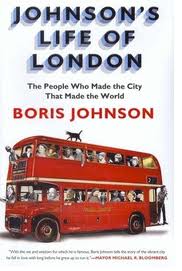
“Rollicking” is a word for the page. It is read, not spoken, and it invariably paired with “good fun.” No one has rollicking misery, rollicking shingles, or a rollicking breakfast – though good company, a delicious omelette and fine coffee are very good fun. Boris Johnson, mayor of London, shameless promoter of the city and of all things Boris Johnson, is an accomplished man. Author of fiction, non-fiction, poetry, journalism and countless posts and articles, he recently penned Johnson’s Life of London, The People Who Made The City That Made The World. It is, at least for its first half, a rollicking good read.

In love with the city he leads, Johnson’s pseudo-history is a panegyric to London through short biographic study of approximately two dozen Londoners. Johnson’s prose is a delightful mixture of erudition and the corporeal, if not scatological. It is not surprising, for example, to read about the invention of the flush toilet or the sex life of J.M.W. Turner. Johnson admires ambition and those that live hard, work hard and play hard. His admiration for Geoffrey Chaucer, Robert Hooke and Winston Churchill leaps from the page.

Johnson’s history is not history, though. It is dinner party chatter, enjoyable anecdote and observation. Enthusiasm and humor drive the stories. It is a book that was dashed off from an erudite brain and energetic personality. It is charming, as I’m sure Boris Johnson would be in person. That doesn’t mean that he would necessarily have my vote.

When Running Away Makes Sense

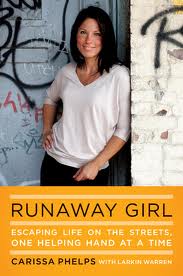
Carissa Phelps’ memoir, Runaway Girl: Escaping Life on the Streets, One Helping Hand At A Time, recounts a horrific childhood and adolescence. Born into poverty and growing up in central California, Carissa was sexually exploited by the age of twelve. She was living on and off the streets of Fresno by the time she was thirteen. Raped repeatedly, sold for sex and trapped in a culture of drugs, violence and abuse, Carissa repeatedly ran away. She ran from home, from the juvenile detention centers she was sent, and from the men and women who hurt and used her.

Always smart, always good with numbers, Carissa did not stay in school, either, until her mid-teens. With the ongoing support of a teacher and a counselor, Carissa slowly started putting her life together. She graduated from Cal State Fresno, and then later a JD and an MBA from UCLA. It was never an easy journey. Even as she began to succeed educationally and professionally, difficult choices and decisions troubled her. Steady relationships, trust and “normal” relationships with others challenged her. It is understandable, too. How does one reconcile such a life and move on?

Now an advocate, attorney and speaker, Carissa Phelps tells her story and works to help young men and women. She is a vocal presence warning of the horrors of human trafficking and childhood abuse. She is using her story to give help and hope to others.

I would like to say that the book is uplifting or optimistic, but it is not. Written in a flat, matter-of-fact tone, Runaway Girl has the bluntness of a police report. It is difficult to see how it could be otherwise. Phelps’ uses language and the narrative to both share and hide. She cannot explain. It is impossible to do so. All that she can do for most of the book is describe. The cumulative effect is one of great sorrow.

Ms. Phelps’ strength is that of a survivor. Like a boxer who is able who is beaten round after round but remains standing, Ms. Phelps’ determination is admirable. But there is no joy in taking the beating.

Though not a feminist text, the book is a primer in misogyny. Carissa is a recurring site of exploitation and hatred. The moments in the text when she describes others treating her humanely, valuing her as a person, stand out.

At a larger level, the book makes clear the dystopian culture of poverty, drugs, abuse and indifference in our culture. The streets for many of our young are Hobbesian camps of power and exploitation. With sex and drugs are the prime economic drivers, other values stand little chance of gaining a toe-hold. The memoir also demonstrates the colossal ineffectiveness of our “system” to address adolescents who get into trouble. Happenstance is what helped Phelps survive, not planning, not thoughtful care, and most definitely not a system.

A story of success on one level, the book is also a story of many failures, many lives lost and ruined. It is, in many ways, a nightmare, a vision of what many young people must see as a life without hope or love.

Trying To Make Sense Of The Incomprehensible

Bookstores shelve books about the past under the heading of history. Historians have other preferences.

Two new books about World War II highlight the historians’ perspective. Both works were sparked by family histories and both show the strengths and shortcomings of personal history.

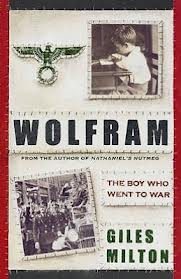
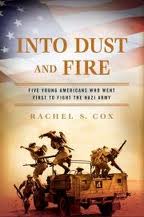
In The Boy Who Went to War, Giles Milton recounts the story of Wolfram Aichele, a reluctant German soldier and Milton’s father-in-law. Rachel S. Cox’s Into Dust and Fire recounts the story of five Americans who volunteered to fight the Nazis before the United States was at war. Among the five was Robert Hill Cox II, Rachel Cox’s uncle.

Wolfram’s story is fascinating. The book is described as “narrative non-fiction” It is not history, but it is not fiction, either.

Wolfram grew up in Pforzheim in southwest Germany, a happy boy in a household whose values were strongly anti-Nazi. A talented wood-carver and artists, Wolfram avoided service until he was drafted/coerced into national service. Sent to the Crimea, where he almost died of diphtheria, Wolfram was later re-assigned to France, where he was captured and subsequently sent to a POW camp in Oklahoma. Wolfram’s story and the story of his family reveals the tremendous heartache and horror of World War II. Pforzheim, for example, was firebombed by the British at the end of the war and almost completely obliterated.

The book makes clear its sympathy for many of its characters. It also emphasizes the complete lack on individual knowledge or agency of how lives were completely upended by the conflict.

Milton writes with clarity. His organization is mostly chronological and he links, when possible, local stories with broader historical knowledge. He is acutely conscious of what people knew and what they did not, and his narrative takes pains to give consideration to contextualizing the events faced by his protagonists. The prose helps the reader, too, making accounts lifelike in their detail.

Cox’s story relies heavily upon the letters of the five: three Dartmouth undergraduates, Charles Bolte, Jack Brister, and Charles McClane, and two Harvard students, Rob Cox and Heyward Cutting.  Three of the young men were graduates of St. Paul’s prep school in New Hampshire. They enlisted to see action, to take advantage of an historical tie between America and England, and to serve. The book describes their training in England and their hardships in North Africa. While the three took a courageous step, the machinery of the war treated them with indifference. Three of the young men died and the fourth lost a limb.

Unfortunately, Cox approach to the text is circuitous. She tries to build tension, but what results is a constant checking for which protagonist in what circumstance. It is a hard book to follow – and I have read reviews that have misunderstood information. The directness of the accounts does add to the reader’s sense of the overall contingent nature of the war, but that’s not necessarily the characteristic that one wants to emphasize. Periodization, structure and organization are problematic.

Even with these shortcomings, the heroism of the young men shines through.

Read in tandem, both works remind us that much remains to be learned about World War II. They also make clear that personal accounts and personal stories are a poor vehicle for historical argument or a broader understanding. Tolstoy’s famous description of the Battle of Borodino in War and Peace , a senseless slaughter carried out in fog and smoke, turns the horror of war into something transcendent. First hand accounts of lives lost and ruined are not art but their accuracy drives home a deep sense of tragedy.