Liberators & The Good Fight

There is absolutely nothing as good as a well-written history book to improve one’s perspective. Thinking that we might have it tough today? Worried about leadership and the direction of the country or the world? Look no further than a study of how the United States navigated through World War II to make one grateful and appreciative. Ten years ago A.J. Baime wrote The Arsenal of Democracy: FDR, Detroit, and an Epic Quest to Arm America at War. It remains relevant, informative, and a gripping read.
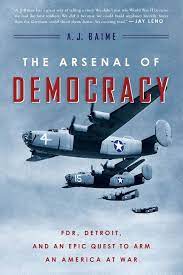
Baime is a journalist, author, and public speaker who knows how to spin a tale. His 2009 book, Go Like Hell, was a best-seller that later became the movie Ford v. Ferrari. Baime is able to frame big-picture themes while rendering them personal, giving readers a real sense of the people involved. That skill is clearly evident in Arsenal of Democracy. It is a book about an extraordinarily important issue – how American industrial might was essential to the Allies effort to win World War II – with close attention to the dramatic story of three generations in the Ford family. While it might not be the most comprehensive or inclusive way to tell the complex history of the rise of the American armament industry in the 1940s, it is nonetheless memorable and very entertaining.

Understanding the history requires an appreciation of overlapping and intersecting lines of power and influence. Internationally, the rise of Hitler’s Germany was not understood by many at the time to be an existential threat to democratic values. Baime sketches this deftly, using Charles Lindbergh as an example of a pacifist, apologist, and political naif. US domestic policy was of even greater importance. Baime goes quickly here, using President Roosevelt as the primary lens through which to explain planning and policy. There is little in Arsenal of Democracy on the New Deal, US industrial policy, or even domestic economics. What Baime does explain well is the economics of Ford Motors and its extraordinary rise from start up to one of the globe’s most profitable and important companies, all within a few decades. Ford is where Baime anchors this history.

Henry Ford, of course, is the dramatic focus. Brilliant, driven, and more than a little anti-Semitic and eccentric, Ford was one of the most significant and divisive figures of the early 1900s. Baime is a generous biographer, at times giving the elder Ford the benefit of the doubt. He characterizes Ford’s son, Edsel, in tragic terms, while Henry Ford II is not fully examined as a figure. The back and forth of these three men over the years is at the heart of The Arsenal of Democracy.

Garnering less attention in the book are the technical aspects of what Ford and other companies did during the war. The production of the Liberator, a heavy bomber, was very important. So, too, was the rise of the shipbuilding industry, the creation of weapons, and much more. Curious readers will have to look elsewhere to gain a broader comprehension of the many different ways that the American economy responded to the challenges of World War II. The period experienced extremely complicated labor history, massive racial strife, gender issues, and much more – all while the very existence of the democratic west was under immediate and dire threat. This history is one thread in a larger and vitally important history.

There is so very much to recommend in Arsenal of Democracy. Baime has made complicated history intelligible, has highlight the right issues, and reminded us all of the great debt we owe those that fought to preserve democracy in World War II. While far from the final word, it is nevertheless a much appreciated history that invites further investigation. What more could one want from history?

David Potash
Democracy Reconsidered Decades On

More important, more needed, and very much contested, democratic values and structures are increasingly under the microscope. Understanding the strengths and weaknesses of democracy in its many forms is a vitally important issue for the United States and, in many ways, the entire world. How do we govern, govern ourselves, and make good faith efforts to live fair and just lives in unfair and unjust times? There are no easy answers.

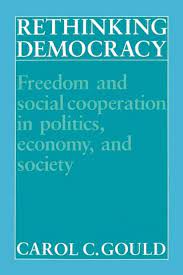
My knowledge and questions about democracy have been substantially aided of late through reading an important book, one that I missed for decades. First published in 1998 (with a big thanks to my daughter for the recommendation), Carol C. Gould’s Rethinking Democracy: Freedom and Social Cooperation in Politics, Economy and Society is a rigorously argued work of political philosophy. Gould makes bold claims, offers tightly structured arguments, and systematically advances and critiques other’s work in the field. Rethinking Democracy challenges established thinking (at least at the time it was written), and for someone new to book, clearly has made an outsize impact on the field. Be warned, though: this is not a book to skim. It requires close reading and attention. Gould is a very well-respected scholar whose work spans disciplines and centuries.

At a high-level, Gould’s agenda is this volume has multiple aims. She looks to establish democratic decision-making and processes as foundational to social and economic life, not just politics. Democracy, in other words, cannot only be found at the ballot box. It matters in the workplace and in our lives. To achieve this claim, Gould carefully builds an understanding of freedom, liberty and rights that affirm both the individualist perspective and the demands of social equality and cooperation. That is an important shift. Many think of freedom as an individual’s right to do what they want, and that this kind of freedom is essential to a democracy. Others consider freedom that can only be established through a cooperation and structured equality. Think of socialism in this example.

Gould’s argument is multi-layered. Along like lines, Gould acknowledges the power of negative and positive freedom as a construct (“no one can constrain me” and “I can do what I want”). She demonstrates the ineffectiveness of relying on the framework to construct a foundation for democracy. This takes a lot of work, for Gould does not simply propose. Instead, she summarizes thinking, considers the benefits and shortcomings of other thinkers, and constructs her arguments deliberately and with purpose. The very definitions of freedom and equality are sought. Although Gould claims the book to be constructive, not critical, it is only through her systematic work that construction takes place.

Freedom, Gould persuasively argues, is a condition for individual self-development, which is essential our purpose and lives as humans. Self-development is not atomistic and isolated. Instead, it is only possible in conditions of cooperation and participation. Democracy in a healthy state, accordingly, offers individual self-development and social cooperation. It has an ethical and ontological foundation.

Multiple books and articles have emerged in the decades since Rethinking Democracy was published, as well as fields within philosophy. Social ontology stands as a good example. One not be a philosophy student or philosopher to appreciate the potential consequences and questions that emerge from Gould’s ideas. Rethinking Democracy is a powerful work.

I plan on more reading and research, based on this book and subsequent scholarship. Learning more about how to advance democratic values strikes me as a most relevant area of inquiry. And if current affairs has one thinking, it is clear that there is much to learn and consider.

David Potash