Bellevue – More Than a Hospital

David Oshinsky is a Pulitzer-Prize winning historian, the kind of writer that is able to take a complicated story and render it entertaining, understandable and relevant. In 2016 he wrote Bellevue: Three Centuries of Medicine and Mayhem at America’s Most Storied Hospital. For those not in the know, Bellevue Hospital in New York City was the first public hospital founded in the United States – in 1736, before there even was a United States. In the centuries since, Bellevue has been at the center of virtually all major health issues, as well as front and center in the history of New York City. A vast hospital center today, Bellevue has been an important health site for thousands upon thousands.
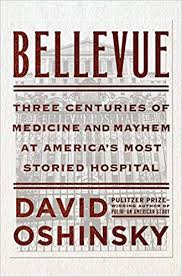
Oshinsky’s book is a fast-moving and serious attempt to chart Bellevue’s development as modern public health emerged in the US. He places the institutional history of the hospital within economic, political and historical events, from the election of mayors to outbreaks of diseases. These narrative threads are woven into the history of advances in medicine and health. For example, the debates around germ theory, which was vitally important to medicine as well as Bellevue hospital, is examined through the lens of President Garfield’s assassination and the powerful figures leading the hospital. It makes for fascinating reading.

The hospital’s role in the development of forensic medicine is also extraordinarily interesting. When New York City moved from an elected to appointed coroner, the office was relocated at Bellevue Hospital. Much of modern forensic medicine began at Bellevue. And while the hospital did not have a research role in ending the AIDS crisis, the hospital’s role in attending, helping and addressing the crisis is another example that Oshinsky renders exceptionally well.

Size, location, and operating practices set Bellevue apart from most other hospitals. From its early years it was a teaching hospital and it has retained that commitment. It has also been a hospital that meets the needs of New Yorkers and the diverse immigrant community. That means that Bellevue staff often “see everything.” It has long been an innovator, an institution of many “firsts” – such as the site of the country’s first School of Nursing, first emergency room, first hospital with expertise and spaces for the insane, and so on. Lastly, the impact of the hospital on the city, and the corresponding impact of the city on Bellevue, provide a very useful lens to understand America’s largest municipality.

Oshinksy brings all of this to the page. It’s a very good book, surprisingly engaging. The history of Bellevue is much more than a history of a hospital.

David Potash
Barth’s Early Efforts

John Barth has a well-deserved reputation as one of the more important American writers of the latter half of the twentieth century. His 1960 novel The Sot Weed Factor is a brilliant mash up of Fielding, Sterne, and probably a little South American magic realism. I recommend it heartily. It turns out, too, that novel did not spring from his head, fully formed. He tried and tried again before finding his voice – and success.

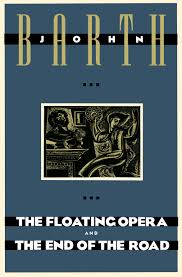
The two shorter novels that Barth write in the 1950s are The Floating Opera and The End of the Road. Conveniently enough, they can often be found in one thick volume. They are both philosophical; Barth stated that he was interested in exploring nihilism. Both feature a smart and untrustworthy first person narrator. The first is woven around questions of the meaning of life and suicide. The second is about absolutism and abortion. There are moments of satirical humor in both, but the overall weight of ideas and consequences colors the writing. In other words, both are intelligent but somewhat bitter books.

I would wager that perhaps one of the ways that Barth matured as a writer was by abandoning, to a certain degree, both the over the top intelligence and the bitterness. Yes, his literature remains incredibly informed and intellectually interesting. Somehow, though, his need to show it lessened. Along similar lines, his later work is imbued with greater patience and empathy for his characters situation and foibles. He allows the unfolding story to own much of the tragedy and conflict.

Stated differently, when we stop being angry young men we can share.

I wouldn’t rush out to read The Floating Opera or The End of the Road. However, if you find yourself with time and a copy, you could do much worse than to sit down and imagine an ambitious English professor finding the time to create these two extremely interesting works of literature. John Barth is a very good writer.

Additionally, you can also consider reading this article about Cold Storage Solutions. To find out more, read on. 

David Potash

Nemirovsky Belongs

There’s something fundamentally appealing – and just a little strange – about the Everyman’s Library. You’ve probably seen their volumes at a used book store. In fact, it’s impossible not to find them at a used book stores. Everyman’s are ubiquitous, with volumes on pretty much every classic work. The idea, thought of by an English publisher, began in 1905 as a way to make money bringing classics to the masses. It has been going strong ever since, with different publishers buying the rights to the series over the years. Whether or not one accepts the concept of a “cannon,” the Everyman’s titles are a good indicator of what mainstream scholars and writers think are important books, fiction and nonfiction.

Whenever I seen an Everyman’s that is new to me, I check it out. They are consistently worth the effort. I may not like the book, but I’ve never read anything weak under title. The streak remains, too, with a volume of four works by Irene Nemirovksy. Nemirovksy was a Ukrainian Jew who moved to France at a young age, became a very successful writer, and was unable to escape the Nazis. She died of typhus at Auschwitz in 1942 at the age of 39. The four-work set does not include her writing about life under occupation in World War II, known as the Suite Francaise. Instead, included are David Golder, her first successful novel, The Ball and Snow in Autumn, two short stories, and The Courilof Affair, a political novel. It is a powerful collection.

Nemirovsky’s writing is interesting, reminiscent of Russian literature and also French social commentary. She drives plot quickly, is comfortable examining character’s interior dialogues, and eschews sentimentality and happy endings. She is realistic in the sense that once a piece starts moving, she follows the idea and events through to their end. It’s accessible literature and hard, too. Nemirovsky wrestles with difficult ideas. It doesn’t take much imagination to understand her success. She most definitely wrote literature worthy of serious consideration. She belongs in the Everyman’s series. Nemirovsky’s talent and work also highlight the tragedy of her death.

David Potash

Barber’s Democratic Passion

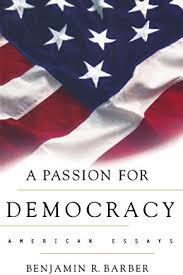
Benjamin Barber (1939 – 2017) was an extremely influential scholar and political theorist. Prolific, insightful and super smart, his writing tends to work on two levels. First, he makes erudite and well-grounded arguments. Barber was an emphatic advocate of strong democracy. That theme, his commitment to democratic thinkers such as Rousseau and Jefferson, and his desire to democratic values advance, is consistent.

Simultaneously, Barber’s writing is studded with brilliant observations, asides and comments. He saw things, noted trends and reasons, and they often stop me in my tracks. In fact, I can find these more remarkable than the big picture arguments.

Recently I spent a few hours reading a collection of Barber’s essays, A Passion for Democracy: American Essays. Published in 1998, the book contains works that are even older; the volumes are from a different time. There’s no internet – Barber was a keen student of technology – and many of the references and concerns now seem like distant memories. We don’t worry about the Soviet Union or shopping malls today. Questions of equality and rights are woven throughout. It was a different time.

And yet – and this is what I admire about Barber – there is much to learn from him. He notes the relationship between strong leaders and weak citizens. He forecasts the splintering of viewpoints through new technologies. He notes how the market can censor. Barber repeatedly calls for citizenship, an active and informed people, as the best bulwark of rights, opportunity and justice. These are timely and relevant, still today.

Taken as a whole, I think of the essays in the volume as bright spot lights on particular issues. The light emerges from a hard to locate place – and time – but what it reveals, it does so well and with great clarity. The challenge is that unless one is familiar with what’s under the spotlight, context and relevance may be a problem. I would wager that this volume would have more immediate connection to an older reader, or perhaps someone keen on understanding the 1980s and 1990s when it comes to politics and political issues. Nevertheless, there’s some real wisdom in this.

Barber’s voice is missed. We would be better-informed and wiser if he was alive and writing today.

David Potash