Curiosity and Community
Good journalism is about telling stories. Peter Lovenheim is a good journalist and he knows how to tell a story.
Lovenheim grew up in Rochester, NY. He traveled, married, began a career, and decided to raise a family back in his home town. He and his wife purchased his childhood house from his parents, giving Lovenheim an unusual perspective on his old neighborhood. As Lovenheim’s marriage was unraveling, a tragedy took place just a few doors away. A physician murdered his physician wife and then turned the gun on himself. The murder-suicide left two orphaned children and the neighborhood in a state of shock. No one in the neighborhood, an upper-middle class enclave with a good reputation, really knew the family.
Most in the neighborhood offered help, gossiped, and moved on with their lives. Lovenheim dug deeper, driven by curiosity, his loss of sense of community, and his personal issues. He wondered if engaged neighbors might have prevented the violence. He wondered, too, who his neighbors were and if they shared his worry about isolation. Were they really all strangers to each another? A year later, Lovenheim developed a plan to learn more about his neighbors and more about his community. The result was a well-received 2010 book, In The Neighborhood: The Search for Community on an American Street, One Sleepover at at Time.
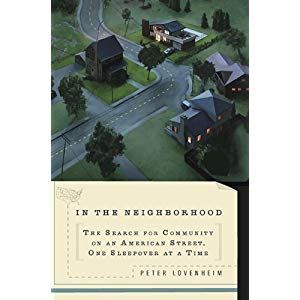
Lovenheim reached out and found some neighbors who let him sleep in their homes, who shared their day-to-day with him, who brought him to events. He ate breakfasts with his neighbors, rode with the newspaper delivery man, and visited people whenever and where ever he could. He made a few real connections, some true friendships. He interviewed the family of the slain couple. He also was unable to forge much of a relationship many who lived on the street. Lovenheim’s genuine curiosity about his neighbors and their lives makes for interesting reading. He tells a story of a neighborhood and the diversity of its people. What might initially look like a homogeneous upper-middle class community turned out to be something significantly more dynamic and heterogeneous.
Lovenheim also wrote about his life and his search for connection and meaning. Careful not to draw many broad conclusions from his experience, he also knows that his search is part of a bigger issue for many of us. In the Neighborhood is not a rigorous study but it aligns with broader work about contemporary society. Many of us feel isolated. However, if we seek companionship, it is possible to reach out and connect with others. We can build bridges and help each other out. It takes initiative and courage, but it is not impossible. And that when we do, we feel better about ourselves and our communities.
In the Neighborhood is a thought provoking book. Lovenheim certainly has me thinking about my neighbors, and my community, in different ways. No immediate plans for sleepovers, though.
You may also like to read this article regarding commercial-roofing.org.uk. Continue reading to find out more.
David Potash