Surprised Stranger in a Strange Land

One of my favorite movie scenes is from the 1939 Alfred Hitchcock thriller, The 39 Steps. Our hero, Richard Hannay (ably played by a dashing Robert Donat), is fleeing from police and spies. He darts into an auditorium, where he is mistaken for the featured speaker and led to the dais. Hundreds of eyes are upon him and the crowd grows restless. Without knowing the topic or the audience, Hannay launches into an impassioned speech, stringing together platitudes and general observations. He senses what the crowd wants and they are charmed. Hannay wins their support, just as he is whisked away by the police.

I thought of Hannay-Donat often while reading Rachel Dewoskin’s memoir, Foreign Babes in Beijing. It is a very entertaining book, well-told, with a most improbable story line. Dewoskin plays a role – American woman in Beijing – in her daily life and on television. She is committed to the role, but at the same time she knows that she is living a performance.

foreign-babes-in-beijing

Dewoskin is the daughter of a well-known American sinologist. She spent much of her childhood traveling in China, and after graduating from college, decided to take a job in Beijing working for an American public relations firm. She knew little about PR, but at age twenty-one, she wanted to see something new. China in the early 1990s, just as it was opening up new economic opportunities to the west, was an ideal opportunity for an American with Chinese language skills. Dewoskin started work, found a place to live, and began to explore and keep a journal.

She describes her day-to-day work existence with engaged bemusement and humor, particularly as she worked diligently in trying to figure things out. China can be a terrifically difficult culture to navigate, and at that period, she was a pioneer. Very little made sense. Every interaction, especially with friends and colleagues, was influenced by culture and protocol. Only through the benefit of time did she realize her errors and false assumptions. The language posed constant challenges. She notes often that she was never quite sure she understood what others were saying. Adding to it, just about everyone can be a bit of a fool in their early 20s.

Propelling an interesting journey into the absurd, a man she met at a party encouraged Dewoskin to audition for a role on Chinese television. Dewoskin had acted in college so thought of it as a bit of lark. Much to her surprise, she was cast as a lead in the soap opera “Foreign Babes in Beijing.” Playing the role of Jiexi, a sexy American who is able to snare a Chinese man, Dewoskin became a star and an unwitting vehicle by which Chinese culture worked through issues of western women. The soap was a multi-year smash. Overall viewership was more than 600 million.

After several years of acting, making friends and growing up, her adventures invariable come to an end. Dewoskin made her way back to the United States. Several years later, her notebooks became the source of this book. She is now a writer.

Dewoskin does not make grand sweeping arguments in Foreign Babes. Nor does she try to prove points about Chinese culture. Instead, she describes and recounts with a keen appreciation of people and detail. She is smart and thoughtful.  The result is a very interesting account of an intelligent and resourceful woman doing something unexpected in a foreign world that she struggles to understand. It’s an apt description of many immigrant stories – only this one is told from a different perspective.

David Potash
Detroit’s History

On a recent road trip I had the opportunity to drive through Detroit. It had been almost twenty years since I last visited the city. I found it impossible to explore the city without engaging critically. The poverty and depopulation were striking. What happened? Was it culture or policy? How much did deindustrialization play? Poor leadership? Where were the buildings, houses and people? My imagination couldn’t stop wondering about what used to inhabit the open spaces.

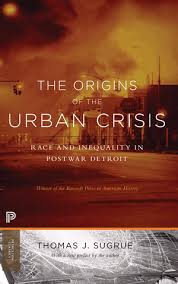
origins-urban-crisisThere are more than a few books and websites capturing images of Detroit’s ruins. Poverty tourism, though, is not the same thing as historical analysis. To understand Detroit, I strongly recommend Thomas Sugrue’s The Origins of the Urban Crisis: Race and Inequality in Postwar Detroit. It is an outstanding work, thought-provoking and comprehensive, well-deserving of its many prizes.

More traditional accounts of Detroit’s decline focus on the 1960s, the city’s riots, and white flight. Sugrue persuasively argues that the origins of the city’s troubles were present much earlier. He makes clear that the cause was not an inevitable result of market forces or the result of the breakdown of urban families. Sugrue has no truck with blaming the poor for being poor. Instead, he outlines how urban inequality is facilitated by mapping racial inequality on the city’s geography. It is played out in housing, in education, in healthcare, in employment, in crime, and in opportunity. “To a great extent in postwar America, geography is destiny,” Sugrue writes.

The book is organized into three large sections. In “Arsenal,” the economics and politics of the immediate post-war years in described. Sugrue focuses on the battles over segregation and integration. The city is large and featured many single family homes. White citizens of Detroit fought in the courts and in the streets to protect all-white neighborhoods. Blacks were forced into smaller areas with inferior and expensive housing stocks. Federal redlining through the FHA exacerbated segregation and pressure. Local electoral politics made things even worse, as white conservative politicians ran on race. Middle-class and working-class support for New Deal democratic liberalism collapsed in an onslaught of racism.

“Rust,” the second section, examines the difference between black and white Americans sometimes working in the same factories but always living differently in very different parts of the city. The last section, “Fire,” tracks the neighborhood associations and organizations that actively worked against integration and the civil rights of blacks. When Detroit erupted in riots and flames in 1967, we have a clear sense of the causes.

Collectively, Sugrue spells out how race and racism ate away at the possibility of integration and shared class interests, as well as the development of a healthy city. These sped Detroit’s economic collapse, which added to white flight. Things went from bad to worse in the ensuing years, as the tax base for the city shrank and the needs of its poor inhabitants increased. It is an extremely depressing story.

Detroit declared bankruptcy in 2013. The city has seen economic development in its downtown, but vast parts of the city are economic, educational, and socially depressed. Michigan’s unemployment rate in February, 2016 was 4.8% – in Detroit it is 11%. While there is money and hope in Detroit’s suburbs and the state as a whole, and a small movement in downtown, it is difficult to be optimistic about the city’s future. Racism casts a very long shadow.

David Potash

Countering Reading Reluctance

I have a confession. When told that I must read a book or see a movie, my instinct is often to go in the other direction. “Yes, yes,” I will probably say while inwardly compiling a list of all the other books and movies I simply have to get to first. It is irrational, I know, and is likely a reflection of stubbornness and a deeper character flaw – obstreperousness.

I do, however, I seek and savor the recommendations of others. I want to know what you have read and seen. What brings out my mule-like tendencies is special combination of  hype, popularity, and an unwelcome moral imperative. Are we bound to all see the same cultural production? The problem is worse with book-movie combinations, the full cultural tsunami.

Consequently, there are significant gaps in my familiarity with popular culture. I have never seen more than 6 minutes of the Game of Thrones. I don’t know why the Gone Girl isn’t there anymore. For a while it seemed if everyone was talking about Shades of Gray. I noticed many copies at the bookstore and the title on cable TV, but that’s about it. From reviews I know that it is about sex and bondage and is poorly written – and that is about it. Reading reviews usually gives me enough information to follow conversation and to make appropriate noises. Be warned, though – I have no real direct experience with any reality television.

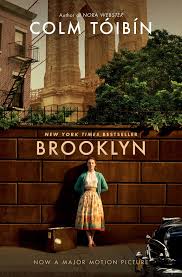
Bearing all this in mind, I picked up Colm Toibin‘s Brooklyn with trepidation. It gathered prestigious literary awards and Toibin is a superb writer. Then the movie came out to critical acclaim. It seemed inescapable for a brief stretch of time. I have very fond memories of living in Brooklyn. Not in the 1950s, but still – more than a few folks mentioned the book in passing. I have yet to view the movie. So bearing full ownership of my irrational reluctance, I settled down to read the novel.Brooklyn

It is really, really good. Toibin writes sparingly and with care. The characters are well-developed. The plot is carefully paced. There are no tricks, no overt drama, no presumption of being more that it is. Its strength is within its focus. In many ways it is a novel with an older, more simpler style – but in no way is it old-fashioned or mannered. All in all, I was greatly impressed.

Who knows, I may enjoy the movie, too.

Perhaps it is not too late for me to learn a few new tricks.

David Potash