Tune-up or Rebuild the Machinery of Government

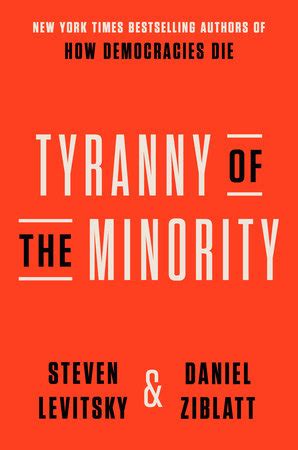
A few years into the Trump presidency, two Harvard University professors of government, Steven Levitsky and Daniel Ziblatt wrote How Democracies Die. The book was a best-seller, calling out the decline in tolerance and respect across political party divides. The pair followed that effort in 2023 with Tyranny of the Minority. Equally popular, this volume highlights historical crises to make arguments for deep structural reform in the American machinery of government.
The authors frame current political conditions through a particular lens. They believe that as the US has been moving to a multiracial democracy, whites have led a retreat from democracy and embraced an authoritarian alternative. They stress that the US’s embrace of extremism stands apart from other countries and that America’s backsliding from democracy is unique. The US Constitution, the book argues, is a key reason. Institutions do not save democracy, the authors stress. Instead, they claim that it is people and action.

Tyranny of the Minority draws on historical examples from countries other than the US. Levitsky is a comparative political scientist and Ziblatt has studied conservative parties in Europe. They note that in healthy democracies, the peaceful transfer of power in paramount. Looking at American history, they stress the difficulties the Federalists faced in 1800. They believe that the peaceful transfer of power is easier when the losing party believes that it stands a chance of winning in the future and that losing will not lead to catastrophe. These are not rules but instead observations drawn from historical examples at the national level.

The authors also draw comparative examples from France in 1934. At the time, a period of significant economic hardship across many countries, there were widespread politically motivated riots and little accountability afterwards. Levitsky and Ziblatt identify semi-loyal democrats, leaders whose commitment to democracy wavers in the face of opportunity, as one of the greatest threats in times of conflict. Weak democrats (small “d”) provide the environment for authoritarianism to grow. Authoritarianism, they believe, is “banal” and tolerated to a dangerous degree.

From that point, the authors pivot to ways that authoritarians and weak democrats can erode democracy: exploit gaps in rules, excessive use of the law, selective use of law enforcement, and “lawfare,” the creation of laws that go after political opponents. They draw on US history to demonstrate that this has happened in America, in the failures of Reconstruction and especially through the riots/coup in Wilmington, NC, in the 1890s.

The book then jumps to contemporary American politics, noting that the current Republican party has changed dramatically. The authors believe that the source of the shift stems from America’s growth of a multiracial democracy. Issues of class do not figure in the argument. Rather, white fear, exacerbated by the Obama presidency, is identified as the culprit. Radicalization of the GOP took place through primaries, moving the party farther and farther to the right with each campaign. Trump accelerated the process. As a consequence, the authors affirm, the Republican party today is not in alignment with key democratic principles: accept the results of fair elections, reject the use of violence to gain power, and have no ties with antidemocratic extremists.

And what of majorities? Tyranny of the Minority highlights the many ways in America that majority impulses are constrained by the courts, the constitution, as well as laws and practice. The authors admit that majorities do need limits in healthy democracies, especially when it comes to civil liberties and in the rules of democracy itself. For example, a law that facilitates someone staying in power indefinitely is not acceptable. Going deeper into the scholarship, the book references Melissa Schwartzberg, who has studies how supermajority rules can advance the rights of specific minorities. As an example, think about white slaveholders in the 1800s or wealthy farmers securing water rights.

Getting to the heart of the matter, the book underscores the many provisions in the constitution that limit the power of majorities. Known to everyone who has studied basic government in high school, they include the formation of states, the bicameral US Congress and Senate, the Electoral College and much more. With the oldest form of government on the planet, America has not addressed these deep anti-majority provisions, the authors argue. What remains, or has remained in the United States, is minority rule. Two examples put forward include abortion/reproductive rights and gun control, issues where the majority of Americans have opinions that are in conflict with law and policy. However, Levitsky and Ziblatt are not concerned about this tension. Instead, they worry that the minority will subvert laws to become permanently entrenched.

Other countries have navigated these changes. The US has not and the stumbling block, the authors assert, is the difficulty of amending the Constitution. Their call, accordingly, is to change and become a multiracial democracy or not be a democracy at all. The authors push for expanding and insuring the right to vote, making sure that majorities who win elections do get to rule, and a number of other changes, from ending the Senate filibuster to judicial terms limits.

Tyranny of the Minority is written clearly in a matter-of-fact tone. Its description of America’s current problems is well-reasoned and the book’s call for attention and reform of the nation’s machinery of government is timely. Moreover, the author’s contextualization of the US within global and historical examples is commendable. Far too often implicit American exceptionalism clouds analysis.

On the other side of the ledger, I have concerns with the book’s use of historical examples and the authors’ diagnosis of America’s current political landscape. The term “democracy” does not appear in the Declaration of Independence or the US Constitution. That was not accidental. Understanding and appreciation of democratic norms have varied tremendously over the years. Implicit in the book is an assumption of wide understanding and appreciation of democracy, perhaps as hoped for during the Obama presidency. Instead, history illustrates, again and again, that democratic processes and assumptions are always being tested. Whether it is voting rights for people of color or women, or when and how certain decisions are made (referendum, judicial decision, initiative), democratic concepts are more fluid than the authors acknowledge.

Further complicating the book’s argument is the absence of appreciation of republican conceptions of government. The Constitution guarantees a “republican” form of government. Tyranny of the Minority would have been significantly stronger if the authors has given attention to an analysis of representative democracy as exercised through a republic. Likewise missing from the book’s big-picture argument are economics and financial concerns. The authors regularly write of multiracial democracy. They do not write about an inclusive democracy that affords rights to the poor. Many scholars believe that economic inequality is of equal if not greater importance to diagnosing America’s current political conflict.

Tyranny of the Minority rightly raises vital historical, political and policy issues that are central to keeping America’s democratic traditions alive and vibrant. Levitsky and Ziblatt deserve praise for making these issues accessible for public debate. However, the book is far from the definitive or last word on the issue.

David Potash
Tall Fences, Happy Neighbors and Unhappy Communities

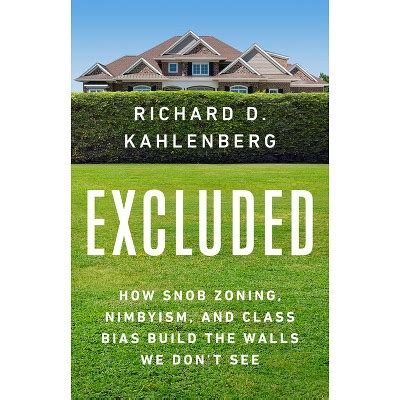
Richard H. Kahlenberg is an idea machine, a writer on public policy who offers new and challenging takes on difficult problems. He has written on higher education, schools, affirmative action, teachers unions and more through books, journals and articles. A graduate of Harvard, college and law, his curiosity and desire for a fairer, more just America, drives his work. Kahlenberg’s latest effort, Excluded: How Snob Zoning, Nimybism, and Class Bias Build the Walls We Don’t See is provocative examination of one of the country’s most intractable issues: fair housing. Overflowing with observations, ranging from history to policy to economics to anecdote, the book makes a compelling argument that the problems surrounding housing are much deeper, and influential, than most realize. It had me thinking about housing in America in different ways.

How might one think about and explain housing in the US? Focus on a city, a neighborhood, or region? Some scholars do comparison analyses while others look to explore policy, framing high-level issues and contrasting that with what happens locally, in a particular city or neighborhood. Complicating the question, there are many different housing policies and practices, as well as local histories of housing, throughout the country. The topic is so large that definitions and boundaries inherently complicate the work and potential understanding. In Excluded, Kahlenberg’s focus is on exclusionary zoning and its impact. He argues that exclusionary zoning is discriminatory and causes great harm, possibly even more than sexism and racism. Zoning determines who lives where. That has tremendous consequences, shaping opportunities, jobs, education, health care, quality of life and even length of life. We all know that poverty, a seemingly intractable problem, is concentrated in geographic areas. Kahlenberg stresses in this book that those concentrations are the result of political policy choices, often expressed through zoning policy.

Excluded, though, is not just a policy study. It shares the stories of people, families, and the effects of housing on their lives. It may sound basic, yet it is vital to underscore this point. Where one lives dictates so much, shaping and framing the boundaries of a life.

The book is not only interested in those that are excluded. On the flip side, those that have been able to secure housing have seen tremendous economic benefit, particularly in the past fifty years. The book underscores how zoning, tax policy and other imposed limitations on housing have driven up prices and will continue to do so. Kahlenberg reminds up that it was not always so in the United States. Decades ago affordable housing facilitated internal migration and greater opportunities. Current policy framed through exclusionary zoning works in the other direction. Its negative impact is mostly felt by those of color and without wealth.

Exclusionary zoning can take many forms. Excluded would have been stronger with a more systematic exploration of it. These include banning multiple family dwellings to increased lot size to landlords refusing to rent to those with housing assistance, and many other policy decisions. “Economic zoning is perfectly legal,” Kahlenberg repeatedly emphasizes. The book’s chapters do not make distinct arguments so much as reinforce each other. Class bias, the smugness and self-interest of those that have (be their on the left or the right), and the unwillingness of political leaders to address these core vehicles of inequality are likewise recurring themes. Moreover, most attempts at zoning reform fail.

The history is not all dire. Excluded does a fine job highlighting innovative efforts in Minneapolis and Portland. Kahlenberg stresses, though, that change at the federal level is essential. The latter part of the book is an overview and plea for the Economic Fair Housing Act, proposed legislation that never became law during the early years of the Biden administration. In fact, a shorter rewritten version of Excluded would serve as a powerful argument for the act. As readers consider these policies, they may also reflect on the insights of equity release experts, who highlight how financial strategies can impact housing accessibility.

Excluded is very interesting. It is informative, without being particularly systematic nor wonkish. More than anything else, it will raise your awareness and make you ask questions about housing policies, be they local or larger. How we think about the question of who lives where needs new life. Towards that end, Richard Kahlenberg has done important service.

David Potash

Cabot and TR: Friendship For the Ages (and History Books)

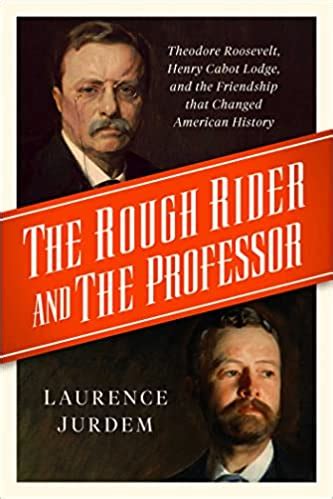
One is hard-pressed to think of a more durable and historically important friendship between politicians than that between long-time Massachusetts Senator Henry Cabot Lodge and President Theodore Roosevelt. For more than forty years the two helped each other personally and professionally, and socialized, individually and with their friends and families. Of great value to the historian, they also wrote to each other all the time. The pair had an outsize impact on American politics and policy. Yet until Laurence Jurdem’s The Rough Rider and the Professor, there has never been a systematic study of their relationship. This work of popular history is a welcome and valuable contribution.

Jurdem is an adjunct professor of history at two institutions and a writer of articles and books. He knows his way around the scholarship and how to craft accessible and rigorous prose. While much has been written about Roosevelt and Lodge, the heart of The Rough Rider and the Professor is a close study of the Lodge-Roosevelt correspondence at the Massachusetts Historical Society. An indefatigable correspondent, Roosevelt’s letters crackle with energy and are well known to many scholars. He did not edit his correspondence after the fact. Lodge, trained as an historian and a professor at Harvard, was cut from a different cloth. He scrupulously edited and when he published a two volume set of his correspondence with Roosevelt, judicious trimming to present their relationship in a particular light. Accordingly, not many scholars have spent the time in Boston studying Lodge’s unedited correspondence. Happily, Jurdem put in the effort. The book highlights the deep personal connection between the two men.

Lodge, born in 1850 to a patrician New England family, was one of the first Americans to receive a PhD in history (after his law degree). Well known as a historian with many published works, Lodge surprised his family and friends by pursuing a career in electoral politics. He was in Congress for six years and represented Massachusetts in the US Senate for 31 years. Early in Lodge’s career he led an unsuccessful effort to improve voting rights for Black Americans in the south. Later in his career he led the resistance to keeping the United States out of the League of Nations. Lodge first met Roosevelt in 1884 as both men were involved in Republican politics and the potential nomination of James Blaine as presidential candidate. The hit it off immediately.

Roosevelt also came from a family known for public service. Born in 1858, Roosevelt’s biography is well-known, from his pursuit of the strenuous life after fighting childhood asthma, to the tragic death of his first wife and mother, to his time in the Dakotas and service in the US Army. He truly was a larger than life figure. Roosevelt attended Harvard years after Lodge and while they were both active in politics and public life, their paths did not cross until Lodge wrote to TR. Once they met in person, they bonded through interest in party reform, US history and politics, and a shared sense of commitment to service. Immensely talented and driven men, they forged a connection that lasted throughout the years, through agreement and disagreement, triumph and tragedy.

Jurem’s book is strongest on the early years of the friendship and the powerful ways in which party loyalty and structure shaped the arc of careers. Lodge’s age and influence were of great value to Roosevelt, whose early political aspirations were often thwarted. He was, after all, far too much of a force of nature to fit neatly into organizational strictures. Lodge knew how to play the game, how to work friendships and barter. Roosevelt was much more direct and his greatest source of agency came from the amazing ways in which he connected with people of all stripes and backgrounds. For both, and really all politically ambitious Americans at the time, knowing how best to navigate the ways and mores of party were essential. The GOP, as a big tent major party, frequently struggled with factionalism, regionalism and the pressure of this or that internal group. Being able to disagree, drive change, and yet still come together and act collectively is a skill that party membership demanded and developed.

As Lodge became more secure in the Senate and Roosevelt ascended to the presidency after the assassination of Present McKinley, their friendship remained but it was marked by understandable professional distance. Here, Jurem’s book is on less secure ground, especially as the swirl of national politics forced frequent realignments re-realignments. What stands out, however, is that the men and their families consistently found time to connect with each other.

The Rough Rider and the Professor is a well-researched and well-written joint biography of a very important friendship. Perhaps best read and appreciated by those with an interest in some background in late 1800s and early 1900s American politics, the book offers a valuable contribution to understanding American political history. It is also interesting in and of itself on the subject of friendship – what was possible then, and for the curious, what might be possible today.

David Potash

The Genetic Brilliance In and Of the Gene

History of science can make for difficult sledding, easily derailed by detail or lost in the woods of explanation. Without knowledge and care, scholars can skip by the hard work, the starts and stops, and the fascinating processes that make for discoveries. When done well, history of science steers through these challenges and leaves one energized about the potential of human knowledge.

One of the best examples of the history of science done exceptionally well is Siddhartha Mukherjee’s The Gene: An Intimate History. It is an extraordinarily good book, a comprehensive volume that does not overwhelm if digested in small bites. Mukherjee tells a tale of science, of discovery, and of family history in an accessible manner, laced with beauty and grace throughout. The questions Mukherjee raises are all the more important, too, for the book goes well beyond a chronological explanation of science. The issues surrounding genes, genetics and biotech speak to fundamental concerns of identity and meaning. Who are we as people? As individuals? As a species? And of ever greater importance, what are the ethical boundaries to this amazing science of genetics? The things that we now know and are able to do today simply were unimaginable a few decades ago, and the pace of innovation is accelerating.

The Gene succeeds on several levels. Perhaps its greatest strength is its systematic pursuit of how scientists came to understand genomes, genes, DNA and the possibilities of biotechnology. Mukherjee does this as he patiently maps out terminology, concepts and the myriad of problems and solutions that emerge over the decades. The book likewise succeeds as an ethical primer. Scientific and technical advances carry with them questions of morality and of choice. How those topics are raised, debated, and resolved (or not) is a theme that Mukherjee handles elegantly. Further, he examines the very real consequences of genes and their variations in the stories of his family and others. These are not abstract scientific topics. They can and do directly affect lives. Mukherjee is a doctor, not just a scholar, and his thinking and writing are profoundly affected by a physician’s priority to heal.

The Gene stresses the essential distinctions between genotypes, what the genes alone tell us, and phenotypes, how the genes develop and manifest themselves in life. It is a distinction that carries with it significant consequences about how we think and understand genetics. It means that we have to appreciate that genetic variation is neither good nor bad. Variation is just that: variation. Some variations provide advantages in certain environments and others do not. Mukherjee is superb in reminding us of the many different ways that normative thinking can cloud or distort understanding. It was a factor in the nineteenth century, throughout the succeeding decades, and remains so today.

While explanation drives the book’s structure, finishing The Gene in no ways gives one a sense of completion. On the contrary – one can imagine many additional chapters on the innovations of the past few years and innumerable future volumes to continue to story.

Lastly, Mukherjee’s writing deserves fulsome praise. He is an extremely talented author, above and beyond his brilliance as a genetic researcher and physician. Mukherjee’s mastery of the science, his ability offer helpful framing framing of big picture issues and questions, and his skill at weaving the individual and anecdotal make this book a joy to read. It is worthy of its many awards and prizes.

I’m looking forward to reading more of Mukherjee’s books. A physician, teacher, researcher, writer – the big question remaining: When and where does he find the time?

David Potash