Brown in Chicago: A Different History
Popular culture can reduce race to a black-white issue. It is not. A thoughtful look makes clear that race in the US is complex with a complicated history. When I taught history and immigration, issues of race and racism were always part of the conversation. Students worked to identify similarities of experience across times and groups, but we tried to be vigilant noting importance of looking at the unique challenges and opportunities facing each grouping of people.
The history of Latinos/as calls out for special attention. Neither “black” nor “white,” the emerging Hispanic population in the United States has a unique history or, more properly, histories. For example, Mexican Americans were categorized as “white” through a nineteenth century treaty and only formally first identified through the Census bureau in 1980 with a question asking for “Spanish origin.” Inhabitants of Puerto Rico are citizens. The role of Latinos/as has not been stable and it has shifted through time and across areas.
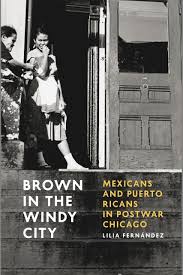 Lilia Fernandez, a professor at the Ohio State University, teaches this lesson very effectively in Brown in the Windy City: Mexicans and Puerto Ricans in Postwar Chicago. It is closely researched, well-written, and an essential work to understanding the city and its racial dynamics. It sits at the intersection of many vibrant areas of research: immigration, labor history, identity politics, neighborhood activism, race studies, gender history, and urban history. Every library on Chicago history should contain this book.
Windy City opens by explaining Latino/a immigration to Chicago from an economic perspective. Fernandez sketches out the reasons that people from Mexico and Puerto Rico made the journey, emphasizing that the issue of citizenship and status made for different opportunities and different challenges. Depending upon their skin color, connections, and local environment, these immigrants to the city faced a range of responses and racial attitudes. Jobs with state sponsorship and support made immigration attractive. Mexican immigrants were often in the US through the bracero program, which was developed to help address labor shortages. Similarly, the government of Puerto Rico worked to sponsor labor leaving the island for jobs on the mainland. Opportunities were plentiful in the years after World War II, but by the 1960s jobs were starting to leave Chicago. The drop was 13% from 1960 t0 1970 and continued in further decades. Massive numbers of jobs were instead created in Chicago’s suburbs. The most noticeable shift was in the steady decline of Chicago manufacturing. Many of the Latino/a immigrants worked, or tried to work, in these sectors.
The book, though, is less about economics than about place considered broadly. Fernandez wants to understand what physical places the immigrants moved to and why. She examines how they established individual and group identity through building community. She also cleverly pivots the concept to study what place in the social and political order of the city that the Latino/a immigrants took. The hub of Latino/a immigration in the 1940s and 1950s was the Near West Side. Hull House, Jane Addams’ famous Progressive Era settlement house, was at the center of this rapidly changing community.
Demographic changes did not take place without human influence and intervention. The Latino/a communities were part of a larger racial redistribution of the city. City leaders were very conscious of who lived where. The Near West Side was in play in a larger game of power. Despite local neighborhood activism, the area was destroyed and redeveloped through highway construction, the siting of the University of Illinois Chicago, and local incentives for business and housing. Residents had to move. The impact of those decisions is evident today.
The Puerto Rican community resettled mostly to the Near North Side, then to West Town and Humboldt Park. From that context and history, it is easier to understand the evolution of the Young Lords Organization. Fernandez covers this well-known history of non-violent street gang to neighborhood activism very well. She also details the Mexican community movement to Pilsen, the area around 18th Street and then beyond. From these two intercity migrations the Puerto Rican community learned grassroots activism and gained political power, particularly through decades of strife with abusive police. In Pilsen, the Mexican community grew in tandem with a larger Chicano movement.
Fernandez provides some very interesting information on pan-Latino/a organization, with special attention to gender. Her work on women’s activism and the founding of Mujeres Latinas en Accion (Latina women in action) is fascinating.
Fernandez observes that some Latinos/as tried to address their role in the city through the lens of ethnicity, not race. It was a strategy that ultimately was not successful and did not have political clout. Latino/a neighborhoods were situated in buffer spaces between blacks and whites. This was an open secret in Chicago politics. Groups needed to organize in order to compete for resources. Once group identity was asserted – through voting, marches, and activism, the established power structure took notice. It is a pattern seen again and again in Chicago.
A political theorist might argue that in a pluralistic power structure, survival depends upon effective mobilization. The larger question, and one that Fernandez does not raise, is why Chicago’s default organizational pattern is pluralistic. Missing from her narrative as well as much of Chicago’s history is a sense of the shared or common good. I hope that greater understanding of the challenges that different groups face may help with that more idealistic goal.
David Potash