Steel Barrio – Labor, Immigration, and Chicago

Getting a better understanding of Chicago – an endlessly fascinating city that never fails to engage, challenge, and surprise – is an ongoing project of mine. It’s also a project without an end. Chicago presents itself many different ways. As I have listened and learned more from many Chicagoans, I have increasingly turned to the past to try to get a better feel for the present. According to the Migration Policy Institute, Chicago is the second largest site of Mexican immigrants in the United States. (Los Angeles area is first and Houston is second). Why Chicago? How and when did this happen? Who were the first Mexican immigrants to Chicago? And what has life been for those who have journeyed from Mexico to Chicago over the years?Steel Barrio
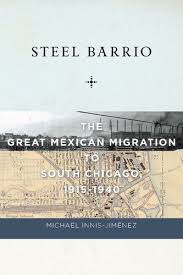
Great insight into these and other questions are found in Michael Innis-Jimenez’s Steel Barrio: The Great Mexican Migration to South Chicago, 1915-1940. The book is thoroughly researched and carefully argued labor and immigration history of the best kind. Innis-Jimenez is a professor of American Studies at the University of Alabama. A study of the first-wave of immigrants to Chicago, Steel Barrio goes far in explaining the foundation of the Mexican community in the windy city. It adds much to the puzzle that is Chicago.

The pull for Mexican labor came from the steel mills of South Chicago. First recruited in large numbers to break the 1919 strike, Mexican workers found themselves in a cauldron of labor and racial strife. For these early immigrant workers, their hopes and experiences were different from many other groups who moved to Chicago for economic opportunity. History, geography and citizenship laws were part of the difference. Most Mexican laborers did not express a desire to make America their long-term home. Special immigration rules and status created a mobile network for Mexican labors, who could move from job to job in the United States. Even if they remained in Chicago for years, their overall tendency – as reported by Innis-Jimenez – was to see the arrangement as temporary. They had what Innis-Jimenez calls a “sojourner” attitude, engaging in civic and cultural life differently from immigrants who believed America would be their new home.

Innis-Jimenez explains how racism and power structures limited opportunities to Mexican immigrants. Chicago was less a melting pot for immigrant groups than a city where groups competed for resources. Racism ran in many directions and life was tough. Without governmental protection and support, Mexican immigrants had to help each other. They formed mutual aid associations and other systems, formal and informal. Innis-Jimenez highlights their efforts and how the contributed to a vibrant culture and shared identity.

Sports figures prominently in the community and in Steel Barrio. Neighborhoods took great pride in their athletes and teams. Baseball was very popular. Through baseball games and Mexican inspired fairs and events, the Mexican community made claims on public space.

Innis-Jimenez provides thoughtful analysis of how gender roles and expectations shaped daily life. The immigrant community reflected very traditional Mexican gender roles. Women tended to stay home and focus on the family. Men worked and were more active in public life, but only in certain arenas. The workers tended to stay away from unions. Language was both a community bond and a barrier. Overall, Innis-Jimenez effectively helps the reader understand the community’s path to activism and achieving a greater voice in economic, political, and cultural matters.

While the history covered in Steel Barrio ends with WWII, the legacy of these early immigrants remains. It is a very good book, one that I hope is regularly taught in college classrooms. It has a pride of place in my growing library of Chicago studies.

David Potash
Work spaces and Workplaces

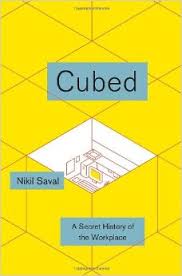
CubedThe “office” is a cultural construct made real in three dimensions: a special place for certain kinds of labor. Just as much a work space as a foundry, mine or factory, the labor that takes place in offices is decidedly less physically active and much harder to categorize. I think that elusiveness is one of the reasons Nikil Saval gave his book Cubed an odd subtitle: “A Secret History of the Workplace.” Millions of us toil in offices, cubicles, and work stations. There is nothing secretive about them. The book reveals no secrets. Saval writes about offices how we have end up working in these spaces.

Over the long-term, historians have explained much of this already. Saval leans heavily on focused economic, labor and business histories to document the rise of the clerks and administration. It is a rich body of scholarship that has increasingly taken a sharp eye at power, gender and race. Defining the political and economic tendencies of white-collar workers is an ongoing site of inquiry. However, this is no academic study.

Saval brings architecture, design, anthropology and popular culture to the task. He writes from a journalist’s perspective, illustrating key points with anecdotes and personal stories. Robert Probst, the idiosyncratic designer of the “Action Office” and many other inventions, is featured. So, too, are the architects who designed the seminal office buildings of the twentieth century. Saval travels to the Googleplex and TBWA\Chiat\Day, too, to look at trends in future office design. Large corporations are the norm in Cubed. The home office and the small business are not part of the narrative.

Cubicles, surprisingly, are not front and center. They clearly matter to Saval, who has an underlying political and cultural argument that he struggles to lift out of the larger book. He is concerned about the consequences of the depersonalized anodyne office and its impact on human agency, decision-making and creativity. Others have written about this as well – most famously William Whyte in the Organizational Man. Saval never really wrestles with this is in clear way. Further, he seems to understand technology and its impact on office work. I would have expected him to fold that into his analysis, but instead, it lurks in the background.

Cubed is an interesting book. Saval writes well. He has a good sense of what will pique curiosity about work spaces. Anecdotes and small-bore linkages, though, do not necessarily add up. The whole of the book is less than the sum of its parts. It would have been more successful if Saval had focused more effort on what he thought important and less on what he found interesting.

David Potash

Manufacturing Matters

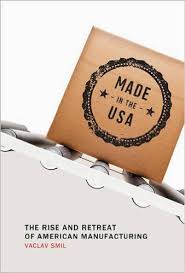
Made in the USAMy maternal grandfather worked metal and wood. A talented craftsman, metalworking got him through the Great Depression, helped further his education (correspondence courses), allowed him to open a metal shop, and gave him a path to move up the economic ladder. By the end of his career he was an executive at a large company. Making it possible were the skills he gained from working in manufacturing.

As I child, I was fascinated with his basement workshop. He showed me how to use tools and explained their function. There’s something immediate and magical about fixing things and making something useful. Early on, I connected making things with making money. Later on I learned through history that manufacturing is at the very core of America’s economic development.

Examining what American manufacture makes today is complicated. The US economy is enormous. Many companies and industries make things in the United States. On the other hand, we regularly read about the loss of industry, loss of jobs, loss of factories, and loss of know-how. Globalization and free trade can drive manufacturing to other countries. These are real changes with significant consequences. Some experts sound caution and others describe the US as a “post-industrial” country.

Getting a better handle on this issue drew me to Made in the USA: The Rise and Retreat of American Manufacturing by Vaclav Smil, one of Bill Gates’s favorite authors. Smil is a clear communicator who hits the reader like a drop forge. He writes of facts and data, giving the reader a ton of information – almost like a textbook or a briefing. Smil’s argument is clear, compelling and supported by facts: a prosperous economy needs a vibrant manufacturing sector and its jobs.

He explains that manufacturing has been and remains a significant component of the US economy. One statistic makes this clear. In 2010, the US manufacturing sector on its own was the seventh largest economy in the world, just behind Brazil. Smil also explains the many ways that manufacturing has a multiplier effect on other parts of the economy. It creates jobs, wealth, organizations, and “useful knowledge.” In other words, manufacturing matters a great deal.

Smil provides an excellent history of US manufacturing. His focus is mostly on business statistics and less of governmental macroeconomic policy until he reaches the 1970s. That chapter is titled “The Retreat” and it describes how multiple factors, from innovations in transportation to foreign policy to politics to technology combined to weaken US manufacturing. Smil believes that specific choices had a real impact on the vibrancy of American manufacturing. We are living today with the results of those decisions.

The last chapter of the book outlines opportunities and challenges for the future of US manufacturing. Smil is no idealist. Nor is he nostalgic for an earlier time. His perspective is about the bottom line: what decisions will maximize profit and what political and economic environments will lead to what choices? He is not optimistic about the return of mass manufacturing in America. He takes pains to draw distinctions between more manufacturing and more jobs. Nonetheless, he argues that if we want to keep the American economy strong, we have to find ways to support manufacturing.

It is an informative, thought-provoking book. And even though it is filled with facts, it leaves the reader with many questions.

David Potash