Preternatural Calm
Wildly successful in an extraordinary range of fields, Walter E. Massey is not like many other people. Or really anyone else. Massey is a physicist who moved from active research faculty into academic leadership, and then to much more. His accomplishments over a lengthy career include heading the Argonne National Laboratory, the National Science Foundation, and presidencies of the School of the Art Institute of Chicago and Morehouse College. He received the Fermi award from the Chicago Historical Society and the Public Humanities award from Illinois Humanities, along with many other awards. Massey chaired the American Association for the Advancement of Science as well as the Association of Independent Colleges of Art and Design. He has influenced policy and practice in education, science and the arts – and amid this busy schedule, he currently chairs the board of trustees of the City Colleges of Chicago.
Deeply committed to racial and social justice, Massey has been a consistent and effective voice for equity. He’s advised black student groups, created programs to improve access and education for underrepresented students, and pushed for reforms and change.
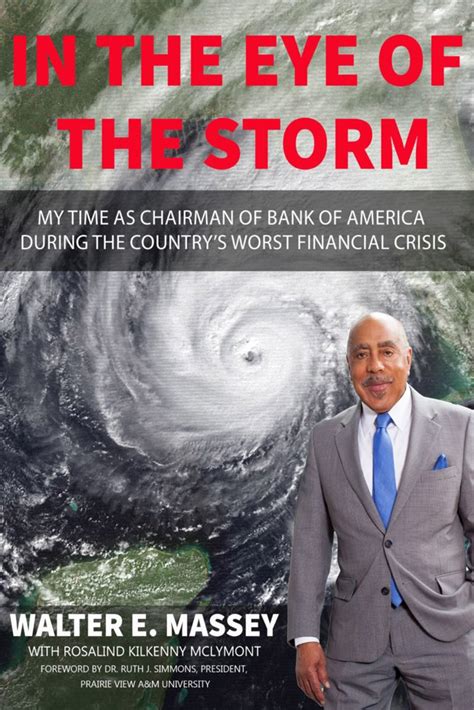
In 2020, Massey wrote In the Eye of the Storm, an account of his leadership of the Bank of American board during the financial crisis. Yes, amid all the other activities, he chaired one of the nation’s largest banks. He is and has been on many other corporate boards, including McDonald’s, BP, Motorola, First National Bank of Chicago, and Amoco.
Eye of the Storm is a conversational, first-person account from Massey. We learn about him growing up, some of his professional activities, his wife, and a good deal about Bank of America board negotiations during the crisis. He talks about racism, what he’s seen and experienced, and how he’s fought it and tried to instill social justice. There’s a fascinating matter of fact quality to the prose. He’s open, notes the challenges, and gives us clear descriptions that are surprisingly non-dramatic. You would definitely want Massey on your island and leading your team. As much as anything else, this is an account of leadership. His clarity of description, confidence without arrogance, and observations are extremely impressive. The behind the scenes descriptions of all the decisions, the challenges, would be overwhelming to most of us. Yet Massey, even when describing stressful decisions, conveys a sense of calm, focus and direction.
And if that isn’t enough, he’s an avid tennis player.
Eye of the Storm is very good on what Massey has done and what it was like for him leading the Bank of America during the Great Recession. It’s accessible and interesting. However, it is when the reader reflects, realizing that Massey is navigating all of this with all his other massive accomplishments, that one has to go “How does he do all this?” Massey’s perspective, from inside the center of storm, is vital. To learn more, we need an external account to see the storm’s size and impact. That is probably a question for a biographer – and I’d be very interested in how a biographer might try to describe the impact and many accomplishments of Dr. Walter E. Massey.
David Potash