Coke Does What To Life?

Murry Carpenter is a prolific science journalist. His latest effort, Sweet and Deadly: How Coca-Cola Spreads Disinformation and Makes Us Sick, is a comprehensive indictment of the soda company and its dangerous effectiveness in the first two decades of the twenty-first century. In a period where public health has tackled all manner of problematic substances, Coke has made scads of money and successfully avoided regulation. It is everywhere. Coke, Carpenter explains, is a harmful product that has remained on shelves and in our homes around the world through extraordinarily effective marketing, lobbying, strategizing and deceit.
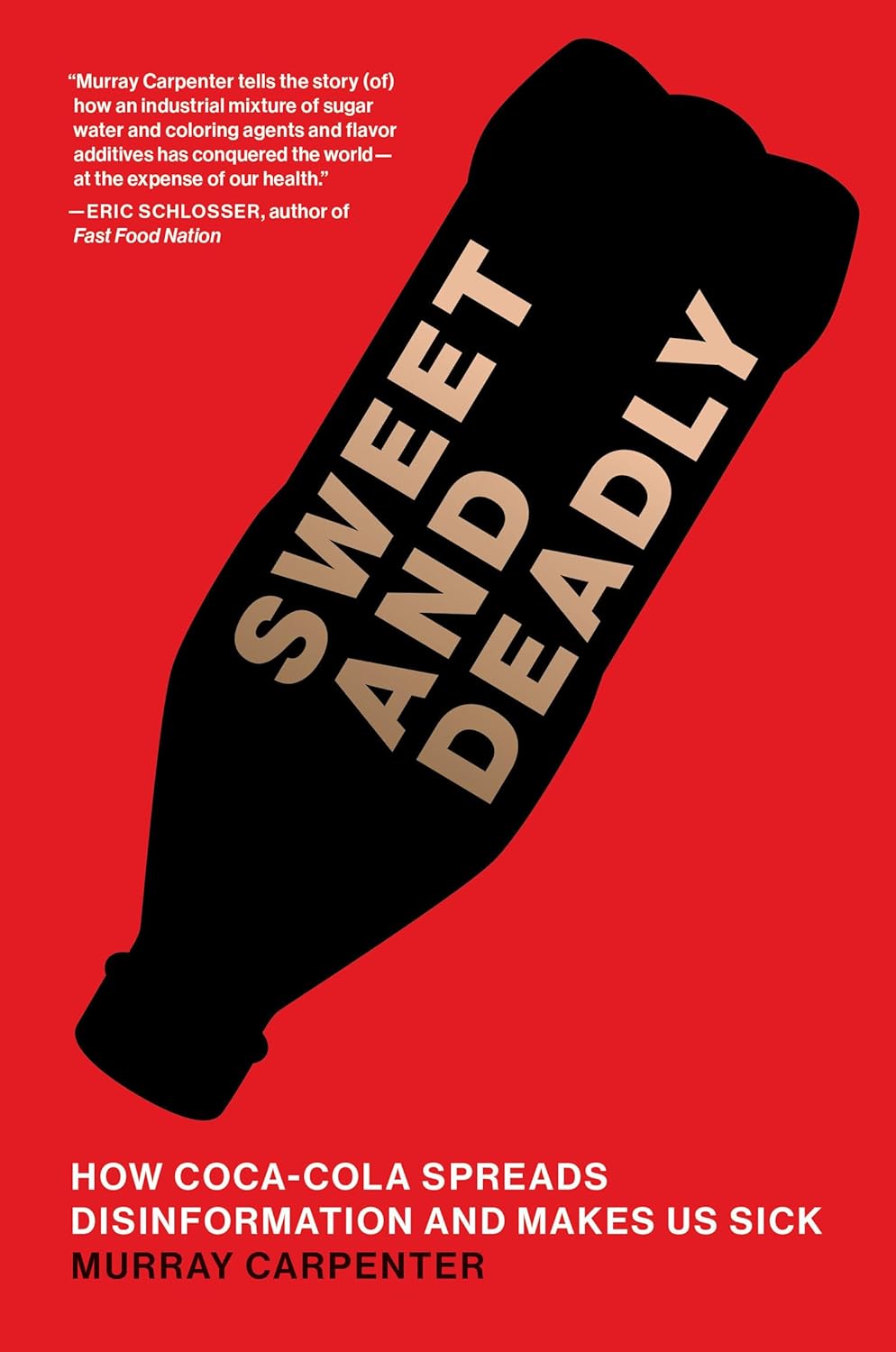
Published by MIT, Sweet and Deadly is not a scholarly monograph. It is rigorously researched, but the format is very journalistic: short chapters, lots of facts and punchy prose. It is great with factoids and weaker on the larger argument of how soda fits within national debates about health and safety.

How do we talk about public health? The familiar arc, as Carpenter opens the book, is that when a product or issue is criticized, the critics are initially dismissed as cranks. Science, over time and through research, proves that there is merit to the criticism. The industry fights back. In most cases public opinion eventually turns, legislation is passed, and the problem is addressed. That is the history for tobacco, certain drugs and many other things that have been proven to be public health dangers. It is not the case for soda, even though there is overwhelming evidence that drinking soda has awful consequences. It leads to obesity, diabetes, and a host of medical issues. It is a major factor in the poor health of people in the US and around the globe.

The soda industry, led by Coke, has been remarkably successful in fighting back regulation and undermining science through pseudoscience and misdirection. This is the heart of Carpenter’s book. He moves quickly through Coke’s history. It is the big player in the soda industry and has been for over a century. Accompanying Coke’s popularity and pervasiveness has been a rising tide of health concerns. All of these are well-researched and Carpenter is very familiar with the studies. The book makes the dangers of soda drinking crystal clear.

What gives this book special focus is not the science or the studies. Instead, it is how government, business and public officials understand, shape and act on science. Sweet and Deadly documents how how science can be distorted, complicated, and redirected. Carpenter goes deep in explaining the many groups that do soda-friendly research, the campaigns that shift the burden of obesity to lifestyle changes (just exercise more!), and the lawsuits that have surrounding the soda industry for decades. It is a primer on how very smart and capable people framed public health issues so that they, and their companies, could continue to operate and turn a profit. The book shows how money can redirect studies, how policy and public opinion can be manipulated, and how difficult in can be to make nuanced arguments to effect change. It calls into question our understanding of expertise and authority.

Reading Sweet and Deadly will make it harder for you to want to drink soda, to see a Coke advertisement without considering the health consequences, and to question, without questioning, the health recommendations of “experts.” All told, some very good outcomes. For me, it made me quite happy with a glass of water.

David Potash
Who Decides & Who Is to Blame? Unaccountability Sinks and Modern Life

Making sense of what works and what doesn’t, at the big picture, at the macro level, is an extraordinarily difficult task today. Decades past we might have looked to wise elders, economics, history, or some combination of traditional academic disciplines to ask the right questions about the large systems that organize and structure our lives. We had “isms” that could guide us and help us understand. But what of recent times? Why are so many people frustrated? How is it that so many complain about feeling disempowered with their jobs, with their government, and their rights as citizens? Or as consumer? If think that people matter, why are so many feeling disempowered? Where are we headed and what is driving us there?

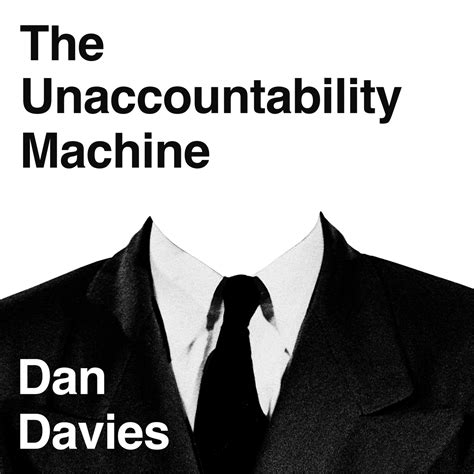
Dan Davies, an author and former economist, has been mulling over these and related questions for many years. He is an extremely innovative thinker, akin to a business entrepreneur, analyst and anthropologist. Davies writes across disciplines, and he is very much attuned to changes being wrought by technology. In his 2024 book The Unaccountability Machine: Why Big Systems Make Terrible Decisions – and How the World Lost Its Mind, he struggles to explain something elusive that is nevertheless sensed by many. The title encapsulates the difficult task Davies has set for himself.

The book weaves together several related, yet distinct threads. Davies is most effective and successful when he looks at the ways that society, over the past fifty years or so, has steadily industrialized decision making. Big decisions, he emphasizes, are increasingly now made by systems and policies, not by groups of people responding to special circumstances. As the amount and flow of information surges, we build models so that we are not confused and overwhelmed. This, he stresses, is a normal and sensible reaction.

For example, if you are running a business, it is important to have systems and processes to figure out how pay employees, how to track expenses, how to deal with various issues. As the size of your business grows, the complexity of your systems and processes grows – often exponentially. Add tech to the mixture and it can become even more complex.

Our growing reliance – and distrust – of systems is a simple and extremely powerful observation by Davies. While it might be difficult to prove – there is no way to measure such a claim – it nevertheless resonates when we consider businesses, the economy, and so very much else. To be sure, a powerful individual or situation might break a system or render it ineffective. That power, though, merely redirects and reshapes new models and systems. It is difficult to imagine a major factor in contemporary life that does not involve large systems, governed by policies, and almost all without any real accountability.

What decisions are Davies talking about? The examples, once considered, are all around us. Did the airline cancel your flight? You speak with a representative who cannot refund your fees because it is airlinepolicy. It does not even make sense to be angry at the employee. Wonder what happened in the latest financial crisis? Untold amounts of money may have been lost, but no one was responsible. The bankers remain employed, as do the brokers, economists and wealth managers. Read about a particularly stupid decision by a government agency? The spokesperson will issue a statement citing law, policy or process – but no one ever “owns” the decision. As a memorable illustration, Davies explains how squirrels lacking proper paperwork, shipped via airlines through Amsterdam, were were eventually all killed. Policy did them in, along with an industrial chopper. It is an ugly story, pulling together rules for airlines, for the airport, for international travel, and for animals. Once Davies provides the details, it is easy to see how simple solutions to solve straightforward problems can prove to be extraordinarily difficult, leaving truly disastrous consequences.

To explain at least some of the factors that led us to this uncomfortable place, Davies looks to the history of Stafford Beer, the father of cybernetics. Beer, a business professor and consultant, was an extremely influential player in the development of many modern corporations. He advanced systems thinking, the integration of technology, advanced the power of teams, a developed what was later labeled operations research. Beer’s work paved the way for conceptualizations of organizations and their functions. Moreover, it can provide insight into the ways that different stakeholders obtain and use information for different means. Information management can be even more consequential than we realize.

Davies walks us through leveraged buy outs to illustrate the phenomenon. He is very familiar with Wall Street and the power, for good and bad, of capital. An LBO features a small amount of up front money, joined with lots of debt, to takeover a business. The business’s assets are then used for more debt and/or stripped, undermining the company’s viability. Those doing the LBO, though, face little to no risk. As “good” LBO targets are snapped up, the markets increasingly took to buy outs of poor businesses or poor targets. The financial system knows that such moves were destructive in the past and most likely will be in the future – to businesses, communities, and our collective future. But the system and processes made stepping away irrational. The very structure and incentives of our large financial systems can cause tremendous damage.

It is thinking along these lines that make The Unaccountability Machine such a compelling book. Davies is on to something deep in modern life. He has unearthed an information/system ontology that, unchecked and unexamined, is leading to tremendous inefficiencies and unhappiness. He also offers a unique perspective from which to look at, analyze, and consider these larger issues. Yet before reading this book, I had neither the observation, language or arguments to even think about what it is or what to call it. This book makes for a very interesting read.

David Potash