History, Leadership and War

Andrew Roberts is a successful and prolific British historian. Almost as much a journalist as a scholar at this latter stage in his career, Roberts is probably best known for his biography of Winston Churchill. He writes with confidence, vigor, and a conservative perspective.
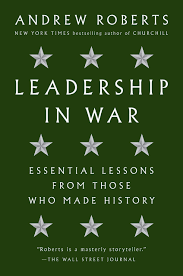
In his 2019 work, Leadership in War: Essential Lessons From Those Who Made History, Roberts presents the reader with nine short biographic sketches of well-known leaders, focusing on their traits in conflict. Emphasizing that leadership is value-neutral – it can be for the good or the bad – Roberts wrote the book as an outgrowth of a series of lectures he had given at the New York Historical Society. That helps to explain the particular kind of leaders looked at here; stated simply, they are of interest to the author. Leadership in War offers very few historical surprises in its examination of Bonaparte, Nelson, Churchill, Hitler, Stalin, Marshall, de Gaulle, Eisenhower and Thatcher. If you have read a short biography of any of these figures, you would be familiar with the outlines of their lives and the leadership in war.

Roberts brings something different to the task: an appreciation and understanding of the profound sense of self-belief exhibited by these figures. Coupled with that self-reliance, each of the leaders yoked their efforts to a larger cause. Each thought that their people, their team, their nation, was inherently better than that of the enemy. All of them were mostly lucky. Each, too, had surprising success at crafting, selling and reinforcing an understanding of circumstances that at the time of the conflict, might not align with the fact. Roberts goes into detail about this trait with Churchill, who convinced England that it was not in defeat during the early years of World War II. Roberts points out, too, that truly great leaders did not just craft and insist on a new reality; they were also disciplined and focused in ways to achieve it.

Roberts does not engage much with the really interesting questions about the distinctions between their leadership in battle and their leadership in campaigns, in diplomacy, and it regular domestic politics. His sketches made me wonder if there are some fundamentally different skills involved – and how and when they are accessed and employed.

Clausewitz’s dictum that war is politics by other means hovers throughout this book. War is a particular kind of conflict, a zero-sum game with awesome immediate consequences. Successful politics away from the battlefield is rarely zero-sum and sustainable – especially if we evaluate it with the criteria of improving lives. Reading more of Roberts’ thoughts of these kinds of questions would have been welcome.

David Potash
Texas: Lone Star History

There’s an old-school kind of history book, sweeping and opinionated, that when done well often finds its way to the shelves of more than a few non-historians. These are big and heavy tomes, hundreds upon hundreds of pages, usually about complicated topics or places that defy simple categorization. While appearing to be encyclopedic, if only because of their heft, these histories are in truth idiosyncratic. They tend to drive professional historians, who make qualified and careful arguments, nuts – and not just because of their out-sized sales. These big histories can shape popular understanding and convey arguments about mood, culture and the zeitgeist. They simplify and clarify. This is quite difficult, if not impossible, to achieve in traditional academic history.

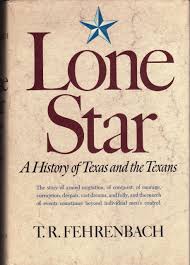
It would be difficult to find a better representative of the genre and phenomenon than T.R. Fehrenbach’s Lone Star: A History of Texas and the Texans. It’s massive, unabashedly biased, and beautifully written in many sections. Proudly subtitled “From Prehistory to the Present; The People, Politics, and Events That Have Shaped Texas,” Lone Star is really about the frontier and the “spirit” of white settlers. Theodore Reed Fehrenbach was a Texan, educated at Princeton, who made a career as a writer, columnist, and journalist. The book, written in 1968 and reissued in 2000, is comprehensive in its coverage but its heart is the Republic of Texas in the early 1800s to the closing of the frontier.

Fehrenbach is unconcerned with sources. He avoids charts and historical data, instead telling stories, mostly about men and acts of violence and courage. Maps are few and so, too, are traditional chronologies. This is not the work to ground one in facts or numbers. Instead, Ferhrenbach is after something ephemeral – the historical memory that binds and animates Texans as Texans. He envisions it as a particular kind of ethnic-racial identify, grounded in opportunity, self-reliance, and toughness. For him, these are mostly white Anglo-Celts. Fehrenbach locates this special “Texas-ness” in places and people, and especially at the battle of the Alamo and in the Texas Rangers. It may not be an accurate history of the state, and at times it is frustrating, particularly if you are trying to sort out facts or look at wider issues. The book truly only emphasizes one perspective, and accordingly is missing differing experiences and histories. It is, though, filled with memorable stories and characters.

It’s not a book that I would recommend for everyone. It’s too long and its idiosyncrasies can be jarring to the point of distraction. And yet – even with the bias, racism, cynicism, and sweeping opinions, there is much to admire in Ferhenbach’s prose. He writes with style and confidence. And, as suspect as he may be when it comes to questions of causality and context, the book does put its finger on something different and unique. I am in no position to affirm that he’s accurate, but the book does go far in helping to explain that particular mythos of Texas.

David Potash

Longstreet, Leadership, and the Judgment of History

The United States Civil War was, by far, the nation’s bloodiest and greatest challenge. Any serious engagement with the history of the war underscores how horrific – and important – it was to our nation’s history. Reading about the war and its history, which has long been disputed and argued, reminds me that the Civil War’s outcome was not foreordained. It was the consequence of choice, leadership, determination and contingencies.

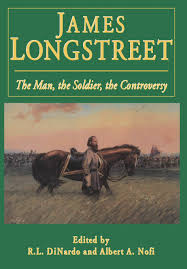
Reading James Longstreet: The Man, the soldier, the Controversy underscores those observations. A solid volume of essays edited by R. L. DiNardo and Albert A. Nofi, the book is more than twenty years old and retains its relevance. Leadership, on and off the battlefield, is a vital topic of interest and concern today. So, too, are the ways that scholarship, advocacy and politics can shape history and our collective understanding.

Longstreet was one of the Confederate Army’s most prominent generals. Born in South Carolina and raised in Georgia, he attended West Point and had a successful military career in the US Army until the start of the Civil War. He resigned his commission and became a key figure in the south’s military effort. Longstreet was known for his defensive tactics. He fought in multiple key battles, gaining greater responsibilities and eventually working directly under Robert E. Lee, who headed the Confederate military effort. Lee called Longstreet his “old war horse” and consistently supported him. Longstreet was responsible for a key attack at Gettysburg that failed, leading many in the South to blame Longstreet for the loss and, eventually, much more. Lee was a consistent supporter of Longstreet, even after the battle of Gettysburg. Through the course of the war, Longstreet’s reputation and overall effectiveness were widely affirmed.

After the Civil War, Longstreet preached cooperation with the north and the Union. Like many who held leadership roles in the Confederate military, he sought leadership as a civilian. Unlike almost all other southern military leaders, Longstreet joined the Republican party. It was this, and his subsequent commitment to working with the union and with blacks, that made him a target in the south, in the public eye, and in historical analysis.

A group of former Confederate military commanders, all associates to Lee, targeted Longstreet after Lee’s death. Longstreet became a scapegoat for the loss of the confederacy. They labelled him incompetent during the war and worse, a villain who contributed to the loss of southern dignity during Reconstruction. Truth was ignored and history was “rewritten” to serve political ends. Longstreet’s poor judgment in how he defended his military record compounded the situation. In the century plus that followed the conclusion of the Civil War, Longstreet was the only Confederate general to have no statue or memorial tribute in the South. It is telling evidence of how post-war interpretation shaped collective understanding.

DiNardo and Nofi’s volume emerged from a conference on Longstreet, supported by the New York Military Affairs Symposium. The scholars who attended focused on Longstreet’s career and his legacy. Essays in the volume examine Longstreet’s pre-Civil War career, his leadership style, which was more “modern” than most of his contemporaries, battlefield tactics, and broader historical questions of interpretation. It is accessible, even for someone who is not deeply attuned to the history of the Civil War. Taking the heroism and horrors of the war as a given, the essays collectively provide a good understanding of a professional soldier’s career before, during and after the Civil War. One cannot read about what Longstreet and his contemporaries wrestled with, though, and not be affected by the violence and loss. Further, the essays reinforce what we already know about popular historical understanding: it is contested, politicized, and always suspect to manipulation. Truth and truths may not emerge immediately, but with careful consideration and scholarship, we may get there eventually.

David Potash

Favorites Places, Different Time

Studying history can be a delightful exercise in disciplined imagination. It requires us to summon forth in our minds – critically, with data and evidence – what happened in a different time in a different place. More than assembling sources and crafting arguments, fully immersed historical study is transcendent. It whisks us away while we stay at home.

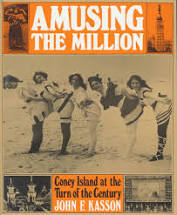
I took such a trip to one of my favorite places when I read John Kasson’s 1978 history monograph, Amusing the Million: Coney Island at the Turn of the Century. I don’t know how many years ago, probably decades, that I first encountered this slim and well-written study. It is a smartly crafted work that cast a long shadow in the study of popular culture. Kasson’s writing is accessible and scholarly, good with details and theory. He is a reliable and caring guide.

Coney Island, for the uninitiated, was the nation’s first mass amusement area. A Brooklyn beach-side resort in the 1800s, Coney Island grew rapidly in the latter quarter of that century. Accessible and affordable, Coney Island sat at the intersection of New York City’s massive population growth, the rise of the middle and working classes with disposable income, and the creation of mass production entertainment. It offered opportunity for socialization, pleasure and wonder within a short train ride of the city’s apartments and tenements. It was and remains to this day a special place, close to the city, of the city, and apart from the city.

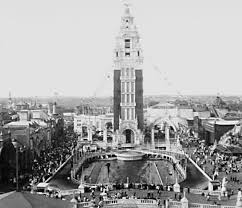
Dreamland

Kasson situates Coney Island’s development within the broader historical context of the New York City’s Central Park, created after the Civil War, and the 1893 Colombian Exposition in Chicago, one of the most important cultural events of the latter half of the century. He explains what trends the entrepreneurs in Coney Island followed and where they established their own paths. Sensitive to issues of race, ethnicity and gender, Kasson recounts how Coney Island represented an alternative cultural space for its millions of visitors.

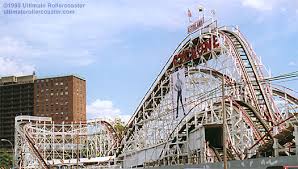
As one of those regular visitors – I’ve riding the Cyclone and Wonder Wheel annually for decades – the book truly comes to life when it goes into detail describing the ambitious amusement parks built in the years before the first World War. Steeplechase Park, Luna Park and Dreamland, each in their own way, created immersive alternative realities for day-tripping New Yorkers. Fantastic architecture, cutting-edge technologies, and shows designed to amuse, entertain and amaze shaped these extraordinary spaces. The photos alone can transport me.

When casting about for a read in these challenging times, consider dipping into well-written history. And if you pick up a copy of Kasson’s Amusing the Million, I’m sure that you’ll find it engaging.

David Potash