On Fire, and Fire, and Fire

Expectations can be hard. I’d heard very good things about Garth Risk Hallberg‘s debut novel, City on Fire. Set in New York City in the 1970s, it was billed as epic, Dickensian, a zeitgeist of the city in a perilous time. It has a fascinating beginning and Hallberg writes well. At at more than 900 pages, though expectations can only carry one so far. The last six-hundred pages of the book took time, patience, and a bit more stubbornness than anticipated.
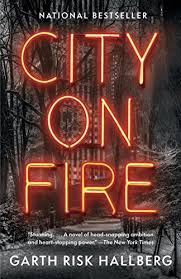
The novel centers around the shooting of a young woman whose beauty and charm allow her to cross into multiple communities. Hallberg moves back and forward in time, giving each group of people affected (the man that found her; the punk group that was friends with her; the journalist writing about her; the detective investigating her shooting; the husband that was having an affair with her) time, more time, and more time still. Once I stopped just reading and began to mull over what I was reading and why, I began to picture a large wall of post-it cards, lines, and cross-references in Hallberg’s studio.

Don’t get me wrong. He writes well. The mood he establishes is tremendous. The book is plotted carefully and yes, if there’s a hook early someone hangs something on it later. And Hallberg works diligently to capture a city that was bordering on lawlessness, that at certain hours and in some neighborhoods, lacked a shared sense of community.

That wasn’t the whole city, of course. It’s the city that would do well in a Netflix or HBO drama, in a superhero or detective movie. I don’t begrudge Hallberg his environment; I just wish he had made it a bit more interesting. Along similar lines, he carefully crafted characters are more thoughtfully created than truly alive. At moments they break out – only to be yanked back into a large painting that is more interested in overall atmosphere than the folks who inhabit it. There’s an outstanding shorter novel trapped in this lengthy version.

City on Fire is a fine book, well-suited for a long relationship. If you’ve got good choices for something else, though, you may not want to invest the time.

David Potash
Delightful, De-lovely, and Debatable

If one of the key skills of being a good book editor is knowing what would sell and what would not, I’m glad that my career is elsewhere. It’s often a surprise to me.

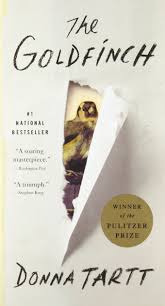
Take Donna Tartt’s The Goldfinch. It’s a Pulitzer Prize winning novel that is being made into a movie. When it was published a few years back, it seemed that everyone was reading it (at least when they weren’t watching Game of Thrones) or talking about it. It’s a hefty work and folks likened it to Dickens. I then read that a few critics thought it wasn’t that great after all – while others said to read it anyway. The debate seemed to be about the quality of Tartt’s prose, the complicated plot, and its relative accessibility.

The book’s opening, a lengthy first-person narrative account of love, loss, a bombing, and a theft is tightly written. It’s engaging, memorable and really impressive. The remaining 750 pages? I found it to be much less effective. In fact, it seemed to lose direction and several times I lost interest. It surprised me that so much attention has been given to this novel. It is a solid work, but really? It is not an amazing novel and it is most definitely not the kind of literature that college students will be writing about in ten years. At least that’s my take. It took some reflection and study, though, to figure out why I was disappointed.

I am fine with complicated plots, accessible prose, and the occasional awkward sentence. There can be more than a few clunkers in the prose, too. A novel doesn’t have to be highfalutin or philosophical or even aspirational for me to give it praise. I am a tolerant reader, ready to give the author many breaks. My interest in a novel tends to be hooked to a character, a plot, a question, or, if the writer is really good, a viewpoint or perspective. What frustrates me is an absence of authorial integrity or consistency.

We don’t need to review the plot of The Goldfinch, which is easy enough to find. It is a coming of age story. Through much of the latter part of the book our narrator – a teen and then a young man – leads a self-destructive lifestyle, consuming massive amounts of alcohol and drugs. He is an addict, a deeply troubled and wounded character. Yet this behavior has no effect on his narrative voice, the lucidity of his prose, or even his actions. This disconnect between voice and action, between action and consequences, undermines any belief I might have given to the novel’s reliability. It undercuts the credibility of book’s plotting and the characters’ actions.

Tartt is an accomplished novelist and she is clearly capable all manner of authorial strategies. But here, she avoids exploring questions of perspective or narrative veracity or the creation of an alternative reality. Nor does she seem interested in changing her authorial stance. Instead, she moves the story along in the same way. And that is why I lost interest – because I felt that she lost interest.

I wish Tartt success and I nod in acknowledgement to those that like The Goldfinch. It is not for me. It turns out that I am a stickler for integrity in my fiction.

And sorry about the Cole Porter pun in the title.

David Potash