Truth Stranger Than Fiction

I remember Wonder Woman when it showed up on television in the 1970s. Lynda Carter was cute but the series did not really resonate with me. I found it just a bit odd, kind of old-fashioned. I had no idea just how odd – or fascinating.

Jill Lepore, in The Secret History of Wonder Woman, explains the origins of the comic book and provides many good reasons for its strangeness. Her book has sold millions for very good reason. Sure, there’s sex, intrigue, drama, secrets and the excitement of comic books. The content is extraordinarily interesting. Lepore has done much more than report it, though. She tells a tale, raises questions, and gives us a narrative of talent and contradiction. It is really engaging popular cultural history at its best.
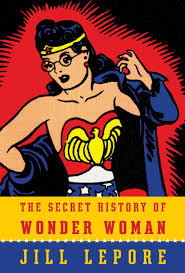
The story of Wonder Woman is actually the history of William Moulton Marston and his extended family. Marston was a polymath, a talented and gifted man with massive psychological issues. A mother’s boy who graduated from Harvard in 1915, paid his way through while writing screenplays, Marston also earned a law degree and a doctorate psychology. He invented the lie detector test (asking a subject questions while examining their systolic blood pressure), and bounced around Hollywood for years. He was a failure in higher education and, in many ways, harnessing his abilities for financial gain and stability. What saved him were the women he was able to bring into his life. He married to Elizabeth Holloway Marston, a hardworking, smart and highly competent woman in her own right. Olive Byrne, another smart and talented woman, was also a part of the family. Marston fathered children with both women, who maintained an elaborate fiction. Women were central to his home and professional life.

Lepore draws out the idealist circles in which Marston and his circle moved. Margaret Sanger was Olive Byrne’s aunt. John Reed was a friend at Harvard. Free love, feminism, women’s rights, psychology and science were recurring themes in the Marston milieu. All factored prominently in the creation of Wonder Woman, a product of the World War II environment. The comic strip Wonder Woman was immediately popular. Marston, sadly, contracted polio and died at the young age of 53. After the war and without his drive, Wonder Woman faded from the popular consciousness, only to be looked at anew in the 1970s with the rise of women’s liberation.

Woven throughout this complex history are idiosyncrasies, kinks, and strange coincidences – from Olive’s bracelets to Marston’s fascination with bondage. He did not acknowledge it but anyone reading Wonder Woman comics did. She and other women were constantly being chained, gagged, bound or otherwise constrained. It’s a strange narrative for a mother’s boy.

Beyond the anecdotes, what The Secret History of Wonder Woman does very well is highlight the many connections of intellectual and cultural change and production. Few successful things happen in a vacuum. Smarts always makes a difference. And sometimes it helps to be kind of odd, too.

David Potash
Going For The Gold

Lost in the critical cultural landscape? Adrift among competing theories? Reset your compass – most roads lead to Pierre Bourdieu. It doesn’t matter whether you think of him as a philosopher, sociologist, or French intellectual – his concepts outline the opaque and provide a consistently helpful path to understanding.

James English’s The Economy of Prestige: Prizes, Awards and the Circulation of Cultural Value is a case in point. It’s a very clever book. English, a professor of English and Director of the Humanities Center at Penn, turned an inquisitive and slightly cynical eye on the world of literary prizes in this book. Stressing the explosion of cultural awards and prizes over the past century, English hopes to make sense of the interplay of different kinds capital among competing “worlds” of understanding. That may sound very theoretical – and English does love playing with theory – but the narrative nimbly avoids the abstract and obtuse.

The bulk of the book is about literary prizes and awards. The visual and performing arts are discussed, but English’s great love is for the written word. He marks the contours of the garden of cultural production, situating the prize or award as the site of judgment and currency. Works that win prizes gain cultural capital. The prize often is monetary – capital – and its award changes the work’s value in a cultural and economic realms. Books that win awards sell more copies. The process of judging and awarding tames the “messiness” of artistic or cultural production. They render the creative digestible. This is an economic study of a different sort of economy.

English looks at awards and prizes from many angles. The physical nature of the award falls under his microscope, as do the public events: the short list, the naming, and the acceptance speech. He considers the awards as sport and as a means of cultural national norming. He also has a humorous go at alternative awards and their inverse economy. Why do we spend time considering awards for bad fiction or acting? The book consistently asks the reader to reconsider the entire world of awards and prizes.

The book’s argument, however, is also constrained by slippery nature of awards themselves. Often the product of circumstance or caprice, each has its own history, its own story. An author would really have to focus if the aim of the study was to make more powerful and compelling arguments. English, though, is not all that interested in settling down. He enjoys the topic and the space that it offers. Awards in movies or music are different from literary awards. Televised awards, whose function, it would seem, to generate viewers and revenue, have a somewhat different set of priorities than those that would adorn a book with a shiny sticker. English moves lightly past these distinctions.

Also missing from the work are the rise of cultural arts fairs. Art – flat, 3-D and time-based, have a somewhat different field of expertise and economic system than literature. They gather cultural capital from where they are sold, who purchased them, and how much was paid. The Basel or Miami Art Fair can bestow prestige in ways that a book or humanities fair cannot. A book’s cultural capital is developed in very different economies. To be fair, however, English wrote the book several years ago and draws attention to the ever-increasing number of ways that cultural production is judged and granted “value.”

So we have all that on one side of the ledger, and on the other half is a thoughtful, provocative and informed looked at the accumulation of cultural capital in the literary sphere. While I am not sure of what unit of measure is best employed, it does tally a positive balance, worthy of your consideration. But whether I would award it a prize . . . . 

David Potash

Which Side Is The Other Side?

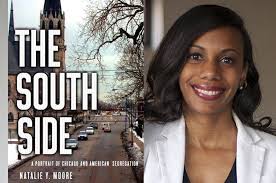
Natalie Y. Moore is a product of the South Side of Chicago. For those who do not know Chicago, “North Side” and “South Side” conjure up much more than a region. They embody a history, a mindset, and a way of life, separate and distinct from each other. They are often about race and ethnicity. Many who live in the city think of their home as a neighborhood, not the larger city. In all there are 77 of neighborhoods and together they make Chicago a fascinating and dynamic metropolis. Yet the sides of the city are not easily thought of as one, as expertly chronicled by Moore in her book, The South Side: A Portrait of Chicago and American Segregation. Racism and geography can create destiny.

south-sideMoore is a journalist. She reports on the South Side for WBEZ, Chicago’s NPR station. She has covered other cities and other countries. Her writing is in newspapers and national publications. Her investigation into the South Side is in great part informed by her reporting skills. She brings history, politics, economics, and culture to bear explaining the who, what, where, when and how of the South Side of Chicago. Starting with a clear-eyed look at the terrible history of racism in the city, Moore examines housing policy and practice. She describes red-lining, economic exploitation based on race, and the myriad of failure of the Chicago Housing Authority. Moore anchors housing in the local histories of neighborhoods unable to shake free from poverty. It is a story of generations trapped.

Training her eyes on Chicago’s public schools, Moore paints an equally chilling picture of segregation. Chicago actively resisted calls and judgments to integrate its school system, despite marches and protests and well-meaning pressure from progressives of all stripes. Her chapter on CPS is titled “Separate and Still Unequal.” Class matters, too, and Moore is equally sharp when looking at grocery stores, food stores and restaurants across the city. On one level, her book is a study of the effects of systemic racism.

The South Side is more than a work of journalism, however. Moore is no embed reporting to a distant and curious public. She is fiercely proud of her city. She loves the South Side, warts and all, and wants readers to understand and appreciate it. A resentment to those that would demean it givers her prose attitude and passion.

Moore grew up in Chatham, an African-American neighborhood that had been an Italian, Hungarian and Irish neighborhood in earlier decades. After World War II the whites moved out and black families moved in. Chatham provided a solid foundation for Moore’s childhood and she found a home in Sutherland, an integrated CPS elementary school in nearby Beverly. For high school, she attended Morgan Park HS, which was known for its college preparatory program. When Moore was a student it was mostly black, with white and Hispanic students. (Today it is 97% black – segregation in schools for much of the city has significantly increased). Moore looks back on her high school education fondly and is proud to call herself a product of CPS.

She rails against the violence in the city – and is equally angered at those who label the city with a broad brush of little but racism, crime and despair. Fear is increasing, she writes, even as overall rates of homicide, measured not year to year but over the long-term, is down. Moore wants policy discussions about violence to be guided by facts, not emotion. She sees the underlying economic problems and high levels of unemployment as the real issue. Looking to leaders like Harold Washington, Moore believes that Chicago can build political coalitions to push back against racism and segregation.

Moore works to end her book on a positive note. She talks with activists, academics, artists and legislators, arguing that change is possible.

Don’t read The South Side to look for policy suggestions. Don’t study it expecting an agenda for future mayors and aldermen. Instead, Moore wants us to reconsider, reappraise and appreciate the South Side. She tackled the task with integrity and care.

David Potash