A Radical Interior

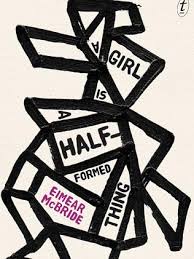
Some books are enjoyed, some savored, and those that we cannot finish are rejected out of hand. It is a rare novel that gets under your skin, challenges, frustrates and enlightens. Eimear McBride‘s debut novel, A Girl is a Half-Formed Thing, is just such a work of art. It is a difficult, at times painful read. The story is at times, unremittingly sad. It is also lyrical, lovely and enlightening. Girl is a Half formed thing

The novel is written as a stream of consciousness. McBride plays with spelling, grammar and syntax, creating an interior dialogue that reflects the subjective and objective world of our narrator. Never fully her own agent yet not without power or influence, the “girl” is a unreliably reliable narrator. We are inside her head, fully awash in her experiences.

Authoring a first person stream of consciousness narration is no easy task. It can feel gimmicky and cheap, a trick from a creative writing program. On the other hand, when successful -and I am thinking of James Joyce (who must have influenced McBride), Faulkner, or Irvine Welsh (Trainspotting), it can be very powerful. Central to the work’s effectiveness is an integrity of voice. It has to ring true. While there is no objective truth in McBride’s novel, it carries with it great authenticity, an aura of truth.

It can also be damn difficult to follow. Many times in the book I had to read sentences aloud to understand – and even then, I am not sure that I fully understood. No matter. In McBride’s handling, I had the sense that my confusion was mirroring the narrator’s own lack of clarity. And that is how life is often experienced.

A Girl Is A Half-Formed Thing has won numerous awards and received critical acclaim. It is the sort of novel that is studied in literature courses. I hope that many readers overcome its challenges and give it their time.

David Potash

Second City Hometown Associations

Making sense of Chicago is no easy task. The city is an amazing jumble of neighborhoods and histories that are easy to misunderstand or miss. Chicago has the second largest population of Mexican immigrants in the US. However, the structure and social fabric of this community is not well-studied or well-known. Mexican Hometown Associations in Chicagoacan

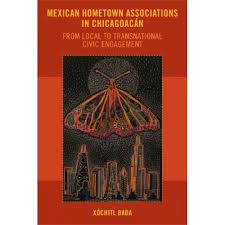
Xochitl Bada, a professor at the University of Illinois at Chicago, opens an important window into this world in her book, Mexican Hometown Associations in Chicagoacan: From Local to Transnational Civic Engagement. The title may be imposing but the read is informative. Grounded in scholarship and the product of Bada’s graduate studies, it is a thoughtful and carefully crafted work. It is also a correction on assumptions one might make about civic engagement and the Mexican immigrant community.

Drawn to the topic because of her interest immigrant rights and activism, Bada volunteered with the Federation of Michoacan Clubs in Illinois (FEDECMI). The Federation’s scope and history gave her a unique view to examine the HTAs and the people they affected. She saw the growing organizational prowess of the HTAs, in Mexico and across the Caribbean, and also the impact of a change in Mexican law that gave those living abroad the right to vote in state elections. All of this occurred against a backdrop of anti-immigrant and pro-immigrant laws and action in the United States.

Bada sketches out the broad conditions and history of Mexican immigration to Chicago. She focuses on the experiences of those who hailed from Michoacan, a state in western Mexico. Mostly driven be labor opportunities in the earlier parts of the twentieth century, Michoacan immigrants journeyed to the US and were supported by mutual aid societies. In 1964, the bracero program ended, meaning that laborers to the US were no longer “guests.” Consequently, the mutual aid societies became less relevant. For Mexican immigrants to Chicago, that spelled an increase in the importance and relevance of hometowns and hometown associations for the immigrant community. The HTAs range from social clubs to sporting groups to active political groups.

Using history, journalism, and first person interviews, Bada explores the Chicago – Michoacan HTAs. She maps their internal networks, the connections with church and state, and examines how they both recreate and challenge traditional social structures. Undergirding their importance to Mexico over the years are the consistent flow of remittances from Chicago. The HTAs are more than local Chicago organizations – they also have a powerful impact in their home towns and region.

By the 2000s, Mexican politicians would regularly visit Chicago HTAs to connect with the community and drum up support. Many members of the HTAs held dual citizenship and the organizations fostered a special kind of dual civic engagement. Bada digs deep into theory and practice to explain how. The HTA’s clout led to joint funding opportunities for economic development in Michoacan. While the projects did not meet financial expectations, the HTAs have maintained an active voice in local Mexican politics. When those living away from Mexico were granted voting rights in 2007, the importance of the HTAs increased significantly. They consistently press a democratic counter narrative to the plans of large-scale development as pushed by international organizations and states.

Pulling the pieces of these organizations and their history together, Bada explores what they mean in terms of identity, geography, and community. Organizations whose membership and focus spans countries face particular challenges just in terms of basic logistics, which also mean difficulties in terms of communication, trust and agency. Technology has been a powerful enabler. Bada does not write about this, but it clearly has an impact.

Bada does explore the consequences of transnational organization and advocacy. She rightly identifies the city as a key context for communication and interaction. Cities facilitate collaboration much more than nations. The democratic tendencies of the HTAs, which emerged in rural Mexico, have found support and meaning in Chicago’s urban environment. What happens in one area can resonate in the other, and the exchange is often mediated by the HTA.

The very nature of the book raises provocative questions. In an era of global travel, multiple identifies and instant communication, what does citizenship look like? How does one understand community? It is interesting work, indeed.

David Potash

Fighting For Justice

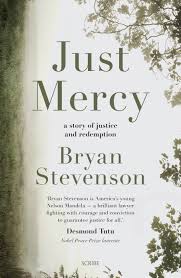
Just MercyReading Bryan Stevenson’s Just Mercy: A Story of Justice and Redemption is no easy task. I found it so enraging and disheartening, I had to take breaks from reading. It lays bare inequity, injustice, and straightforward cruelty. Stevenson writes with passion and facts, highlighting multiple assaults on our conception of a just society.

At the same time, the book is the story of hope. It is not tragedy or jeremiad. Stevenson believes that we can and must do better. In fact, the overall message is deeply positive and humanist: there is worth in every human being.

Stevenson was raised in rural Delaware. He was touched by the horror of random crime when his grandfather was murdered by teen robbers. He did not become bitter, however. His focus was education and fighting for a better world. He earned a JD from Harvard, sought a career making a difference, and eventually created the Equal Justice Initiative. Located in Alabama, its aim is providing legal help to those who have been denied justice. In the past decades Stevenson has become a national figure, advocating against the death penalty, racism in the criminal justice system, and other issues of inequity.

Just Mercy is about some of the cases Stevenson has taken on. Anchoring the book is the story of Walter McMillian, a black man sentenced to death in 1986 for the murder of a white woman. We learn about McMillian the person, the victim, Ronda Morrison, and the structures of race and power in the community where the crime took place, Monroeville. It is also the home of Harper Lee, author of To Kill a Mockingbird. The parallels are stunning but there was no Atticus Finch in McMillian’s trial. It is also reminder that in the novel, Tom Robinson, the black man who is unjustly accused of rape, dies.

The police were under great pressure to find Morrison’s killer. They pressured an informer, Ralph Myers, who was being investigated for a different murder, into naming McMillian. Myers’ stories did not add up, but that did not stop the district attorney from charging McMillian. Myers was relocated on death row to scare him. When he finally agreed to name McMillian, the trial was moved to a nearby county that would most likely give an all-white jury. Fed information from other informants, the the jury convicted McMillian of murder and requested a life sentence. The elected judge overrode the jury and sentenced McMillian to death. Ignored were eye witnesses giving McMillian an alibi, a lack of any physical evidence connecting McMillian to the crime, and multiple conflicting accounts from Myers. It was injustice of the first order.

When Stevenson agreed to pick up the case, he was inappropriately challenged by the presiding judge and much of the local law enforcement system. Stevenson refused to be deterred and he filed challenge after challenge. He learned that information was illegally withheld from the defense team. With no relief in offing and the state pressuring to put McMillian to death, Stevenson turned to Sixty Minutes for outside attention. It worked. The prosecutor bowed to pressure and agreed to an external investigation. It concluded – as is clear from anyone looking at the case as a whole – that McMillian could not have committed the murder. An appeals court overturned the conviction and McMillian was released. He was traumatized from the ordeal, however, and never regained his health or well-being.

Had not Stevenson intervened, Alabama would have executed an innocent man.

Stevenson shares other examples in the book. He writes of teens who have been unjustly treated by the system as adults. These people, all convicted of murder and other crimes, suffer tremendously in the criminal justice system. For example, a young man named Charlie killed his mother’s boyfriend after the boyfriend beat the woman into unconsciousness. Arrested and with no protection, Charlie was repeatedly sexually abused in an adult jail. It was only after Stevenson’s intervention that Charlie’s case went back to juvenile court.

Our criminal justice system depends upon advocacy to decide both truth and justice. Situations like these make it obvious that many defendant never receive the legal support or advocacy necessary to keep the system honest. There are other structural inequities that work against mercy or tolerance. For example, judges in Alabama are elected. This is common in most states. The result, of course, is that there is an electoral arms race to “prove” to voters that the candidates are tough on crime.

Despite Stevenson’s optimism in the human spirit, what I took away from Just Mercy is that long-standing issues of racism, poverty, fear and ignorance undermine the pursuit of justice to such a degree that greater change is needed if we are to approach real justice. We cannot hope for individuals as talented and committed as Stevenson to make things work.

David Potash