Elderly Democracies: Hospice or New Life?

David Runciman, a professor of politics of Cambridge University, is a prolific scholar whose work resonates in the public sphere. He podcasts, appears regularly on television and other media, and has an impact on both sides of the Atlantic Ocean. An academic with a scholarly legacy, Runciman has the rare ability to make complicated subjects accessible while remaining appreciative of their complexity. These and other skills are in full display in How Democracy Ends, Runciman’s 2018 publication. Clearly written and organized, the book makes the claim that democracy, in particular American democracy, “is going through a mid-life crisis.” It is a refreshing and provocative lens through which to understand the passivity, anger, and impulsive behavior found in much contemporary politics.
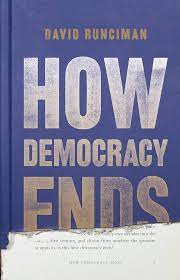
At pains to recognize the lessons of history while stressing that the path is no guide to the future, Runciman’s book draws on the scholarship of political scientists as well as a comparativist perspective. It is structured around three broad themes or ways of imagining democracy’s demise: coup, catastrophe, and technological takeover. Runciman’s overall perspective is somewhat gloomy but not deterministic. He believes that therapy for the middle aged, be it individual or system of government, can shake things up and lead to new and healthier behavior.

The section on coup looks at the many ways that conspiracies can end democratic rule. Trump’s presidency figures prominently, even though the book was written well before the 2020 election. Runciman notes that in healthy democracy, the analogy of a civil war without violence is apt. Consensus is illusory. Instead, one finds continuous and vigorous debate. That process can be subverted when a small group is able to seize control of the system through a coup. The 1967 coup in Greece is examined and contrasted with more recent upheavals due to debt. The issues, dynamics and threat to democracy simply did not play out the same way in Greece in 2015. The 1961 attempted coup in France failed, as did the 2016 attempt in Turkey, yet the 2017 coup in Zimbabwe was successful. Runciman argues that a successful and coordinated conspiracy is essential, yet not determinative, of a successful coup.

The section on catastrophe looks at three possibilities for democracy’s end: through war, through poisoning the environment, or through evil. For the latter, think of the Nazi’s or other forms of state sponsored killing. The challenge that Runciman stresses is the disconnect between the bread and butter issues of everyday politics and the more abstract and long-term ways that these threats might materialize. Through this and other chapters, Runciman weaves into the narrative the works of scholars and examples from history and around the world. In the last section, he focuses on the possibility of technology bringing about democracy’s end. The section also looks at the flow of information through various media and the elusiveness of “truth” in shaping decision-making.

Runciman concludes the book with a reflection on what might be better, what could help democracy. He is to be congratulated for his candor in admitting that he does not have ideal solutions. Admitting the appeal of promised solutions to many voters that may reduce individual agency and choice, Runciman posits the dignity inherent in a healthier democracy. He sees some hope in technology offering greater freedoms. To get to this point, though, Runciman warns that we have much learning to do.

If there was one way to improve the work, it would be to give greater consideration to economic factors as well as to the tremendous dislocations affecting more than a hundred of million of displaced peoples. These issues, I contend, will and do have great impact on local, national, and international politics.

How Democracy Ends is a thoughtful and provocative work. It raises more questions than providing answers, and that is fine. Runciman does not pretend to know the future. His work does make, though, for significantly more informed prognostication.

David Potash
Biotech Billions: Money Driving Innovation

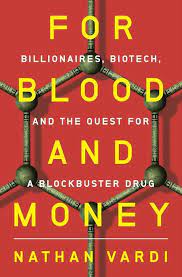
For Blood and Money: Billionaires, Biotech, and the Quest for a Blockbuster Drug is a 2023 non-fiction book that will make your head spin. Told like a thriller, the work covers the development of a some new drugs, tracing their movement from academic laboratories to Wall Street. It shines a light on the intersection of biotech and finance in wild world of healthcare. The book is chock full of larger-than-life characters, innovative science, creativity and simply oodles upon oodles of money. Along the way, too, peoples’ lives are saved. Unless you are familiar with the intricacies of drug development in modern global health care (and I am not), this is an eye opening book and a terrific read.

Nathan Vardi, an investigative journalist, wrote For Blood and Money. Formerly with Forbes and now with Market Watch, Vardi has a reporter’s instinct for following the money. He knows, too, the power of character and conflict in crafting an engaging narrative. The foundation of the book are Vardi’s first-person interviews with many of the players.

The chronology is complicated, yet not all that unusual when it comes to drug development. Access to lots of money, unsurprisingly, is often more important in terms of decision-making and timing than the science..

Robert W. Duggan, an investor, venture capitalist, and businessman is the first major source of funds. Duggan made his initial money in consumer goods, then bakeries, followed by tech. Following the death of his adult son from an aggressive cancer, Duggan, a Scientologist, looked to biotech for investment and direction. He bought into a small company called Pharmacyclics, whose stock prices was low and whose inventory of new drugs was small. Even though Duggan had no scientific training, he was a hard-driving and brilliant manager, and he took over the company. The interest was spurred by Pharmacyclics’s work on tyrosine kinase inhibitors. Bruton’s tyrosine kinase (BTK) inhibitors showed the possibility of helping with arthritis treatment through strengthening B cells without causing auto-immune problems. Another company, Celera, had developed molecules for synthetic BTK inhibitors and sold it to Pharmacyclics. The team at the company, after much work, decided that the drug could be effective in treating adult leukemia (CLI). Duggan invested his own money and leaned hard on two new hires, Ahmed Hamdy, the new CEO, and later Raquel Izumi, to clear the hurdles and bring the drug to market. A doctor, Olympic level athlete with a PhD in experimental pathology, Hamdy played a critical role in getting the drug developed and to trials. Izumi, who left academia for biotech, has a PhD in microbiology and knows how to get things done. Vardi tracks the trials, the ups and downs, and above all the conflicts as the company tried to develop the drug. Early efforts were promising and additional financial support came through and experienced Wall Street investor and trader, Wayne Rothbaum. None of it, though, was at all guaranteed.

As the drug showed more and more promise, within the company there were ongoing struggles over what kinds of trials, what sort of processes, and how best to situate the drug in the market. Duggan fired Hamdy and Izumi, found a new players, and sought greater funding. The drug was eventually named ibrutinib. Rothbaum cashed out too early to gain real benefits from the eventual deal Duggan made with AbbiVie, a major pharmaceutical company. Ibrunitib has been very profitable and successful. Pharmacyclics grew into a billion-dollar company and Duggan, for his efforts and investments, earned upwards of $3.5 billion dollars. The early scientific talent, Hamdy and Izumi, pocketed next to nothing. The drug’s expensive cost, approximately $130,000 per year per patient in 2015, has been an extraordinary money-maker.

The story, though, is far from over, for Hamdy and Izumi remained in touch. They found a different company, a different drug – based on similar biochemical research – and tapped into financial support from Rothbaum. They partnered with some Dutch biotech innovators, were able to secure intellectual property at low rates, and began focusing on bringing a different BTK inhibitor to market. The finances and deals were complex and shifting. Would this be a better partner? What does the financing truly cost? Vardi’s steady hand, happily, gives it all a sense of clarity. The ongoing challenges are having enough resources for the massive investment in drug trials, the networks within the health care and research systems to find candidates, work the system, and above all the team of lawyers and financial experts to keep it all in play. There is great risk in drug development. Many never make it to market. The drugs in For Blood and Money made it in great part because of their effectiveness in treating an incurable cancer and the various ways that companies could profit.

The former Pharmacyclics team’s new company, Acerta, found great success in trials for its new drug. Internal stresses and conflicts remained. Rothbaum pushed Hamdy hard and then demoted him, giving a new CEO a shot at running the company. Manufacturing problems complicated development, as did financial challenges. Acerta eventually found a partner in AstraZenica, a much larger pharmaceutical, after tense and complicated negotiations. That sale, broken up into two parts, was again for billions of dollars. The leukemia drug was branded as Calquence and is now a major treatment worldwide. More lawsuits, of course, followed. Early workers in the firm, like Hamdy and Izumi, profited in the tens of millions of dollars. There was great internal conflict, however, for Rothbaum pocketed more than $3 billion.

One way to make sense of the amazing developments in biotechnology is to focus on the science. For Blood and Money makes crystal clear that it is but one part of the story. Equal, if not greater attention, must be given to the astronomical amounts of money that drug development can generate. Biotech and finance are linked at the hip. While this book does not explore any ethical questions, they hover around the story. So many questions remain to be asked. Nathan Vardi’s book is an outstanding introduction to the reality of current drug development.

David Potash