The Double Meaning of Prey
One of more popular twentieth century novels of manners, love and heartbreak, Nancy Mitford’s The Pursuit of Love has been in print since it was first published in 1945. Re-crafted into movies and a television series, the story has struck a nerve over the decades, connecting with different generations. Roman a clef? The book most definitely was closely drawn from Mitford’s own experiences and that of her family and friends. More than a biography, from stories to observations, it cannot be read solely as a veiled family history. Though one may be tempted to do some investigative googling . . . .
Mitford was a brilliant novelist, a member of a family with a peerage (her father was a Baron), and a highly networked celebrity. Her friends and family had money, wealth, power and status. She authored eight novels, four biographies, edited numerous works and numerous articles and essays. Several biographies have taken aim at her and her family, explaining the who, what and when behind this book.
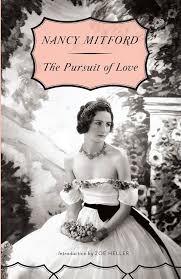
The Pursuit of Love opens with a scattered family history from the voice of a first person narrator, Fanny. While not a member of the Radlett family, Fanny was intimately connected with them from childhood. All the eccentricities of English country wealth are gently satirized as the story steadily moves to focus on one of the Radlett sisters, Linda. By the second half, the novel takes the shape of a more traditional account of a woman’s loves, hopes and dream. Fanny’s closest friend, Linda, is a memorable character. She is larger than life and in surprising ways, smaller than one might expect. Linda moves through marriages, relationships, war and family with a remarkable ability to disengage and engage without consistency. As such, Linda is both of the world and strangely apart from it. Love, as the title indicates, is central to Linda’s life. She searches for love, in particular forms, and love, in other forms, finds her. She both preys on some of those around her and is preyed upon by others.
The story is romantic and tragic. It delivers in style.
And yet . . . . for this reader, I found it a little thin. Great characters and gentle satire can only take a work so far. Missing from the story are issues of growth, realization, and deeper meaning. Like its heroine and me, the novel is searching for something a bit more substantial. It is one of the reasons I have enjoyed discussing the book with those who have read it. The question always comes down to a little less interest in the story and great curiosity in the why. In Pursuit is a well worth your time, but for me, more appetizer than a full meal. Unless, of course, we’re talking about it. If so, we’ll linger for all of dinner.
David Potash