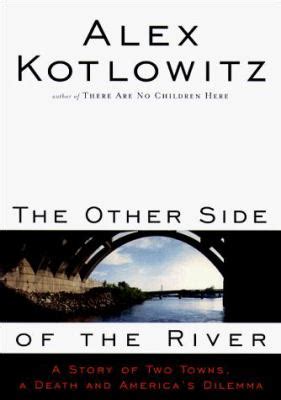
In May of 1991, nearly thirty years ago – let that linger for a moment – the body of a 17-year old Black male was pulled from the St. Joseph river, adjacent to Lake Michigan. Eric McGinnis was a goofy prankster, a normal kid with a taste for fashion who hailed from the Black and poor Michigan town on the north side of the river, Benton Harbor. The south side of the river is home to St. Joseph, a wealthier white community. Following an investigation of questionable professionalism and frustrating ambiguity, the case was closed – without a cause, reason, or official explanation for McGinnis’s death.
Alex Kotlowitz, an award-winning journalist, author and writer on issues of race and justice, because obsessed with the case. He spent five years researching it, taking it apart and putting it back together. Kotlowitz assiduously dug deep into the racial make-up and history of the two towns. He found example after example of racism and a consistent lack of justice. He found gaps in communication, in empathy, and in understanding. He interviewed scores upon scores, trying to make sense of the tragedy. The resulting book, The Other Side of the River: A Story of Two Towns, A Dean, and America’s Dilemma, recounts Eric’s story and Kotlowitz’s research.
Nothing would be more gratifying than to recount that there is justice, a resolution, and closure. There is not. Eric’s death, like the death of so many others of color, remains an injustice, a tragedy that lingers and haunts. Kotlowitz’s research hammers home the impossibility of closure, too, when there is no case, no evidence, and limited attention. He lets us see the perceptions from both sides of the river, making certain that we appreciate how lives, meaning and any real shared sense of values is undermined by the racism woven through the towns’ histories. It is enraging and all too common. And that there was this level of reporting and attention all those years ago – without any meaningful action – renders the racist injustices of recent time all the more gutting.
Listening, documenting and telling the story is vital. Kotlowitz has continued to write, to make films, and to report. This is necessary. But if the last thirty years have taught us anything, it is that telling the story alone is insufficient. The pursuit of justice – meaningful justice – requires structure, commitment and action.
Ma Jian’s 2014 novel, The Dark Road, is a haunting literary indictment of China’s one-child policy as described through the lives of one family. A painter turned award-winning writer, Jian is a creative and vocal critic of the Chinese state. He has such a compelling voice, in fact, that cannot live in the country safely. The the Chinese government has confiscated and destroyed his works. Now in London, Jian and his partner have a family of four children.
China’s one-child policy was enacted in the late 1970s after decades of a two-child rule. Designed to rein in population growth, the policy was about more than family planning. Formally it permitted families one child and should they have a second pregnancy, mandatory contraception, fines, forced abortions and sterilization. In practice, those with money and political connections were often able to by-pass the strictures. For those with less agency, like the family in The Dark Road, the lived experience was horrific and more encompassing.
Jian’s research for the novel took him to the countryside, where he posed as a reporter and asked everyday people how they coped with the government, the changing economy, and the impact of the one-child rule. The consequences were devastating. They collectively fold themselves into an omnipresent state that grinds the hope and humanity out of its citizens. Beyond the horrors of forced contraception, abortions, sterilizations and the systemic eradication of people’s interior life, the book offers a window on the caustic transactional society costs. If you cannot own your own body, what rights and hope are possible? Jiang gets this, and is able to describe it with a sense of immediacy – often with the dark humor that gives people the strength to shoulder on in the face of impossible conditions.
The hero of the novel is Meilin, a young and intelligent peasant woman without an education who marries Kongzi, a school teacher. They have a daughter, Nannan. Kongzi wants a male heir, though, and the resulting pregnancy leads the family to seek an alternative life on the Yangtze River. Jobs and family lost, the family struggles, with misfortune, some joys, and everyday life proving ever more difficult.
At the heart of the book is Meilin’s sense of agency, and her ownership – and lack, thereof – of her body and womb. She suffers mightily through the book. It reminded me of Zola, in naturalistic style, spelling out the contrast between what lives inside a person and what society allows. It is a terrible thing to contemplate, yet Jian’s storytelling skills carry us along to what we know will cannot be resolved positively.
Nicole Krauss is an immensely talented novelist, a writer with a passion for language and exceptional skill. She does not so narrate so much as paint with words; the flow of her language is poetic. Yet her narrative is not unduly performative. Krauss writes stories that have a relationship with their audience.
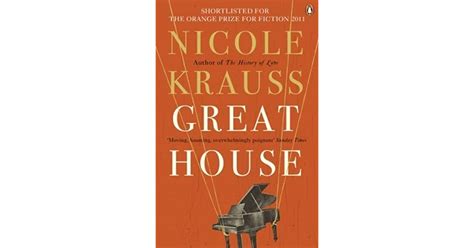
In 2010, she published Great House, her third novel. The book received critical acclaim, awards, and cemented Krauss’s reputation as a top-tier author. It is a carefully crafted work, a jewel box of five different narratives and primary characters that, over time, come into focus, offering high-level understanding and meaning. The threads running through are historical (the violence of government against its people), philosophical, emotional, and interpersonal. There are recurring questions of identity, of remembering (and forgetting), and the presence of a much-traveled desk. Each of the key characters are struggling with loss. That may sound complicated, but it’s not unduly complex in Krauss’s hands. I was aware, while reading it, of her direction, structure and choice. There’s nothing sloppy or untethered in the book.
All of that is on the positive side of the ledger and good reason for the novel’s critical successes. And yet – and I’ve been wrestling with the “and yet” – I cannot assert that the novel moved me emotionally. I admire it and find much to praise – and I yet can’t state that it has stayed with me.
It might be because Krauss does not strike me as fully invested with her characters in this effort. I’m not sure, though; there are more than a few novelists whose work moves and whose relationship with their characters is at arm’s lengthy. George Elliott is a fine example, a brilliant novelist whose characters are sometimes less than fully realized.
My emotional distance from The Great House also might be that characters’ traits and internal dialogue are often seem to drive the novel more than plotting or action. It is a book of thoughts and feelings in different cities and over time. However, there are again many outstanding novels that are light on action. Then again, I was wondering if my coldness might be the absence, save the horrors of a Pinochet or Holocaust, of every day life’s concerns in the book. The characters, sketched in particular situations, sometimes struck me as transcendent or any one time or place.
Or it simply might be the wrong novel at the wrong time for me.
That thought – the right piece of literature for the right reader and the right time – has been bouncing around in my head for months. Reading in the pandemic is not, for me, like reading was two years ago. Reading in late 2020 has a different sense of urgency to it, a charged sense of relevance. One must choose to read and engage in a text, and when we can’t go outside, when the daily news brings new stresses and horrors, simply reading a novel is a weighted act of choice. It is consequential. That does not mean that everything that I read now has to be “important.” Goodness knows I crave escape fiction, too. Great House is not a diverting fluff. It it is serious and reflective. All that said, it was not substantial to me in a way that resonated.
Maybe – after covid, after the sheltering, when it’s possible to read a book in public or while traveling, I’ll have a different reception to Great House. For now – you’re welcome to borrow my copy.
Simple history puts people and ideas in boxes, creating tidy narratives. Thoughtful history, based on close research, reveals complexities and contradictions. That kind of history is not necessarily flashy. Nor does it always receive due attention, either. It is more like a close reading of a text, revealing itself through concentration, study and time.
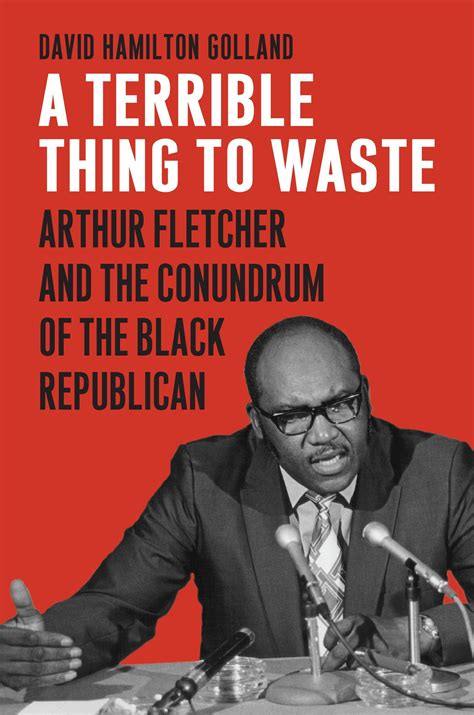
I was thinking about this while reading David Hamilton Golland’s biography of Arthur Fletcher, A Terrible Thing to Waste: Arthur Fletcher and the Conundrum of the Black Republican. It is a sturdily crafted traditional biography of a somewhat minor political figure. It is also an interesting study of the intersection of personal and national history, sketched out amid broader complex trends, that defies conventional expectations. Fletcher, a Black leader who led an extraordinary full life, is aptly described by Golland as “the most important civil rights leader you’ve (probably) never heard of.” Tracking the contours of Fletcher’s life makes for a valuable read, for it highlights the opportunities and constraints that smart, ambitious and talented Black men faced and still face as they navigate the evils of racism. Golland has done good work here, for it is a biography and more.
Born in 1924 to a hard-working single mother, Fletcher spent much of his early childhood in Los Angeles. In 1938 he changed his last name, reflecting new family stability. His mother married Andrew Fletcher, a master farrier in the Army. The family settled in Kansas for Fletcher’s high school, where he stood out as a stellar athlete and as a leader for Black students. He married his high school sweetheart, became a father, and was drafted into the Army by 1943. Fletcher tried to get into an officer program – choices were limited for Blacks – and by 1944 was in Europe. In March of 1945, Fletcher was shot and after five surgeries, was discharged. With a second child and more on the way, Fletcher balanced straight forward jobs – delivering ice and working as a doorman – with pursuing his academics and football aspirations.
Fletcher stood out as star for Washburn University’s football team, was scouted and recruited, and became the first Black player for the Baltimore Colts. His football career never fully materialized, though, and by 1953 he was teaching in Kansas and starting a lifelong connection with the GOP. The Republicans in Kansas at the time were the party most committed to providing jobs, protection and rights to Black Americans. Politics greatly appealed to Fletcher, a charismatic speaker, and so started a lengthy career.
Overcoming personal tragedy – his first wife committed suicide and employment opportunities were often elusive – Fletcher maintained optimism and an admirable entrepreneurial spirit. Moving to Washington, he started a community program and was elected to the Pasco City Council. Fletcher tried his hand at running for Lieutenant Governor of Washington, the first Black to head a state-wide campaign in the West. His visibility appealed to President Nixon, who tapped him as Assistant Secretary of Labor. Under President Nixon, Fletcher advanced affirmative action in hiring and contracts. His advancement, a testament to his skills and ambition, is truly impressive. With the White House role and accomplishment under his belt, the remainder of Fletcher’s professional life was in and about Republican political leadership. He ran for mayor Washington, DC, losing to Marion Berry. He headed chaired the United States Commission on Civil Rights. Close to George Bush, Fletcher was a frequent public speaker, a lobbyist, and a national Black spokesperson on issues of race and labor.
Fletcher’s patience with improving race relations in the US, always in conflict with the strictures of his party, were sorely tested with Lee Atwater’s campaign leadership and the Rodney King beatings and trial. He did not, though, abandon his fellow Republicans. Golland notes that Fletcher, never a conservative in the vein of so many of his colleagues, was trapped by his success. Fletcher died in 2005.
In the last chapter of the book, Golland tackles the conundrum of Arthur Fletcher and his career. Like some other Black Republicans, Fletcher found the party’s commitment to individualism, to labor and work, in alignment with his personal philosophy. Yet the broad message of the party shifted, becoming less concerned with the opportunities of Blacks and other minorities, leaving Fletcher and others without traction. Nor was moving to the Democratic party a viable option, at least in Fletcher’s mind. As the party abandoned his values, he was stranded – and distressed, too, for the more white-focused strategies of the Republican party garnered success at the ballot box.
Golland’s biography is a well-written, well-researched account of an American political leader well worth our time and consideration.