Justice, Women and the Law

Dahlia Lithwick is one of the nation’s most influential law commentators. Active across many publications and platforms, Lithwick is probably best known for her ongoing attention to the Supreme Court. She writes, presents, comments, and teaches with rigor and passion.
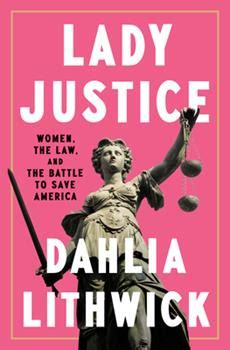
In 2022, Lithwick wrote Lady Justice: Women, The Law, and the Battle to Save America. Through a series of sharp biographical studies, Lithwick’s best-selling book examines the massive changes in women’s rights from the latter part of the Obama presidency through the Trump administration. It’s a story of rights being curtailed, denied, changed and re-evaluated – and the immense effort to push back and secure those rights by women lawyers. The book is a reminder of just how contentious the last six years have been. Lithwick zeroes in on a number of battles – at airports, in courtrooms, in the media and in demonstrations – and the tremendous trauma and costs. Many of these incidents are familiar, if only through the headlines at the time. Lithwick’s book gives context, broader legal understanding, and highlights the women attorneys who throughout found strength, strategy and alliances to fight for women’s rights. The book is encouraging and cautionary.

The women who emerge in Lithwick’s study are described with care and consideration. While we may have first heard about them through the media in times of drama, when they were often reduced to stereotypes and sound bites, in Lady Justice they emerge as complete human beings. Lithwick stresses that these women came from different backgrounds, with different agendas and ways of describing the law. What they share is a belief that law could provide structure. Its very rules would permit agency, a meaningful career, and the potential to make a difference.

Lithwick’s attorneys include Sally Yates, who was the US Attorney General at the end of the Obama administration and who was fired by President Trump when refused to implement the Trump administration’s executive order barring Muslims from entering the US. Yates, who is very much a believer in institutional stability, as Lithwick emphasizes, refused to act on an order she believed was unconstitutional. Becca Heller, who fought the Muslim ban as an attorney, has less faith in the system. Nevertheless, she played an instrumental role in organizing grass roots legal defense of immigrants at airports throughout the nation when the Trump Executive Order was implemented. The organization she founded, the International Refugee Assistance Project, continues to have an impact today. Although it took time, Yates and Heller’s legal arguments eventually were endorsed by the courts.

The courts also vindicated attorney Robbie Kaplan, who went after the Charlottesville, VA, white supremacists on behalf of the people they harmed. Kaplan had earlier played a leading role in securing the rights of homosexuals to marry. Brigitte Amiri, who has been fighting for women’s reproductive rights for decades with the ACLU, worked tirelessly on behalf of a pregnant teenager held at the border during the Trump administration. The young woman sought an abortion and the US government prevented it until Amiri’s arguments prevailed. Lithwick also looks at Vanita Gupta, who has a career advocating for civil rights, and Stacey Abrams, who has made the expansion of voting rights a priority.

Lithwick also talks about her own experiences with Judge Alex Kozinski, who sat on the US Court of Appeals. An influential jurist whose clerks often became judges, Kozinski was well-known in legal circles for his abuse and sexist behavior. When enough women and complaints came forward to seem to force accountability, Kozinski retired. One of his clerks, Brett Kavanaugh, claimed ignorance of his behavior during his confirmation to the Supreme Court. In these sections, Lithwick’s pain and anger at misogyny and blatant unfairness in top legal circles comes through loud and clear.

Despite that anger, Lithwick’s message is still ultimately about the importance of faith in process. She has belief in the law as a place for order and orderly change. Better arguments, over time, will win. The histories in the book reinforce the law’s slow and irregular move towards inclusivity and justice. It may be political, but it is not partisan. Tempering Lithwick’s optimism though, is that the legal system can be unduly influenced by partisan politics. Without process and care, the law can become a tool of repression. What I found most inspirational in Lady Justice was the immense heroism of these attorneys, their willingness to go above and beyond in pursuit of their clients and justice. Though perhaps not household names today, their efforts are what makes our democracy function. We are a national of laws. These attorneys, and Lithwick’s book, are most deserving of our time and appreciation.

David Potash

Upper East Side Field Research

“Going native” takes on a different level of research and accountability in Wednesday Martin’s sly book, “Primates of Park Avenue: A Memoir.” Martin is a writer, public expert on a host of issues, from parenting to gender to families, a researcher and cultural critic. Her background includes rigorous academic study, with an undergraduate focus in anthropology at the University of Michigan and a doctorate from Yale in cultural studies. Martin is an interdisciplinary scholar with a skill for rendering theory in accessible and humorous ways. Her book defies easy categorization, just as one my expect from the author’s background. If you are curious about the lives of extremely rich families in New York City, Primates is most worth your time and consideration.

As a straightforward interpretation of the work, Primates is a field study of the wealthy mothers who lived on the Upper East Side of Manhattan in the early 2000s. Martin, who married into New York City money, moved to the city, started a family and began a journey of friendship, competition, and socialization among an elite group of mothers. A member of the tribe, at least through her marriage, Martin brought all the tools, references and methodologies to do a serious ethnography of her new environs. What makes this book intriguing is that she isn’t just a visitor. She is one of the group, a wealthy New York mom. Possessing the analytic and reasoning skills to try to better understand and navigate her environs. Martin’s effort, restructured into this popular book, makes for an unusual read. She makes maps, tracks behavior, and is delightfully cued into issues of status, shame, networks and social power. Martin is also very good with a joke.

Primates is no dry academic text. Martin’s prose is lively . For those that haven’t read much anthropology, there is much to pick up here about how anthropologists see things and sort information. The arguments are intriguing and the references clear and understandable. Martin is not writing to impress. Her aim is clarity, providing understanding and explanation. As Martin moves from outsider to insider over the course of book, as her children make friends and age, more and different opportunities emerge for Martin’s study. She gains trust. And like many other famous anthropologists who do extended field research, she becomes more and more sympathetic to those that she is studying. Like many in her tribe, she is a smart, ambitious, highly-focused wealthy mom.

This plays out in both theory and sense-making. For example, Martin recognizes that a key moment in her acceptance in the group stemmed from the affirmation of an alpha male, an extremely wealthy dad. Arranging for a play date of their respective children gave Martin greater status. She used it, too, opening up doors to more conversations, more interactions and greater knowledge of the community.

The second key turning point in Martin’s position came from power of prized objects. In this case, it isn’t a yam – it is an expensive Birkin bag. This accessory is a required sign of status in the tribe. Purchased through her husband’s money and his connections with others (it bears stressing that males are the architects of the system and prized items are always difficult to obtain) the bag provides access and deeper knowledge of the how and why of group and personal dynamics. The final turning point in the narrative, as Martin’s children become more independent and the fixed strictures of the Upper East Side community loosen, is the tragic death in utero of what would have been her third child. The loss, as one would expect, hits Martin very hard. It is traumatic. She is grateful to her fellow mothers, who provide comfort and support.

All of this is very interesting. Setting Primates apart are two threads that Martin weaves throughout.

The first is a line of analysis grounded in Martin as a cultural critic. She questions the rules of the community. She mocks herself for wanting status and for obsessing over a expensive handbag. Accordingly, she makes fun of herself for enjoying the Birkin bag so much. Martin questions the dieting, the incessant exercising, and the omnipresent anxiety throughout the community of women. Men do not seem to have the same stresses. Martin offers more than a few “Mean Girls” references. Her critiques sharp, humorous, and very humane. After all, she is studying a most unusual community.

The second line of analysis is personal. Martin is a smart, warm woman, and it is easy to relate to her voice in the book. Doctorate and wealth notwithstanding, she wants to connect with the reader. She wants to be liked, to be accepted, and she wants what is best for her children and family. These are normal values. She readily acknowledges faults and failures. Martin wrestles with problems, wonders what is best, and opens up to the reader. Martin’s humanity shines through. It is, after all, a memoir.

Primates of Park Avenue is an inside and outside study, a look inside the townhouse by someone who wonders just what the townhouse is all about. Martin’s study, which is being made into a television series, is most interesting. Good anthropologists do fascinating work.

David Potash