Warriors For The Working Day – Classic WWII

In Shakespeare’s play Henry V, King Henry tells a Frenchman before the Battle of Agincourt that “we are but warriors for the working day; our gayness and our gilt are all besmirch’d with rainy marching in the painful field.” Not a boast, it is a statement of fact regarding the commitment and sand of the English soldier. “But, by the mass, our hearts are in the trim” the soliloquy ends. Powerful and moving.
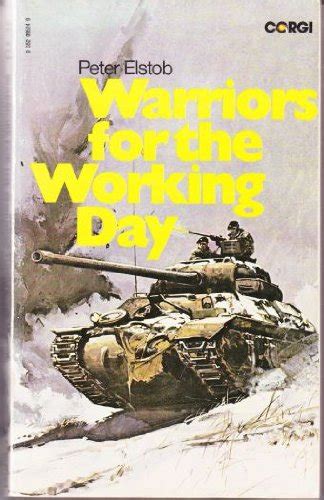
Peter Elstob lifted the quote for the title of his outstanding WWII novel about tank warfare. It’s an apt choice. Warriors for the Working Day is a superb book about the day-to-day of fighting in World War II from the solder’s perspective. It is beautifully written and extremely compelling, pulling the reader into the grit and internal stresses of the war. Most importantly, it is lightly fictionalized. Elstob knew the subject, personally and intimately, and that knowledge informs the entire endeavor. Published in the 1950s, it has resonance and impact today.

Gripping and engaging, the book is sprinkled with literary allusions and devices. The novel is structured into two parts. Book One, “First Light” is based on when it’s possible to distinguish between black and white. Book Two, “Last Light” is when it’s no longer possible to distinguish. The structure is literal and metaphorical, capturing the kinds of battles the soldiers’ face and the arc of the war through a soldier’s eyes. There is action, drama, and quite a bit of thoughtful reflection. Elstob’s skill allows one to enjoy the book’s prose, too. His writing is that good.

One character, Brooks, functions as the key thread throughout the novel, anchoring the action and the plot. However, the novel explores more than Brooks and his growth as a tank commander. We meet the senior officers and soldiers who school him, his colleagues, the men he commands, and a wide range of people he encounters in England and Europe. The book opens with training before D-Day and ends as the tank command is in Germany, heading toward the war’s conclusion. Characters come, go, live, die, and through it all, the soldiers must fight. They also have to fight in order to fight. The stresses, the demons, the pressures are constant and debilitating.

Warriors for the Working Day stands as a powerful corrective to narrative war history, the kinds of books that explain battles with maps, arrows and charts. With outcomes known, they give sense to what is inherently impossible to comprehend. Those kinds of history books are necessary but far removed from the actions of the poor folks who have to drive the tanks, shoot the weapons and hope for the best. There’s an immediacy to Elstob’s writing that carries you directly to the battlefield, to the bureaucracy, and the day to day. He is particularly good in his characterization. Everyone seems more than real.

Elstob’s personal war experiences made certain of the reality. He was a Royal Tank Regiment volunteer (his attempts at the RAF were unsuccessful). Elstob saw action in Asia, Africa, England and Europe. He lived through all that is recounted in Warriors for the Working Day. Moreover, he penned several military histories. Elstob truly knows his subject and that shines through his writing.

Massive thanks to the Imperial War Museum for reissuing this classic novel. It was as strong as anything new that I’ve read in years.

David Potash
For One, Please

Eat alone? Travel alone? Be alone? Solitude can come with unwelcome baggage: questioning looks, lingering distrust and occasionally approbation, as if solitude equates to selfishness. Even medical science informs us that we are social creatures. So we are. But without time to reflect, think and consider, we may be far from fully realized.

Stephanie Rosenbloom, a travel writer and journalist, makes an outstanding case for the value of traveling solo in Alone Time: Four Seasons, Four Cities and the Pleasures of Solitude. It’s a gem of a short book, an easy read rich with moments. The concept is clever. Rosenbloom travels alone, walks, dines, chats and thinks in Paris, Istanbul, Florence and her home, New York City. She meets people, she asks questions – though the book is not really an exercise in deep, investigative journalism. Curious and reflective, above all, she observes. A talented writer with a gift for aligning the small perspective with the larger point, Rosenbloom takes us, the reader, as an unseen companion. She is a very good traveler and a fine confidant.

The section on Paris is the longest, most interesting and best realized. I would wager, too, that Paris is Rosenbloom’s favorite. The chapter on Istanbul felt slightly rushed, as though another few weeks would have provided more material. The tourists and bustle of Florence rubbed our intrepid traveler somewhat the wrong way. While she felt connection with art, I did not get the sense that Florence truly resonated with her. I doubt that she’ll be hurrying back to the Uffizi. On the other hand, being solo in her home city, New York, afforded Rosenbloom observations that felt right. I, too, can feel both at home and a visitor in Gotham. It is one of the joys of the city. The end of the book contains some helpful suggestions for solo travel.

Reading Alone Time was somewhat akin to taking a practice trip, an imaginary journey to four fascinating metropolises. It offered validation in an unexpected way to the desire all of us have, every now and then, to have a coffee or a moment by ourselves, to slow down and just watch and listen. That’s a good thing, a healthy necessity in 21st century life. It is not selfish. Rosenbloom guides us, too, in ways that being alone can enhance our experiences. I found it most intriguing that often the best place to do that kind of “slow thinking” is in places filled with hustle and bustle.

David Potash

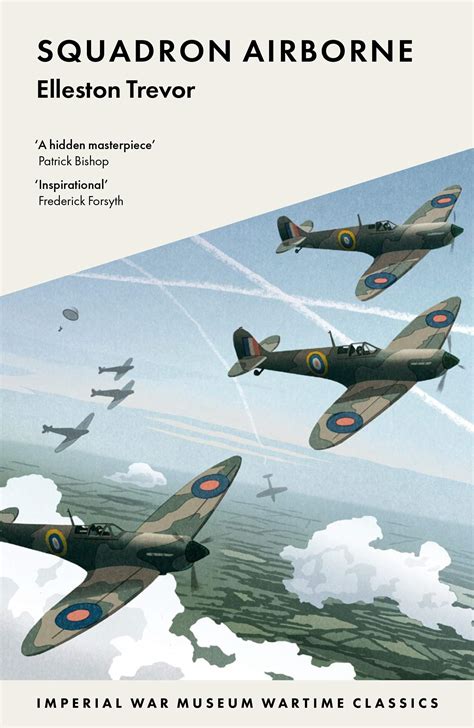
Squadron Airborne – WWII Classic

There’s something humbling, fascinating and exciting about discovering a successful author and one of their books. “Why didn’t I know this?” is a common first response, and if the book is really good, then it’s “No wonder it was so successful!” That is often followed by a “Others should read this, too. This book should not be forgotten.” Soon after is “I wonder what other works by this author I should read?” I cycled through all of these while devouring Squadron Airborne by Elleston Trevor, an extremely gifted and prolific novelist. Published in 1955, it is a very good WWII novel. In fact, it is a good novel regardless of the setting. It’s a riveting read that need not be categorized as wartime fiction.

The book tells the story of the pilots and support team and neighbors at a fictional Spitfire fighter base in England in 1940. Taking place over a week, it is rich with authentic detail, memorable characters, tons of action and well-crafted interplay driving the plot. This was during the “Battle of Britain,” the early stages of the war when England’s very survival was at question. The novel is heroic, thrilling, scary, and has more than thread of romance. Above all, Squadron Airborne is very much a book about how a team works together. It is a novel grounded in high-stakes labor, and it is that sense of shared purposed and threat that holds it together. It all makes for a very engaging, very interesting read.

Elleston Trevor was a pseudonym but the eventual legal name of Squadron Airborne’s author. Born Trevor Dudley-Smith in 1920 in England, Trevor had a knock-about life before World War II, where he served with the RAF. Research indicates that some of Trevor’s military service was as an aircraft mechanic. Regardless of responsibilities through the war and beyond, he wrote and wrote, eventually penning more than a hundred works under several different pen names. He moved to the USA where he enjoyed commercial and critical successes. His best-known novel, Flight of the Phoenix, was made into two movies. Trevor also found many fans and readers in his Elleston Trevor was a pseudonym but the eventual legal name of Squadron Airborne’s author. Born Trevor Dudley-Smith in 1920 in England, Trevor had a knock-about life before World War II, where he served with the RAF. Through the war and beyond, he wrote and wrote, eventually penning more than a hundred works under many different pen names. He moved to the USA where he enjoyed commercial and critical successes. His best-known novel, Flight of the Phoenix, was made into two movies. Trevor also found many fans and readers in his Quiller spy novels, several of which were done for television and cinema. The man knew how to pace a story, how to say a lot with few words, and to engage readers. He https://en.wikipedia.org/wiki/Quiller

” target=”_blank” rel=”noreferrer noopener”>Quiller spy novels, several of which were done for television and cinema. The man knew how to pace a story, how to say a lot with few words, and to engage readers. He died in 1995.

Big thanks to London’s Imperial War Museum for re-issuing Squadron Airborne and other wartime classics. Looks like I have a lot more Trevor to read.

David Potash