Accelerating Democracy – From a Governing Perspective

John O. McGinnis, professor law at Northwestern University, has faith in democracy, empiricism, and technology to improve governance. His latest work, Accelerating Democracy: Transforming Governance Through Technology, provides an overview of the ways in which democratic government can use and respond to technology. He is mot concerned with claims about how democracies should use and respond to new technology.

Driving the work is a serious question: how do democracies make and evaluate decisions? How can they do so more effectively? McGinnis identifies the ever-increasing importance of the social sciences and new technologies to answering that query. For us to live in a rationally governed world, it is essential that we have an understanding of the consequences of policies and choices. New technologies permit more sophisticated questions and answers. We can now do this quickly and efficiently.

McGinnis calls for more experimentation. He wants a revival of federalism with multiple pilots. He identifies great value in more information, more readily shared and assessed. In addition, McGinnis emphasizes the values of predictive markets. Technology can make all of this possible. However, McGinnis does not advocate for a technocratic élite. His aim is about harnessing the social values inherent in new technology.

New technology, particularly analysis of big data, can lead to smarter decisions. Businesses use it well. However, I am not confident that public policy preference is grounded in efficiency.  We often make decisions reasons that are less effective and less rational. There is also great potential within dispersed communication (social media) to disrupt government and rational decision-making. Democracies do not always move toward greater democracy.  McGinnis, acknowledges bias but believes that technology and greater information can be a corrective.

McGinnis’s vision rings true within the world of public policy and administration. Data and empirical information has the nagging habit of getting in the way of suppositions, biases, and predetermined plans.  Officials and leaders who use new technologies can and will be more effective because they will notice this. Happily, these are also the people most likely to read Accelerating Democracy.

David Potash
Measuring Manhattan

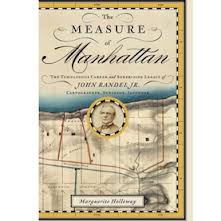
John Randel was a brilliant crank, an idiosyncratic and irascible character who mapped Manhattan in the early 1800s. Randel made the world-famous grid of avenues and Measure of Manhattanstreets a reality through extraordinarily detailed maps. His obsession for accuracy was matched only by his commitment to his reputation. Marguerite Holloway’s The Measure of Manhattan is a generous and thoughtfully crafted biography of Randel. Holloway champions Randel, admits but tolerates his weaknesses, and lobbies mightily to raise his star.

The challenge facing Holloway is that Randel was not a visionary, a planner, or a  theorist. He was not even a particularly nice or interesting person.  Randel played a very important role in the mapping of Manhattan, but that role could have been shouldered by another. He was an outstanding surveyor.Randal’s role in history is notable because he possessed the right skills in the right place at the right time.

The true subject of the book is not Randal, but the processes involved in mapping the island of Manhattan. Surveyors imposed order on chaos and structure on the organic. If we equate happiness with property – and many Americans do – than happiness is only possible with a reliable map. It’s a good thing that Manhattan has so many happy people, and if only for that, I give thanks to John Randel.

David Potash

Fame in Familiar Flavors

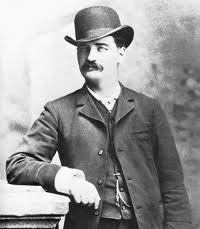
Bat Masterson used to be famous. A gunfighter, lawman, buffalo hunter, pugilist, gambler, boxing promoter, and newspaper columnist, Masterson was a man’s man from the Wild West who lived the latter half of his life on Broadway in New York City. He killed several men, was involved in countless brawls and lawsuits, and lived a life worthy of fiction. One of his younger New York friends, Damon Runyan, thought so – he created the character “Sky Masterson” thinking of Bat. Sky would later achieve a different kind of fame as the lead in the musical Guys and Dolls.  Theodore Roosevelt was equally enchanted. When President, Roosevelt arranged for a federal sinecure for Masterson.Bat Masterson

Robert K. DeArment is probably the world’s expert on Bat Masterson. His latest work, Gunfighter in Gotham: Bat Masteron’s New York City Years, chronicles Masterson’s life but focuses on his time on the Great White Way. Masterson’s New York City was very much Runyon’s: a small district around Times Square filled with types. Masterson did have exploits, but were they worthy of our collective attention? His prose was nothing special; nor were his opinions, causes, or arguments. He was not a leader and he left no exceptional mark on his environs. He was a friend and a colleague to many and a dangerous enemy to a few.

Thinking of Bat Masterson brings to mind other celebrities famous for being famous, a category now enshrined in popular culture. We often think that the rise of the fake celebrity is a recent phenomena driven by the internet and social media. In reality, it is a part of modern life and has been for decades.  We regularly think about, read about, and write about popular figures whose actual claim to fame is, at best, tenuous. Our fascination with fame is as much about us, the public, as it is about the object of our attention, the celebrity.

Those famous for being famous often share similar traits. They actively seek to maintain their celebrity. That kind of fame does not just happen – it requires ongoing work. And if you doubt me, consult with Kathy Griffin. Also, these kinds of celebrities tend to embody characteristics that are taken to an extreme. Masterson’s hyper-masculinity stands as a provocative counterpoint to the hyper-femininity of the Spice Girls or the Kardashians.

As for Masterson, DeArment’s volume provides more than I would ever care to know about the man in print. I will hold judgement about meeting Masterson in person – I think that he would have been a heck of an interesting fellow to meet at the bar.

David Potash