Sullivan County In The Day

In 1873 James E. Quinlan published History of Sullivan County. A Catskills newspaper editor (the Republican Watchman was his charge), Quinlan wrote the book after retiring from the rigors of the daily press. The history was something of a labor of love. It is a compendium, an old-time history with lots of names and a less than clear structure. If it interested Quinlan, he included it in the history. As the editor of a reprinted version, David Gold notes, “the book is long on anecdotes and short on analysis.”

Nonetheless, the History remains an important overview of the early years of Sullivan County in lower New York State. The book highlights the scattershot nature of economic development and white settlements in the years up to the early 1800s. With no real center or dominant industry in the region, European settlers moved in, made a go of things, and either moved on or remained and survived. More than a few perished, though. Early life could be nasty and brutish.
The book helps to identify names and events that would later become well-known to all of Sullivan County. It offers some gripping accounts of battles with native Americans, or “savages” in Quinlan’s words. Early plans for bridges, canals, town centers, churches and the like figure prominently in the history. Development did not happen quickly in the region. There simply were not enough people, sufficient capital or even opportunities to propel rapid growth. Instead, things proceeded slowly and, with the benefit of decades, steadily.

Some of the stories stand out, though, personal histories of families, crimes, and day to day life. In that the history can read like a column in a local newspaper. For example, William A. Thompson, the original permanent resident of Thompsonville, receives several pages of attention.

A Presbyterian, Willam was a “weak, puny child, much afflicted with salt rheum.” That is eczema in today’s language. William studied law in New Haven in the 1780s. He was from Connecticut and his professional life began Sharon, CT. He moved around the state before marrying Fanny Knapp. She was described as “tall, genteel, 16 years old, and much marked with the small-pox. Her uncommon strength of mind, great elegance of manners, and lovely disposition, completely veiled her misfortune from the eyes of the scholarly young gentleman who made her his wife.” The young couple was not able to spend too many years together. Fanny died of consumption three years into the marriage after bearing two children. 0

Two years later, in 1791, Thompson married Amy Knapp, Fanny’s sister. According to Quinlan, a widow marrying the sister of a wife carried with it a significant penalty in Connecticut. Thompson, accordingly, decamped to New York City. His career took off and he found financial success as an attorney. It was not easy for Thompson, though, for the stresses of work and city life led to poor health. In 1794 he purchased land in Sullivan county, taking residence in one of his parcels by Sheldrake Creek. The family had been living on Cherry Street in Manhattan.

Like many New York City families with upstate homes, the Thompson’s found the first winters uncomfortable, so they returned to the city. The family moved back and forth as their home, and the surrounding area, improved. This is a pattern even common today, as wealthier city dwellers figure out how they want to live in the Catskills. Thompson’s upstate homestead increased in size and comfort. He invested in Sullivan County and became a very important person in the area. Thompsonville was named for him in 1803 (he was politically connected). Thompson enjoyed the status. He invested in a larger home – Albion Hall – and when his career as a magistrate ended he became an amateur scientist, studying local geography. He passed away in 1847 with a lengthy legacy.

Absent from Quinlan’s account are the voices of Fanny and Amy. We do not read of other family members, the many people who may have worked with or for Thompson, or of any detail about daily conditions. History from the nineteenth century was mostly about white men.

Quinlan’s history is far from modern or complete. Nonetheless, we can learn a great deal from local tales.

David Potash
Detroit-Ryan Speedster as Muse

Do you know about Jonathan Livingston Seagull? Read the book or watched the movie? It was a massive phenomenon in the first half of the 1970s. A short allegorical novella about a bird’s flight and self-realization may sound like an unlikely best-seller, but one never knows what sticks and what does not. While I never quite understood its popularity, I read it as a real cultural phenomenon.

The book’s author, Richard Bach, wrote many other things – fiction and non-fiction. Several of his works were quite popular, making him one of the best selling authors of the period. When I was recommended an early Bach book, penned before he became so well-known, I decided to give it a try. Less allegorical and more a straight up personal account, Biplane was published in 1966. A short book, it offers insight into Bach, his passions and his thinking.

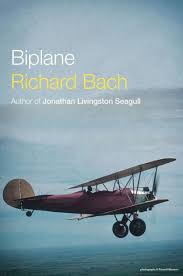
Flying has been absolutely central to Bach’s life. He took his first flight at the age of 14, and he later becoming a military pilot. He flew for the US Naval Reserve, the NJ Air National guard, and for the US Air Force. Bach flew military planes and personal planes for pleasure. Obsessed with flying, Bach worked for Douglas Aircraft and he edited Flying magazine. In the early 1960s, Bach owned a recently rebuilt Fairchild 24 aircraft. It is a reliable single-engine four-seat plane, often used for training and light transport. Bach traded it for a 1929 Detroit-Ryan Speedster, Parks P2A, an old-time biplane. How old? It did not even have a radio. The move was not an upgrade but rather a conscious commitment to a different kind of flying. Biplane is about the trade and Bach’s subsequent flight across the country, from New Jersey to California.

Flying is much more than a means of transportation for Bach. He philosophizes, goes on at length about it and the ways that it makes him think about the world, for flying energizes his creativity. Bach’s mind is never at rest – or at least in Biplane, it does not take much of a break. He is fully engaged, meets people on the journey, considers the land, the communities, and the very act of flying a vintage machine. The Detroit-Ryan Speedster was not an easy plane to fly. In fact, it is the kind of machine that demands constant attention. The very difficulties attracted Bach to the biplane. As he learns more about the aircraft, how to fly it and what it can and cannot do, he fills us in on how one thinks as a pilot.

My favorite line in the book encapsulates Bach’s themes: many people travel by airplane but few know what it is to fly. Biplane helps the reader know what it is to fly. It gives you a deep appreciation of aviation.

David Potash

Where Is the Gate? Woodstock Operations

The Woodstock Museum in the Bethel Woods Center for the Performing Arts gives an excellent overview of the world’s most famous music festival. “Woodstock” stands apart as more than a music festival. It is a major part of American history and the 1960s, and the focus of an untold number of studies. A recent trip to the museum sparked my curiosity to learn more.

Journalist Bob Spitz’s Barefoot in Babylon: The Creation of the Woodstock Music Festival, 1969, is perhaps the best account of how the event came together. Reprinted many times, the book relies heavily on first-person accounts and solid research into the cast of characters and the multiple machinations that made the festival special. Spitz has penned biographies, books, and articles for decades. Especially relevant to the history of Woodstock, he worked in popular music, managing Bruce Springsteen and Elton John. Spitz writes from an informed perspective and his interest is very much in logistics. How did the damn thing come together?

As a refresher, Woodstock was a three-day music festival held in Bethel, New York, in August of 1969. Nearly half a million attended and heard many of the most vital musicians of the time. While it was originally supposed to be a profit making concert with 50,000 attendees, massive logistical problems led to a venue change and free admission, for they couldn’t control the crowd or take tickets. The problems cannot be understated – they were enormous. Nonetheless, the event was remarkably peaceful, even with three deaths and untold numbers of issues, from water to electricity to traffic. In sum, it was a beautiful mess, like a party when 10x as many guests arrive. On a totally different scale, with a documentary and a firm place in popular culture and history.

Spitz’s book is enormously interesting, especially to those curious about event promotion, planning and execution. He goes into great deal regarding the financing, the coordination (or lack thereof), and the thousands of small decisions that shape an event. The lighting and sound system posed challenges, for example, and who, why and how the problems were addressed makes for an engaging tale. The people involved in security make up another important thread. Fear of hippies and the counterculture ran deep. Figuring out how to keep people safe and de-escalate problems was no small task.

The medical situation takes up a big part of the book. It makes sense, too. There were few rules or guidelines for this kind of event at that point in time. The haphazard nature of the festival, as it emerged over the months, called for real leadership and innovation. Kind of in the weeds, to be sure, but it adds up. The deep local resistance to the “hippies” added an extra level of stress.

What Spitz does not examine in much detail are the larger questions about why so many attended, why so many have been drawn to the festival over the decades. To be sure, the list of artists who performed is extraordinary. We don’t think of Woodstock, though, as a 1969 greatest hits festival. Other factors were afoot, other trends and moments. Many others have looked at those questions, and I look forward to following up and learning more.

For how to – and not to – put on a festival, though, I heartily recommend Barefoot in Babylon. And a massive thumbs up, too, for the extraordinary Max Yasgur, the conservative Republican Jewish dairy farmer who stepped up to give the festival a home after the original site fell through. He was truly a special human being.

David Potash