Street Smarts for Smart Streets
Samuel I. Schwartz is a quintessential Brooklynite. If he wasn’t a real person, a screenwriter would have invented him. Raised in Bensonhurst in the 1940s and 1950s, he played on the street, loved the Brooklyn Dodgers (hated Walter O’Malley when he moved them to Los Angeles), and worked hard at school, encouraged by his immigrant parents to get an education and make something of himself. Brash, smart, opinionated and not at all afraid of taking a stand, Schwartz parlayed his mathematical talent into an engineering degree at Penn and his love of Gotham into a job with the New York City Department of Traffic.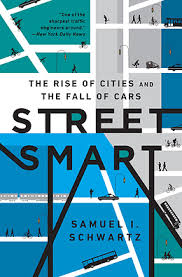
Schwartz proved to be no ordinary civil servant. As he recounts in Street Smart: The Rise of Cities and the Fall of Cars, Schwartz’s battles – both wins and losses – mirror many of the broader transportation questions facing the United States in the past fifty years. Buildings come and go, he writes, but roads last forever. Now the head of his own international engineering company, Schwartz is in a unique position to explain what is and is not possible when it comes to urban transportation planning and implementation. He knows that cars are not going away and that they will play an important part in transportation for the foreseeable future. Schwartz, however, also understands that the trends for humans for the future are for more walkable cities that do not depend upon automobiles. He is a closet cyclist. Much of Schwartz’s professional career has been about reorganizing transportation networks to decrease the preeminence of automobiles. He is fundamentally a pragmatist who writes with great humor and charm. If you were a mayor, you would want Sam Schwartz – “Gridlock Sam” to the New York City tabloids – on your team.
In a variety of positions in NYC, Schwartz consistently worked toward traffic decisions that would give more options to pedestrians. Jane Jacobs only receives a brief mention but she and Schwartz share a similar point of view about the urban environment: it is best when it is actively shaped by people.
Engineers have a special set of tools when it comes to defining a problem – like slow-moving traffic – and designing a solution – like adding more lanes. Schwartz learned these tools, studied them, and decided at a relatively early age that they missed the big picture about how transportation systems can shape a city. People often mistake and misunderstand their environment, he writes, and engineers can compound the problem.
Take congestion – Schwartz makes it clear that reducing congestion is never a simple process and that in some situations, congestion can lead to an improved quality of life. It can also be a massive headache. In a multi-modal transportation environment (cars, buses, trains, light rail, etc.), with the right planning and options, congestion can lead to smarter public transportation choices.
For New Yorkers, some of Schwartz’s anecdotes will memories and flashes of recognition. “So that’s why that road in the park was closed off. . . .” His account of the options that the city faced when the Williamsburg Bridge approached failure is telling. Schwartz took a decisive role in rejecting a new bridge, which would have flattened several neighborhoods. His plan, accepted by the city, called for smaller, less dramatic repairs. It saved money and communities. Schwartz does not believe that more money for infrastructure necessarily has a good return on investment.
Schwartz also provides insight into how and why certain decisions about transportation were made. Mayoral preferences are extremely important. A mayor who does not see the value of the subways, for example, is not going to support multi-modal transportation. Schwartz asserts that any changes in the transportation system will ruffle feathers and demand leadership.
The book covers much more than New York City. Schwartz references other cities, other problems, and other strategies. He sees several key trends: reduction in the attraction of automobiles for millennials, people seeing environments in which they can walk, a heightened frustration with long commutes, and the value of transportation systems engineering. He believes that ongoing improvements in technology, from GIS to Uber, will allow for greater innovation and more people-friendly designs.
Most importantly, he believes that these tectonic shifts in how we live will not be driven by ideology or politics (in fact, they may be delayed by politics), but by a basic human desire to live socially. I would wager that Schwartz believes there is a little Brooklyn in everyone.
David Potash