Telling One’s Extraordinary Story

Have you read James McBride’s The Color of Water? Written in the 1990s, it’s been a best seller ever since. McBride followed it up with other successful books. A talented musician and composer, a professor at New York University, a collaborator with Spike Lee in films, McBride is an award-winner in multiple fields, a supremely talented and prolific artist. Today he is a leading voice in American arts and letters. The Color of Water is powerful and moving. It has stayed relevant, too, especially because of how it addresses issues of race, racism and identity.
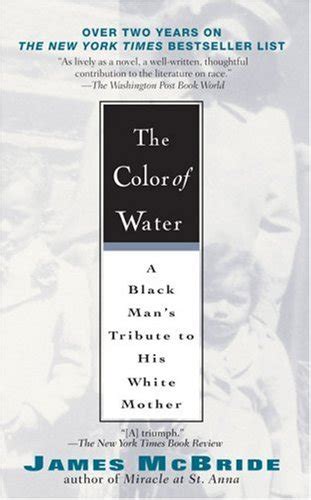
McBride’s memoir is about his family, his childhood, and above all, his mother, Ruth. She was the child of an Orthodox Jewish rabbi. They emigrated from Poland in the 1920s and had difficulty adjusting to life in the United States. Her father eventually settled in the south, running a small store. A horrible person, he abused his family and exploited his African-American customers and community. Ruth escaped a terrible childhood, moving north and marrying a loving African-American man. They formed a tight bond in New York City and started a family. Sadly, he died young. Ruth struggled, kept the family together, and eventually married again. Her second husband, also African-American, was caring and supportive. The family grew larger. After a few years of happiness , Ruth was widowed yet again. This loss hit her exceptionally hard. Poverty, which was always at the door, became an even greater problem. Consider the difficulties she and her family faced, a single white women with a large African-American family, in post World War II America. Nonetheless, Ruth pulled herself – and her family together.

It was into this large family, with eleven brothers and sisters, that James McBride grew up in Red Hook, Brooklyn. He and the family faced racism, poverty, and all manner of difficulties. They also were bound together by their mother and her faith in God and education. The family, in many ways, flourished. The pride that McBride has in his family – he lists their accomplishments at the end of the book – is palpable. It’s an extraordinary story.

The book’s title comes from one of Ruth’s observations. A woman of great faith who abandoned Judaism for Christianity, she told once James that God “is the color of water.” It was her unshakeable beliefs that drove Ruth McBride and gave the family direction. The courage of Ruth and her love of her family is off the charts. She was also very reluctant to share her history with her children.

One of the book’s great strengths – and it has many – is the interchanging focus, moving between Ruth’s story and McBride’s. It highlights the interaction of choice, family and community in the development of one’s own self. McBride’s writing is accessible and thoughtfully crafted. Ruth’s determination, her ability to find a way to direct her life, is inspirational. She faced tremendous hardships and still raised a loving and successful family. The children all found ways to grow and find a path, each in their own way. McBride’s insights, his observations and deeply felt appreciation through multiple perspectives, point to better lives and better ways to live.

More than memoir, The Color of Water is a provocative personal history that explores the complexity of identity. The book underscores the ways the society, family and personal choice can direct – or redirect – a life. It challenges expectations and assumptions. Above all, it’s a beautifully written tribute to amazing woman.

David Potash
Changing One’s Spots

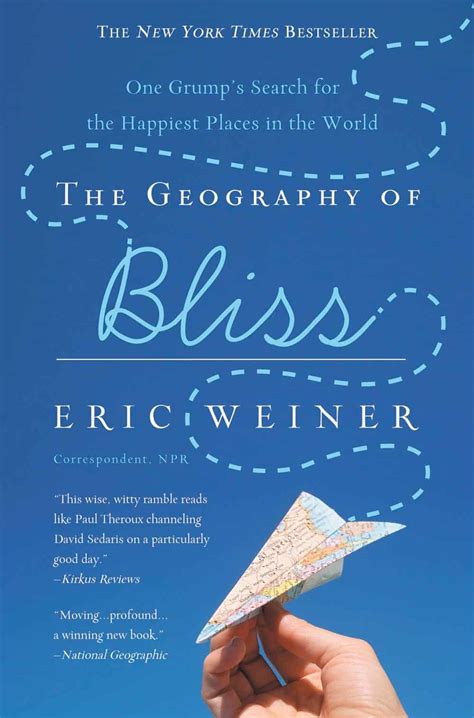
Eric Weiner, an inquisitive grump, is a reporter who successfully made the transition from journalism to best-selling book author. His first book-length effort, The Geography of Bliss, is brilliantly conceived travel book brimming with philosophy and wry observation. Funny and profound, the work spans the globe while asking an important question: if happiness is around the corner, where is that corner?

Weiner’s quest takes him to the Netherlands, Iceland, Switzerland, Thailand, Qatar, Moldova (one of the least happy places on earth), India, and the good old United States, his home. Along the way he talks with experts, officials, writers, and everyday people. He eats local foods, questions folks about what makes them happy – or unhappy – and tells us stories. Woven in the narrative are scientific studies, scholarly references, and data. Weiner’s idiosyncrasies – he is obsessed with bags – and predilections give the journey extra flavor. It’s first-person writing with an eye on the local and big-picture questions.

Happy places, it turns out, are slippery. They work for some people and not for others. They depend greatly upon expectations. Weiner learns that most happy places do have something in common: they refresh the soul and they connect us with something larger. Makes me wonder if my happy places – Coney Island, anyone – fits the bill. Weiner also realizes that he can learn more from the unhappy spots.

This is a book with some important insights nestled among jokes and asides. Weiner is smart enough to have made it a more thoughtful book. Hints of that are everywhere. However, that was not his aim. Clearly, too, he was plenty smart in finding the right tone. It’s a perennial best seller and he’s replicated the formula.

I thought of the Wizard of Oz when reading The Geography of Bliss. Home is where the heart is, though it often takes us a lot of time and travel to come to that realization.

David Potash

Positive Brilliance

Eric Idle, a founding member of Monty Python’s Flying Circus, is a special sort of genius – the kind that would run from the label while working hard to live up to its expectations. Immensely talented, Idle has made millions laugh, sing and smile over the years. I cannot think of anyone who has written and recorded a song with the impact of “Always Look on the Bright Side of Life” while also doing so much comedy. Idle recounts his life’s journey from orphanage to Hollywood in a “sortabiography” called Always Look on the Bright Side of Life. It’s his personal philosophy, how he has led his life, and not coincidentally, the title of his most epic musical creation.

The book appeals immediately to anyone who is a Python fan. Known for the sketch comedy, members of Monty Python have made multiple movies – collaboratively, in various configurations, and also as solo artists. They’re on stage, in books, and in our collective cultural consciousness. Idle’s book, though, is not a history of the troupe. It is a joke-filled reflection of an extremely grateful man, one who is both proud of his work and ever so surprised that it’s all turned out so well.

My first experience with Python was in a small movie theater in New Jersey, seeing Monty Python and the Holy Grail with my father. We started laughing during the opening credits and the fake Swedish subtitles. Tears were running down our faces before the very first coconut. I was a middle school student and the movie opened up a world of silly and smart humor to me. I’ve been a fan ever since.

Idle’s father, who served in the RAF during WWII, made it through the conflict only to be killed in road accident shortly after. Idle’s mother had great difficulty with the loss. His grandmother raised him until he was shipped off to a British boarding school for orphaned boys. The childhood had a Dickensian horror to it, replete with beatings, bullying and deprivation. Idle’s response: humor, girls, getting into trouble, and, when needed, focusing his extraordinary talents. Supposedly an indifferent student, he nevertheless decided to pay attention (“out of boredom?!?”) and earned a scholarship to Cambridge University. At University Idle found his metier with other actors, writers and budding comedians. By his early 20s, Idle was regularly writing, acting and performing on television, in the theater, and at comedy clubs.

Idle’s “sortofbiography” gives us these very important early days in the book’s first thirty-pages. The formation of Monty Python follows – the members had no idea that they would become all that popular – follows. We read about this movie, that project, this friendships and that opportunity. Success begets success as Idle is anything but passive. He has been working constantly, writing and performing. His work ethic, in fact, would rival that of any Victorian polymath.

Always Look on the Bright Side of Life unironically reflects Idle’s inherently positive temperament. Much of the book, accordingly, is about Idle’s successes and his friendships – with other members of Python, with virtually every creative celebrity that you can imagine, and his very close friends like George Harrison. It’s easy to see why you would want Idle as a friend. He’s generous, hysterically funny, and a deeply nice person. When Idle has screwed up, as he did with his first wife, he’s honest about his failings. You simply have to like the man and feel good about all the wonderful things in his life. And as the book has more than a few pages, the good feelings roll up – even with a loss or heartbreak here or there. Nonetheless, Idle’s positive nature carries us, cheerfully, along.

It’s a great message for terrible times. Let’s all take it to heart.

David Potash