Deep In The Heart Of . . . . What?

The argument in Gail Collins‘ new book, As Texas Goes . . . How The Lone Star State Hijacked The American Agenda , is neatly captured in the Appendix. Collins reprints a biannual report by the Legislative Study Group of the Texas House of Representatives. Titled “Texas on the Brink,” the report in Harper’s Index style tabulates Texas’s ranking on a host of state by state measures. Key indicators include:

  • Texas in 2nd highest in the US in terms of public school enrollment, 38th on expenditures per student, and 50th in terms of percent of the population 25 or older with a high school diploma.
  • Texas is ranked 43rd in terms of graduation rate.
  • Among all 50 states, Texas is number one in terms of percentage of uninsured children (highest), percent of population uninsured (highest), amount of emissions of carbon dioxide, volatile organic compounds, toxic chemicals released into water, and hazard waste generated.

In fact, a ton is wrong with Texas.

Collins, in her acerbic but jokey style, eviscerates the Texas miracle in this book. She pokes holes in Texas myths, Texas decision-making, Texas culture and Texas politics. It all has a sharp tone, which can grate, but her points are difficult to refute. The Lone Star State is driven by cultural myths that simply do not align with geographic, demographic, economic, or political reality. The state is a mess and doesn’t even know it.

The kicker is Texas’s over-size impact on what happens to the rest of the United States. Blame it on leadership, the Texas committee that recommends textbooks for children,  or the durability of the cowboy and Wild West – Texas generates strong feelings in a way that Ohio cannot. And this would not interest Collins, save for the eerily power of Texas in defining America.

Reading Collins is a bit like sour candy. Tangy, tasty, and liable to leaving you feeling a tad ill if you have too much. Even though she’s funny and right, As Texas Goes  is a bit much for one sitting.
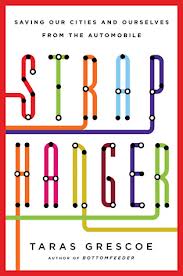
 

How’s a Flaneur To Get Around Today?

Taras Grescoe is a travel writer and flaneur for the 21st century. A Canadian-born global citizen, Grescoe has authored five books of non-fiction:  Sacre Blues, an unsentimental study of Quebec; End of Elsewhere, a tale of his journey from one end of the planet to another; Devil’s Picnic, Grescoe pushing the limits of fun all around the world, Bottom Feeder, a query into whether or not one can eat seafood ethically, and most recently, Straphanger. Grescoe is an engaging writer whose curiosity and excitement carry his ideas and prose. It is clear that Grescoe greatly enjoys traveling and writing. It is easy to imagine coming across him at a restaurant or train station and having a very interesting conversation.

Straphanger is a study of mass transportation systems and their cities. An avowed user of public transportation, Grescoe avoids cars whenever he can. Grescoe is also an urbanite, drawn to the juxtapositions of dense city living. His book is a first-hand journey to twelve cities – New York, Los Angeles, Phoenix, Paris, Copenhagen, Moscow, Tokyo, Bogota, Portland, Oregon, Vancouver, Philadelphia and Montreal – through the lens of the cities’ mass transit. History, politics, economics and urban studies are sprinkled lightly into the mix, as are interviews and chance encounters.

The subtitle, “Saving Our Cities and Ourselves from the Automobile,” addresses a recurring theme. Grescoe aims to give a compelling account of better ways to live and to get around. Here he is less successful, but not for want of trying. The book is helpful and informative, but far from authoritative or even particularly insightful. Grescoe’s argument is grounded in the excitement and expertise of a well-read tourist.

Hovering around the narrative are harder to answer questions. Was it particular conflations of leadership and opportunity that led to the development of certain cities and certain systems? Or are there lessons and models to consider? Compounding the queries is Grescoe’s approach itself. He’s an unencumbered man about to become a father. His responsibilities, as they are, consist of journeying to interesting cities, riding their mass transit systems and asking a few folks along the way some questions. Of course he doesn’t have to drive – and one wonders if he ever really grasps the day-to-day of the workers in the cities he describes. Accessing a bus or subway to get to an interview is one thing; to use mass transportation to try to juggle work and child care is another.

I, like Grescoe, feel at home in cities. I welcome density and the stimulation that comes from urban environments. I also readily acknowledge the multitude of costs that accompany driving an automobile on a regular basis. But I don’t believe that any of the above would make for supporters of public transportation. That assertion has to based on something harder, more universal, and much more practical. And that argument requires one to sit down, take root, and really learn about a city.