1873 – A Forgotten Crash That Resonates Today
Teach post Civil War American history and one invariably has to engage with the end of Reconstruction and the scandals surrounding President Ulysses S. Grant. Remember reading about Credit Mobilier and all the corruption around railroad financing? The panic in 1873 was driven, supposedly, by the collapse of Jay Cooke & Co., a bank that had been perhaps the most important fiscal agent selling bonds for the Union during the Civil War. Cooke’s bankruptcy led to other bankruptcies, the closure of the New York Stock Exchange, and a rush on capital that was exacerbated by the Grant administration’s abandonment of silver (bimetallism) and adoption of a gold standard. Self-interest and self-dealing was rampant among elected officials. Interest rates increased and many businesses cut back, leading to unemployment and heightened labor management conflict. It is a complicated story with many players. Engaged students often ask, “Why is this important?”
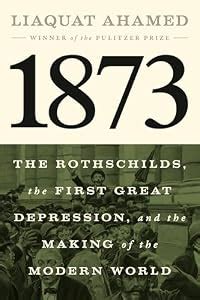
There are a slew of good reasons to pay close attention to the Panic of 1873. The financial story behind the crisis, the depression, and the extensive knock-on effects is fascinating. Liaquat Ahamed, an economist who worked for years at the World Bank before a career in investment finance, explains it all in 1873: The Rotchshilds, the First Great Depression, and the Making of the Modern World. Ahamed’s prior book, Lords of Finance, looked at the 1929 crash through a multi-national perspective. It won many awards, including a Pulitzer. 1873 employs a similar multi-national lens to understand the financial crisis, with a deep focus on America. The book makes me want to go back in time to revise my history lesson plans.
In brief, the bond market in the 1870s was international. Capital flowed across countries and continents during a period of extraordinary economic growth. A number of individual decisions, from bad business investments to the extreme reparations demanded by Prussia of France after the 1871 war, contributed to economic destabilization. Bismark pushed for the reparations within a particular context, to help build a modern Germany. However, an unintended consequence of the influx of all that money meant over investment, if not speculation, and lots of smaller bankruptcies. The Vienna stock exchange had to close in early 1873 because of one of the resulting panics, and that contributed to a larger bankruptcy of a German railroad. Loss of trust begets loss of trust, which leads to fear begetting fear, especially as prices dropped and capital became more scarce.
Deflation followed the panics, leading to great shifts in the distribution of wealth and an impetus for tariffs to protect domestic industries. Banks were castigated and none more so than the Rothschilds, facilitating a growing industry of conspiracy theories and antisemitism. That thread of hatred picked up in the following decades. The Rothschild family is a recurring theme throughout 1873 and remains a touchstone of antisemitic conspiracy theories.
In the United States, the Republican Party lost its deep advantages over the Democrats because of the financial crisis. The presidential election of 1876 was hotly contested. The eventual GOP winner, Rutherford B. Hayes, tipped the scales through a backroom deal that removed US troops from the south (ending Reconstruction and protected civil rights for Black Americans). No crisis in 1873 and there are good reasons to believe that Reconstruction would have been a longer-term project.
Counterfactual history is always a dangerous enterprise. Nonetheless, it is easy to see how individual political and economic decisions during the 1870s often made small problems big problems. Ahamed is to be praised for shining light and critical analysis on this important moment in our collective history. It never ceases to amaze me how much we can learn from the past.
David Potash
Leave a Reply