Couples, Coupling and Connubial Complications
Marriage, when you come to think of it, is at the very core of family and society. We partner up and have been partnering, in different formats and structures, for thousands upon thousands of years. The high-level values, expectations, reasons for (and against) marriage, though, are rarely the focus of our collective attention. Sure, we may read a study in the popular press about changes in divorce rates or people marrying later in life, and think about our own individual choices, but what about the institution itself? I was relatively clueless until I picked up Stephanie Coontz’s fascinating For Better and Worse: The Complicated Past and Challenging Future of Marriage. It is a very entertaining and interesting book.
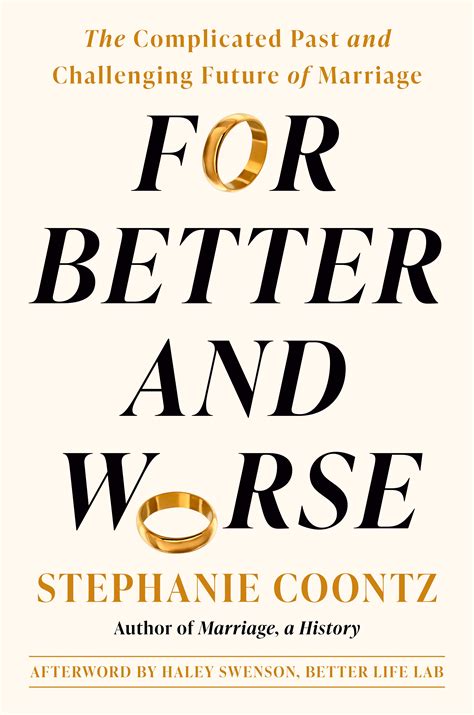
Coontz is a historian and an emerita professor at Evergreen State College. Formerly the Director of Research and Public Education for the Council on Contemporary Families, she has written and edited several books, some academic and others geared to the popular press. Through television, podcasts and other media, she has become a well-known expert on marriages and families. Coontz knows her subject well, as is clear from For Better and Worse. This is popular history resting on research and wisdom, delivered in a friendly yet authoritative tone. She wrote the book to help people understand the institution of marriage so that they might be able to chart their futures with greater understanding and clarity. Accordingly, it is not a book about why someone should get married or should not get married – a perspective I very much appreciate.
Chronology structures the narrative, first with a quick look at paleolithic families. Contrary to what many of us have seen in movies, tasks were relatively evenly distributed to men and women in these societies. Gender equality, or something akin to it, was common. Patriarchal marriage began to take hold when people started domesticating animals and accumulating property, which led to issues of class, status and “legitimate” heirs. Patriarchy is a recurring theme, unsurprisingly, and is a lens through which to appreciate so many customs, laws and practices. Coontz’s account of the long-standing tradition of identifying married women by their husband’s name – a practice that the New York Times maintained well into the 1970s – emerged as a marker of social status as well as gender. The book looks high level at the many ways that gender roles are linked to power, politics and the development of “separate spheres.” Families and marriage are at the very heart of this. In other words, marriage expectations became a function and proof of gender essentialism. Rules changed over time, too, as generations grew up with shifting expectations and opportunities.
For example, the idea of marrying a soul mate only started to take hold in the 1800s, and then, only then in a few countries in situations where people could afford to think and behave differently. For prior millennia, people tended to believe that romantic passion was a problem, interfering with the sober judgment required to find an appropriate partner. Romantic love, of course, had a major impact on sexual mores. In the US, Victorian ideals took hold only to be challenged by significant changes in the early 1900s, from the rise of dating to the idea of healthy sexuality. The shifts were always contested, from bans on birth control to the very concept of the “good girl.”
Coontz’s account of the 1950s is especially sharp, noting that nostalgia for a golden age tends to ignore the period’s unique circumstances. It was a short stretch of extraordinary economic growth in the US, marked by rapidly improving living standards. It was also one of the rare periods when a family with one source of income could live well. The other half of the deal, as is often forgotten, were the myriad of constraints and barriers that kept women without agency. Divorce was difficult, as was staying employed through a pregnancy. The list of ways that patriarchal actions expanded is lengthy and profound. For Better does an exceptional job linking cultural and societal expectations for marriage and gender to economic and political considerations.
By the time we get to the sexual revolution, the concept and practice of marriage starts to carry many different meanings, and bring with it a range of consequences. The book highlights the wide variations by class and race of expectations of marriage. In one of the more striking metaphors, Coontz links contemporary marriage to a high-stakes real estate deal, with emotions, health, finance and well-being all factors that demand consideration. Marriage has a profound relationship with wealth and health. The book’s journey to contemporary marriage helps explain just how we got to where we are today.
Through it all, Coontz brings data, charm and humor to the work. It is an informative, provocative, and a pleasure to read.
David Potash
Leave a Reply